
Buyer Question: I received a batch of silicone kitchen spatulas from China, and they have a really strong chemical smell. The supplier says it’s “normal silicone smell” that will go away, but it’s been two weeks of washing and the smell is still there. What causes this, and how do I prevent it on future orders?
Sources:
- https://www.fda.gov/food/food-contact-materials/guidance-regulation-food-contact-notification-program
- https://www.consumerreports.org/home-garden/kitchen-tools/silicone-kitchen-tools-what-you-need-to-know-a4521544644/
- Chinese silicone product manufacturer quality documentation
- Buyer reports from Amazon customer reviews
The Buyer Question
“I ordered 200 silicone kitchen spatulas from China to sell under my private label. When I opened the first box, I noticed a really strong chemical smell that doesn’t wash out with soap and water. My supplier says “all new silicone has a smell, it will go away after a few days”. But I’ve had the sample for two weeks, and I can still smell it when I open the container. My customers will definitely return these if I ship them like this. What causes this bad smell, and how do I make sure my next batch doesn’t have the same problem?”
Strong, persistent chemical smell in silicone kitchen products from China is one of the most common customer complaints, and it’s completely preventable if you specify the right material and ask for the right tests.
Short Answer
The persistent bad smell usually comes from lower-quality silicone that has more unreacted low-molecular-weight silicone oils, or from contamination during manufacturing in cheaper factories. To avoid this problem when sourcing silicone kitchen products from China:
- Specify 100% food-grade pure silicone (not “food-grade silicone blend” with fillers).
- Require FDA food contact approval for the specific silicone material used (not just the finished product).
- Ask the factory to do a post-curing step after molding — this removes most of the volatile compounds that cause smell.
- Test the smell yourself on the approval sample: leave the sealed sample in a warm place for 24 hours, then open it. If it smells strongly like chemicals or vinegar, reject the sample.
High-quality food-grade silicone should have very little smell when you first open it, and any faint smell should disappear after one wash and 24 hours of air out.
Why Strong Smell Happens With Silicone From China
There are four main reasons:
-
Cheap fillers. Some manufacturers mix cheaper silicone fillers or recycled silicone with the food-grade silicone to reduce material cost. These fillers often have more volatile compounds that cause strong smells.
-
No post-curing step. After silicone is molded into shape, it needs to go through an extra heating step (post-curing) to let the volatile compounds evaporate. This step adds about 4-8 hours of processing time and 5-10% to the production cost. Cheaper factories skip it to save time and money.
-
Poor packaging right after production. If the factory seals the silicone products into plastic bags immediately after molding before the volatile compounds have had time to outgas, the smell gets trapped and can persist for months.
-
Contamination from factory handling. Some smaller factories produce industrial silicone products and food-contact silicone products on the same equipment without thorough cleaning between runs. This can leave industrial silicone residues that cause bad smells in your kitchen products.
China Supply Chain Perspective
The main silicone material production centers for kitchen products are in Guangdong (Dongguan, Shenzhen) and Zhejiang. There is a huge price difference between pure food-grade silicone and cheaper blended silicone:
- 100% pure food-grade silicone: ~$3.5-$4.5 per kg
- Blended silicone with fillers: ~$2.0-$2.8 per kg
That difference flows through to the ex-factory price of finished products. If a supplier’s price seems too good to be true compared to other quotes, they are almost certainly using cheaper material or skipping the post-curing step.
From a factory perspective:
- Most larger, more established factories already have post-curing equipment and will do it if you ask specifically.
- They don’t volunteer post-curing because it adds cost, and many importers don’t know to ask for it.
- You can usually get post-curing done for your order if you just ask for it and agree to pay the small extra cost.
- The FDA food contact certificate is easy to get for the material — if the supplier can’t provide it, that’s a big red flag.
Step-by-Step Prevention Checklist
Step 1: Specify material requirements clearly on your PO
Write this explicitly:
“Product must be manufactured from 100% virgin food-grade silicone. No recycled silicone or fillers allowed. Product must be post-cured after molding to remove volatile compounds. Provide FDA food contact compliance document for silicone material before production.”
Step 2: Get the material FDA certification
Ask for the FDA food contact notification for the specific silicone material batch that will be used in your order. The certificate should be for the material, not just the finished product. This ensures that the actual silicone meets food contact safety standards.
Step 3: Smell test the approval sample correctly
Do this simple test before approving mass production:
- Put the sample in a clean glass jar with a tight lid.
- Put the jar in a warm place (about 40°C / 104°F) for 24 hours.
- Open the jar and smell immediately.
- If you can’t stand the smell after this test, reject the sample and ask the factory to use better material with post-curing.
A faint neutral “new rubber” smell is normal. A strong chemical, acidic, or vinegary smell means the material is bad or post-curing was skipped.
Step 4: Require open air out before packaging
Ask the factory to leave the finished products out in a well-ventilated area for 24-48 hours after post-curing before packing them into plastic bags and cartons. This lets any remaining volatile compounds outgas before packaging.
Step 5: Include smell check in pre-shipment inspection
Add this simple check to your pre-shipment inspection checklist:
“Open one master carton, randomly select 5 finished products, check for strong chemical smell. If more than 1 product has persistent strong smell, entire order fails inspection.”
This gives the factory an incentive to do the process correctly.
Price Comparison: Good Silicone vs Cheap Silicone
| Step | Cost Impact | What happens if you skip it |
|---|---|---|
| 100% pure food-grade silicone | +10-15% ex-factory | Higher risk of smell and safety issues |
| Post-curing after molding | +5-10% ex-factory | Most of the volatile compounds remain |
| Air out 24h before packaging | +1-2% labor/ time | Smell gets trapped in packaging |
| FDA material certification | ~$0 (documentation only) | No proof material meets food safety standards |
The total extra cost for good silicone that doesn’t smell is usually 15-25% compared to the cheapest bid. But the cost of returns and bad reviews from customers is far higher than this extra cost.
What to Do If You Already Received a Smelly Batch
If you already have a container load of smelly silicone products:
- Open all the retail boxes and spread the products out in a well-ventilated area for 3-5 days to outgas.
- Wash them with warm soapy water containing a little bit of baking soda.
- Dry them completely before repackaging.
- For really stubborn smells, you can bake silicone utensils at 180°C (350°F) for 1-2 hours in an oven to speed up outgassing — but you need to make sure the oven is well-ventilated and there is no plastic handle that will melt.
This process won’t fix every bad batch, but it will reduce the smell enough that most products can still be sold at a discount.
Practical Checklist for Importers
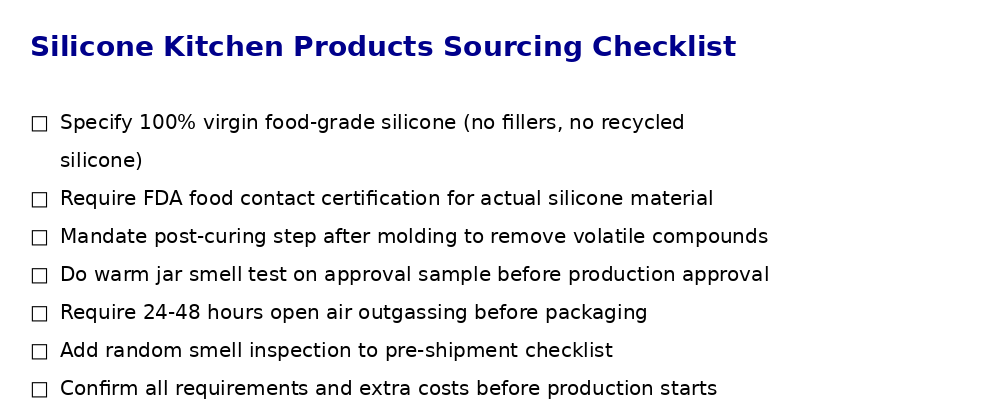
□ Specified 100% virgin food-grade silicone (no fillers, no recycled silicone)
□ Requested FDA food contact certification for the silicone material
□ Required post-curing step after molding before packaging
✅ Done smell test on approval sample using the warm jar method
□ Asked for 24-48 hours open air out before sealing packaging
□ Added smell check to pre-shipment inspection criteria
□ Confirmed the extra cost is included in the final price before production
□ Plan to remind customers to wash before first use in product instructions
Related Questions
Is smelly silicone unsafe?
Most of the time, the smell is just unpleasant, not acutely unsafe. But persistent strong smell means higher levels of volatile compounds, which means the material didn’t get processed correctly. If the material isn’t actually food-grade, that can be a safety issue for long-term contact with food. Always require FDA food contact certification from your supplier.
Can I just tell customers to wash it before use?
You should tell customers to wash new silicone products before use regardless. But if the smell is still strong after two weeks of washing and airing out, customers will still return it and leave bad reviews. It’s better to fix the problem at the factory than expect your customers to fix it after delivery.
Does all silicone from China smell bad?
Absolutely not. There are many good silicone product factories in China that produce high-quality, food-grade silicone kitchen products with post-curing that have almost no smell when you open the package. You just have to specify your requirements clearly and be willing to pay the small extra cost for better material and processing.
Need Help Verifying Silicone Product Specifications?
Send your product type, current supplier quote, and any sample smell issues you’ve had. ChinaSecurely can help you write the correct material specifications for your next silicone kitchen product order from China.
Article Metadata
Suggested internal links:
- /home-goods/silicone-spatulas-smell-strong-china/
- /home-goods/cutting-boards-warp-after-washing-china/
- /why-silicone-spatulas-from-china-smell-strong-how-to-test-and-avoid-bad-silicone/
- https://www.fda.gov/food/food-contact-materials
- https://www.consumerreports.org/home-garden/kitchen-tools/silicone-kitchen-tools-what-you-need-to-know/
- Chinese silicone kitchenware manufacturer quality documentation
Sources: