
Short answer: a silicone spatula can smell strong because of raw material quality, pigment, curing, surface contamination, or packaging too soon after production. The smell does not automatically prove the product is unsafe, but it is a warning sign that small importers should check before final payment.
A realistic buyer question is: “The supplier says the spatulas are food-grade silicone, but the bulk samples smell chemical when I open the bag. What should I ask before shipping the order?”
Start with a conservative approach. Ask for material details, supplier test documents, production and curing process, colorant information, and a simple airing or wash check on random bulk samples. If the product is for food contact, do not rely only on a sales claim.
Why this happens
Silicone kitchen products can pick up odor from material, pigments, processing aids, storage, or plastic packaging. Sometimes the odor fades after airing. Sometimes it points to poor material control or contamination.
Color can also matter. Dark or bright colors may use different pigment systems. A supplier may have a good result for one color and a weaker result for another.
Small importers often approve a photo and a price, then discover odor only after opening sealed bags. By that time, the factory may argue that the goods are finished and packed.
China-side explanation
Many China home-goods suppliers sell silicone items through trading companies or mixed factories. The sales contact may use the phrase “food grade” because it is common in the market, but the real evidence should come from material records and test reports that match the product type, color, and destination market.
For low-MOQ orders, the factory may use existing molds, existing color batches, or standard packaging. If the buyer does not ask for odor checks, the factory’s routine inspection may focus on shape, color, logo, quantity, and packing.
Step-by-step solution
- Confirm the exact material claim: silicone, silicone-coated nylon, TPR, PP handle, stainless core, or another combination.
- Ask whether the test report matches the same product, material, and color family.
- Request random bulk samples to be opened from sealed packaging before shipment.
- Ask the supplier to do a simple odor check after opening, after washing, and after airing for 24 hours.
- Check color consistency and surface feel. Sticky, oily, or dusty surfaces need more attention.
- Confirm packaging is not trapping odor from ink, plastic bags, or cartons.
- For food-contact selling, use qualified compliance review for your destination market.
What to ask the supplier
You can copy this message:
“Before shipment, please randomly open several sealed bulk spatulas and check odor immediately, after washing, and after 24 hours of airing. Please confirm the material of the head, handle, and any inner core. Also send the test report that matches this product and color, plus photos of the packaging materials. If the odor remains strong after airing, please hold shipment and explain the cause.”
This is a normal quality request, not an accusation. A serious supplier should understand why kitchen products need this check.
Odor and material check table
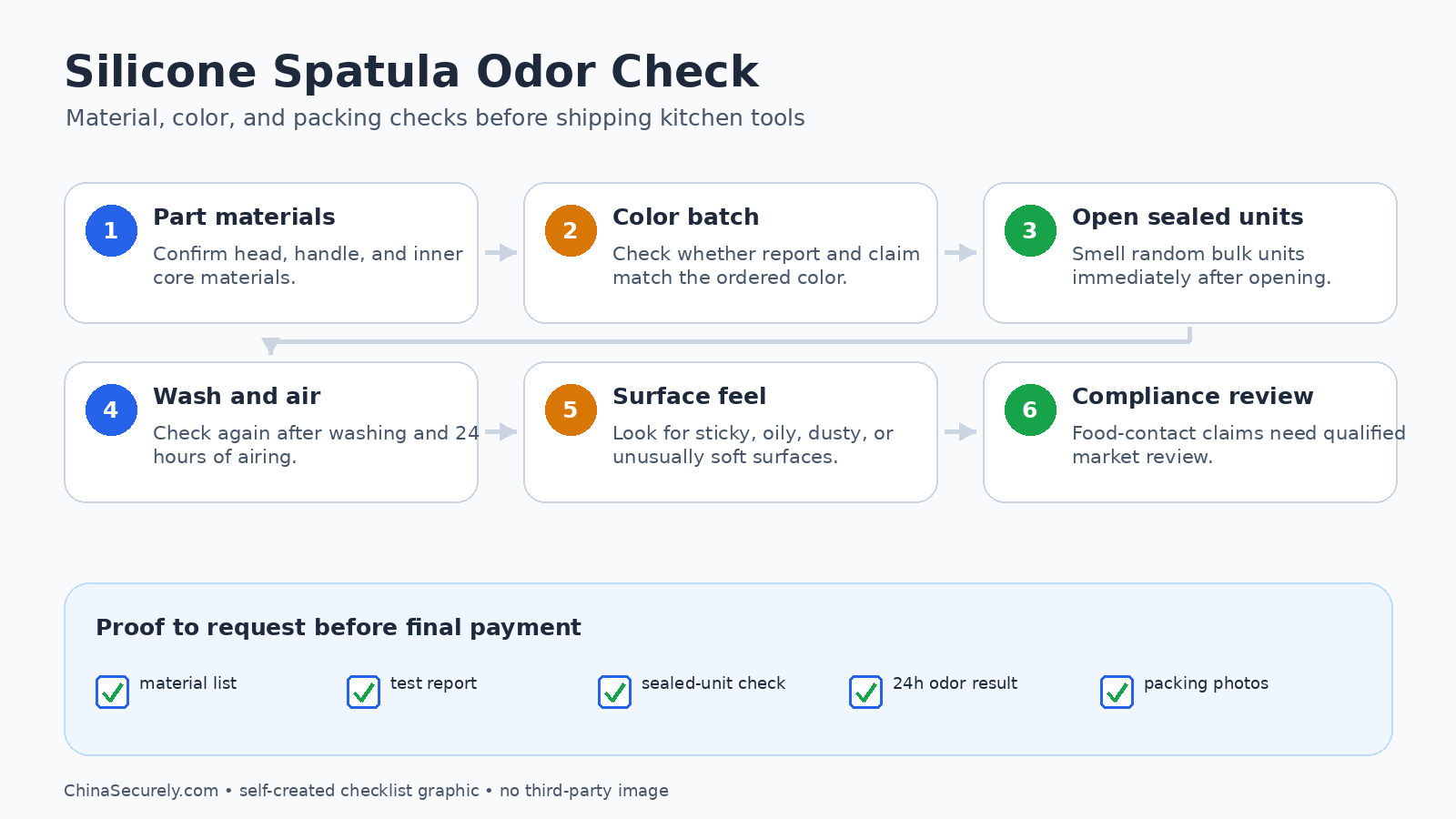
| Check point | Why it matters | Evidence to request |
|---|---|---|
| Product material | Mixed materials can create different risks | Head, handle, and core material list |
| Color batch | Pigment may affect odor and compliance | Color-specific confirmation where possible |
| Sealed bag odor | Buyer experiences odor when opening | Random opened sample photos and notes |
| Wash and airing check | Separates temporary packaging smell from persistent smell | 24-hour follow-up result |
| Test report match | Sales claim is not enough | Report matching product and market use |
Practical checklist before final payment
□ Material of every product part is confirmed.
□ Test report is checked for product, material, color, and date relevance.
□ Random sealed units are opened before shipment.
□ Odor is checked immediately and after airing.
□ Surface is not oily, sticky, dusty, or unusually soft.
□ Packaging material is checked for ink or plastic smell.
□ Care and use instructions are included if needed.
□ Food-contact compliance is reviewed separately for the target market.
Cost and trade-off notes
Better material, better pigment control, and more relevant testing may raise cost. For a non-food decorative silicone item, the risk may be lower. For spatulas, baking tools, baby feeding items, or kitchen sets, weak evidence is not worth the saving.
If the supplier cannot provide product-relevant evidence, keep the draft order small or change suppliers before building a brand around the item.
Source status
The buyer question is an anonymized demand signal based on recurring home-goods sourcing concerns. Because food-contact material is a higher-risk area, this draft uses conservative language and does not give legal compliance advice. Final requirements must be checked against the destination market and qualified testing providers.
Source URLs:
- https://www.cpsc.gov/Business–Manufacturing/Business-Education/Business-Guidance/Small-Business-Resources
- https://www.fedex.com/en-us/shipping/packing.html
- https://www.ista.org/test_procedures.php
Related questions
- How do I verify food-grade silicone from a Chinese supplier?
- What should I check before ordering kitchen tools from China?
- When is a supplier test report not enough?
Light CTA
If a kitchen product smells wrong, pause before shipment. Ask for material proof, random sealed-unit checks, and product-relevant testing instead of accepting the phrase “food grade” at face value.