
Buyer Question: I’m sourcing Bluetooth earbuds from China. The supplier says they use “latest Bluetooth 5.3”. But I see many other suppliers offering 5.0, 5.1, 5.2 at lower prices. What real differences do these versions make for my customers? Do I really need 5.3 to compete?
Sources:
- https://www.bluetooth.com/specifications/specs/
- https://www.bluetooth.com/blog/bluetooth-5-3-whats-new/
- Buyer discussions on Reddit r/Bluetooth and r/Earbuds
- Chinese electronics supplier specification sheets
The Buyer Question
“I’m getting ready to place an order for Bluetooth wireless earbuds from China. One supplier offers Bluetooth 5.0 for $2.10 each, another offers 5.3 for $2.45. The marketing says 5.3 is “much better quality”. But I’m selling to price-conscious customers. Is the extra 35 cents per unit worth it? What do my customers actually notice, and what is just marketing from the supplier?”
This is one of the most common questions for small importers sourcing Bluetooth electronics from China. Suppliers love to advertise the “latest version” because it lets them charge a small premium. But many importers don’t know which improvements actually matter to end users.
Short Answer
For most consumer Bluetooth earbuds and small speakers sold by small importers:
- Bluetooth 5.0 is already good enough for most use cases: basic stereo audio, standard range (10-15 meters), and decent battery life. The major improvements over 4.2 were already done.
- Bluetooth 5.1 adds direction finding (for finding lost earbuds) but this requires extra hardware in the earbuds that most cheap Chinese models don’t actually implement correctly. It’s mostly marketing.
- Bluetooth 5.2 adds better power efficiency for coexistence with WiFi on the same chip and improved LE Audio features. You get slightly better battery life if the chip actually supports it.
- Bluetooth 5.3 improves connection stability in crowded environments and slightly better power efficiency. It’s the current standard but the practical difference from 5.2 is small for most users.
If you’re selling budget earbuds under $30 retail, Bluetooth 5.0 is acceptable if the chipset is from a reputable manufacturer (Realtek, Jerry, Actions). If you’re selling mid-range earbuds $30-$80, specify at least Bluetooth 5.2 to stay competitive. Only market the version number if the hardware actually implements the advertised features.
Why The Version Number Gets Confused With Chinese Suppliers
There are three common sources of confusion:
-
Chipset version vs advertised Bluetooth version. Some suppliers advertise “Bluetooth 5.3” based on the host controller version, but the actual audio profile uses older hardware features. The chip says it supports 5.3, but many of the new features aren’t enabled in the firmware for budget models.
-
Marketing overstates practical benefits. Suppliers know that “latest version” sounds better to buyers, so they’ll advertise the highest number on their product spec sheet even when the new features aren’t actually used by end products.
-
LE Audio vs traditional audio. Bluetooth 5.2 and 5.3 support LE Audio, which is a new standard for low-power audio. Most consumer earbuds still use the older traditional A2DP profile because LE Audio is not yet widely supported by all phones. The version number doesn’t tell you which audio profile is actually used.
China Supply Chain Perspective
Most budget and mid-range Bluetooth earbuds sold from China use standardized off-the-shelf modules from major Chinese chip manufacturers:
- Realtek (Shanghai): Very common for budget to mid-range earbuds. They have clear 5.0, 5.2, and 5.3 chipsets with actual feature differences.
- Jerry (Shenzhen): Very popular for ultra-budget models. They started adding 5.3 labels to older designs more quickly than some other manufacturers.
- Actions: Another major budget chip maker, similar to Jerry.
- Qualcomm: Premium chips, used in higher-end models. Clear version differentiation.
From the factory perspective:
- Chip manufacturers update their product lines regularly, and the newest version becomes the default offering within 12-18 months.
- The incremental cost per unit from 5.0 to 5.3 is typically 10-30 cents (ex-factory China price). This is much less than the retail markup you can charge for “latest version”.
- Factories will often give you the option of the older version at a lower price if you ask specifically. They don’t volunteer this because they make more margin on the newer version.
The important thing is to ask: “Does this chip actually have all the Bluetooth 5.X features enabled in firmware, or is this just a label on an older chip?” Reputable suppliers will show you the official chip datasheet.
Step-by-Step: What to Check When Sourcing
Step 1: Match the Bluetooth version to your retail price point
- Retail < $20: Bluetooth 5.0 is fine. Customers buying at this price care more about price than the latest version.
- Retail $20-$50: Require at least Bluetooth 5.1 or 5.2. Customers expect “recent” technology at this price point.
- Retail > $50: Require Bluetooth 5.3. Your customers will expect the current standard.
Step 2: Ask for the chip model number
Don’t accept “it’s Bluetooth 5.3” — get the actual chip model number (e.g., Realtek RTL8763BFR, Jerry JL6973A). Then look up the official chip specification from the manufacturer website. Verify that the advertised Bluetooth version matches the chip’s actual capability.
Step 3: Test the connection stability yourself
When you get the sample:
- Test the connection in a crowded room with many WiFi networks and other Bluetooth devices.
- Walk 10 meters away from the phone with the earbuds in your ears.
- See how often the connection drops or stutters.
- Compare the test to a known-good product you already sell.
The real practical difference between 5.0 and 5.3 for users is better connection stability in crowded places like malls and coffee shops. Your own listening test will tell you more than any spec sheet.
Step 4: Check battery life with the same use pattern
Bluetooth 5.2 and 5.3 are supposed to be more power efficient. Compare the actual battery life of the 5.0 and 5.3 samples side-by-side. If the 5.3 sample doesn’t give you at least 10% longer battery life with the same battery capacity, the power efficiency improvement isn’t being implemented correctly.
Step 5: Ask your supplier what features are actually enabled
Ask this question directly in writing:
“Which Bluetooth 5.X features are enabled in the firmware for this model: direction finding, LE Audio, improved power control? Please list what is actually working in the product you will ship.”
This weeds out suppliers who are just advertising the version number without implementing the features.
What Buyers Actually Care About Comparison Table
| Feature | Bluetooth 5.0 | Bluetooth 5.2 | Bluetooth 5.3 | Do Users Notice It? |
|---|---|---|---|---|
| Basic stereo audio | Yes | Yes | Yes | No difference |
| 10m+ range | Yes | Yes | Yes | No difference for normal use |
| Connection stability in crowd | Good | Better | Best | Yes, users notice dropouts |
| Battery life efficiency | Base | Better | Best | Yes, 10-15% longer life |
| Direction finding (find my earbuds) | No | Only with extra hardware | Only with extra hardware | Most budget models don’t actually have it |
| LE Audio support | No | Partial | Full | Most phones don’t need it yet |
Practical Checklist for Importers
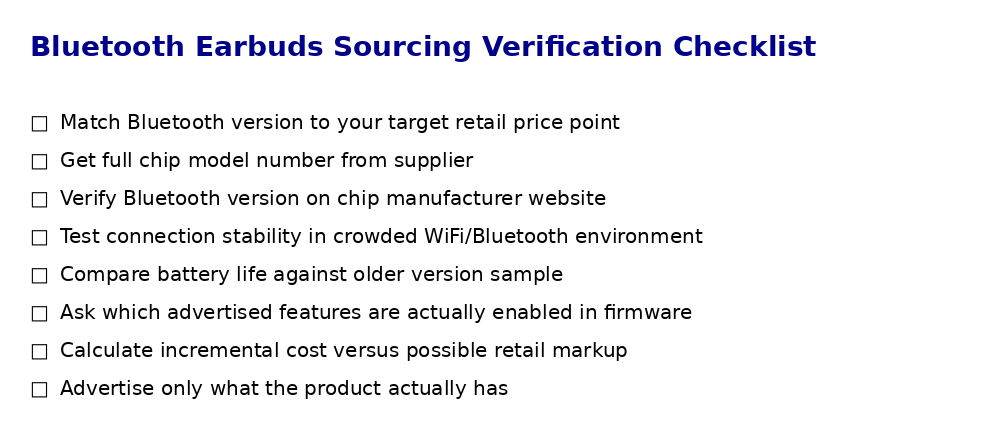
□ Confirmed Bluetooth version matches your target retail price point
□ Got the full chip model number from the supplier
□ Verified the chip model matches the advertised Bluetooth version on manufacturer website
□ Tested connection stability in a crowded environment yourself
□ Compared battery life against older version samples
✅ Confirmed which advertised features are actually enabled in firmware
□ Calculated the cost difference — does the retail price markup cover the incremental cost?
□ Stated the Bluetooth version clearly in your product listing (no misleading marketing)
Related Questions
Does Bluetooth version affect sound quality?
For traditional A2DP audio (the most common for earbuds), the Bluetooth version does not directly affect sound quality. Sound quality depends more on the audio codec (SBC, AAC, aptX) and the speaker drivers than on the Bluetooth core version. The connection stability improvement from newer versions can indirectly improve quality by reducing dropouts and stutters.
Can I get in trouble if I advertise 5.3 but it’s really 5.0?
In most Western markets, false advertising about product specifications can get you in trouble with consumer protection agencies, and you’ll get a lot of customer returns. It’s better to advertise what you actually have. You can still sell 5.0 models honestly by focusing on the price value.
Do I need to pay extra for 5.3 right now in 2026?
By 2026, most chips coming off Chinese production lines are already 5.2 or 5.3 anyway. The question is usually whether you’re getting an older 5.0 chip that’s been in stock for a while at a discount. If the price difference is less than 15 cents per unit, it’s usually worth taking the newer version for future proofing.
Need Help Verifying Chinese Supplier Bluetooth Specs?
Send the supplier’s model number, chip specification, and your target retail price. ChinaSecurely can help you verify whether the specs match what the supplier is claiming, and whether the price premium is justified.
Article Metadata
Suggested internal links:
- /china-earbuds-pre-shipment-functional-test/
- /electronics/un383-certification-verification-china/
- /electronics/factory-test-report-photos-verify-electronics-testing/
- https://www.bluetooth.com/specifications/
- https://www.bluetooth.com/blog/bluetooth-5-3-whats-new/
- Chinese Bluetooth chip manufacturer datasheets
Sources: