
Buyer Question: I imported 500 custom corrugated shipping boxes from China to use for my own products. When they arrived at my warehouse, 15% of the boxes were crushed along the bottom edges. The supplier says “it’s just shipping damage” but I think the boxes are too weak for what I need. What compression strength should I specify when ordering shipping boxes from China?
Sources:
- https://www.fedex.com/en-us/shipping/packing/box-strength.html
- https://www.astm.org/standards/d4160
- Chinese corrugated box manufacturer public catalogs
- Buyer reports from r/FulfillmentByAmazon and r/smallbusiness
The Buyer Question
“I received my batch of custom corrugated shipping boxes from China. The dimensions and printing look good, but when the pallet was unloaded, 15% of the boxes had crushed bottom corners. Some of the boxes were so damaged I can’t reuse them. The supplier says it’s just normal ocean shipping damage. But I’ve ordered boxes from a domestic supplier before and this didn’t happen. What am I missing when I specify boxes to Chinese suppliers?”
This is an extremely common problem that happens because compression strength is rarely specified clearly on purchase orders to Chinese box factories. Most importers only ask for dimensions and material, but forget to specify how much weight the boxes need to support during stacking.
Short Answer
You need to specify the Edge Crush Test (ECT) rating or the Maximum Burst Strength when ordering corrugated boxes from China. These are the two standard measurements of box strength. For most small-to-medium products sold through e-commerce:
- Single wall boxes for products under 10 lbs: ECT 32 (can support ~65 lbs of stacking weight)
- Single wall boxes for products 10-30 lbs: ECT 44 (can support ~120 lbs of stacking weight)
- Double wall boxes for products 30-60 lbs: ECT 67 (can support ~300 lbs of stacking weight)
Always get the ECT rating or burst strength in writing before production, and ask the factory to include it as a hidden watermark or printed mark on the inner flap for future reorders.
Why Box Crush Problems Happen With Chinese Suppliers
There are four common reasons you get weaker boxes than you expected:
-
The factory substitutes cheaper paper. When the order price is very low, some factories will use a lower grade of corrugated paper than what you agreed to. The box looks the same to the eye but has much lower compression strength.
-
Moisture absorption from ocean shipping. Corrugated paper absorbs moisture during long ocean voyages, which reduces compression strength by 30-50%. If your box was barely strong enough at the factory, it will fail after crossing the ocean. You need to add a margin for this.
-
You didn’t account for stacking weight in the container. During ocean shipping, your boxes are stacked 10-20 layers high inside the container. The boxes on the bottom have to support all the weight above them. If every box contains 20 lbs of product, the bottom box holds 20 × 15 = 300 lbs just from product weight.
-
Metric vs imperial confusion. Some Chinese factories use metric burst strength (kPa or kg/cm²) instead of pounds per square inch (psi). A 200 psi burst rating is the standard for single wall shipping boxes — don’t accept 125 psi unless your boxes are very light.
China Supply Chain Perspective
Most corrugated box factories in China are located in Guangdong (Dongguan, Foshan), Zhejiang (Wenzhou, Yiwu), and Jiangsu. The large majority of production is for domestic Chinese use, where stacking requirements are often lower than for export ocean shipping.
When you place an order with a Chinese factory:
- They will usually quote based on the “cheapest material that meets your dimensions” unless you specify strength requirements.
- The salesperson may not volunteer information about ECT or burst strength unless you ask specifically.
- For small-batch custom box orders (less than 1,000 pieces), they often use whatever material is currently on the factory floor to save setup time — which might not match the strength you need.
The good news: once you specify ECT rating clearly in your purchase order and include it in the price negotiation, most factories will honor the requirement. The price difference between ECT 32 and ECT 44 is usually 5-10%, which is small compared to the cost of damaged inventory and replacement boxes.
Step-by-Step Solution
Step 1: Calculate the required stacking strength
Figure out how much weight the bottom box will support in transit:
Maximum stacking weight = (Number of layers in container - 1) × (Product weight + Box weight)
Add 50% margin for moisture absorption and extra stacking. Example:
- You stack 10 layers in a container
- Average product + box = 15 lbs per box
- Required stacking strength = (10-1) × 15 = 135 lbs
- Add 50% margin = ~200 lbs required → use ECT 44
Step 2: Specify ECT or burst strength on your PO
Write this clearly in your purchase order:
“All boxes must be minimum ECT [value] corrugated board. Factory must confirm ECT rating before production.”
Or if using burst strength:
“Single wall boxes must have minimum 200 psi burst strength.”
Step 3: Test the sample compression
When you receive your approval sample, do a simple stack test:
- Place the empty box on the floor
- Put a piece of plywood on top
- Add known weights (water jugs work well) to the plywood
- Leave it for 1 hour. If the box deforms more than 5mm, the strength is insufficient.
This simple test will catch major problems before you approve mass production.
Step 4: Add a moisture resistance option if shipping by ocean
For ocean shipments, ask the factory if they can add a slight wax coating or moisture-resistant liner to the corrugated board. This adds a small cost (3-7%) but significantly reduces moisture absorption during the ocean voyage.
Step 5: Mark the rating on the box inner flap
Ask the factory to print the ECT rating and date code on the inner flap of every box. This makes reorders much easier — you can just check the old box and reorder the same exact specification.
Cost and Trade-off Summary
| ECT Rating | Typical Use Case | Extra Cost vs Cheaper Material | Risk of If You Skip |
|---|---|---|---|
| ECT 32 | Products < 10 lbs, single layer | 0% (baseline) | Low for light products |
| ECT 44 | Products 10-30 lbs, stacked 6-10 layers | +5-8% | Medium — crush risk if stacked multiple layers |
| ECT 67 | Double wall, products 30-60 lbs | +15-20% | High potential for catastrophic crushing |
Practical Checklist for Importers
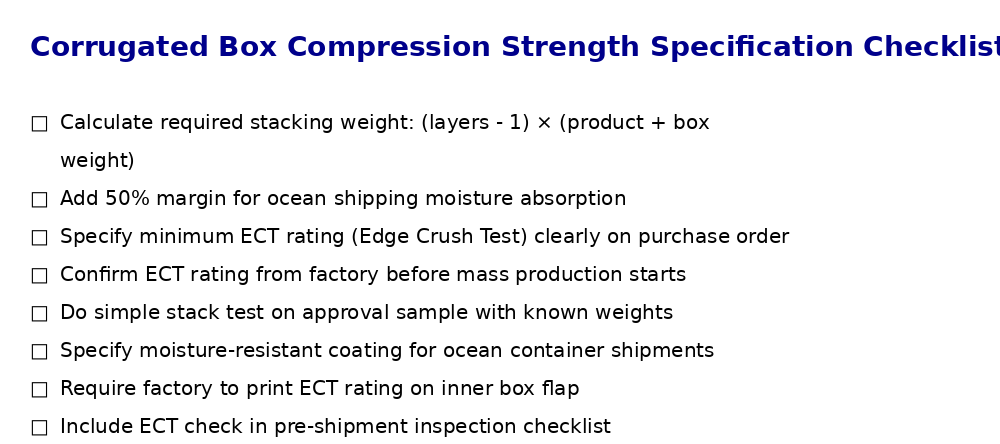
□ Calculated required stacking strength based on your container stacking
□ Specified ECT or burst strength clearly in the purchase order
□ Got written confirmation from the factory before production started
✅ Performed a simple stack test on the approval sample
□ Specified moisture resistance if shipping via ocean container
□ Asked the factory to print ECT rating on the inner flap for future reference
□ Included “compression strength must meet specification” as a pre-shipment inspection check item
□ Confirmed the price includes the higher strength material before production
Related Questions
Can I just ask for “175 g/m² paper” instead of ECT?
Grammage (paper weight per square meter) doesn’t directly tell you compression strength. Two different papers with the same grammage can have very different compression strength depending on the paper grade and corrugation fluting. ECT is a better, more direct measurement of how much weight the box can hold.
Does the fluting size matter?
Yes — for shipping boxes, B-flute is the most common for general use. It has good stacking strength and printing surface. E-flute is thinner for retail packaging, lower stacking strength. C-flute has better cushioning but larger outer dimensions. Specify fluting along with ECT rating.
My supplier says they don’t do ECT testing. What should I do?
Most smaller Chinese box factories don’t have in-house ECT testing equipment, but they buy their corrugated board from a separate mill. Ask them to get the ECT rating from their board supplier. If they refuse to ask the mill, that’s a red flag — find another supplier.
Need Help Specifying Custom Box Requirements?
Send your box dimensions, product weight, and typical stacking arrangement. ChinaSecurely can help you get the right compression strength specification for your order from Chinese box manufacturers.
Article Metadata
Suggested internal links:
- /packaging/custom-mailer-boxes-arrive-crushed/
- /packaging/custom-box-moq-china/
- /packaging/color-difference-sample-custom-boxes-china/
- https://www.astm.org/standards/d4160
- https://www.fedex.com/en-us/shipping/packing/box-strength.html
- Chinese corrugated box manufacturer technical documentation
Sources: