
Short answer
If USB-C cables from China only charge some devices, the buyer may have approved appearance without locking the real specification. Before bulk orders, confirm whether the cable is charge-only or data-capable, current rating, length, internal construction, connector quality, e-marker requirements where applicable, and sample test method.
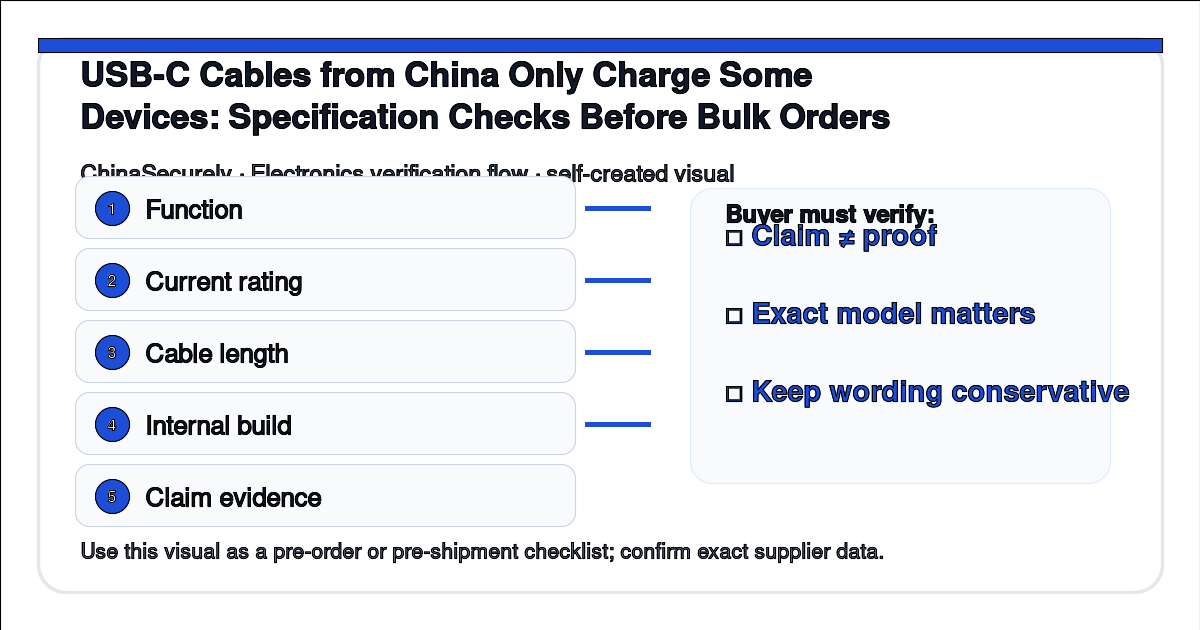
Buyer question: “The USB-C cable sample charged my phone, but customers say it does not work with some tablets or laptops. What did I fail to specify with the Chinese supplier?”
A cable that works with one phone is not proof that it fits every device or marketing claim.
Why this problem happens
USB-C is a connector shape, not a single performance level. Cables can differ in data support, charging current, wire construction, length, shielding, connector quality, and electronics inside the connector where applicable. A supplier may quote a low-cost cable that looks correct but does not support the performance the buyer expected.
The phrase “fast charging cable” is especially risky because it can mean different things in sales conversations. If your packaging or listing promises performance, you need evidence for that exact model.
China-side explanation
Many Chinese cable assemblers source wire, connectors, chips, jackets, and packaging from upstream suppliers. The outside color, logo, and length are easy to match. The internal construction is where cost differences appear.
USB-IF publishes compliance and document resources. Those resources are useful, but the buyer still needs to know what claim is being made and whether the exact cable design supports it. A document for a similar cable should not be treated as proof for your model.
Step-by-step solution
- Decide whether the product is charge-only or charge-and-data.
- State the intended current rating and device use case in the purchase order.
- Confirm cable length and whether performance changes with length.
- Ask whether an e-marker or other required component is needed for the claimed performance.
- Request the supplier’s QC test list and sample test records.
- Test multiple samples with the intended chargers and devices.
- Check data transfer if the cable is sold as data-capable.
- Do not use USB logos or compliance claims unless you can support them.
- Inspect random bulk units before shipment for function, labeling, and packaging claims.
What to ask the supplier
Copy and adapt this message:
Please confirm whether this USB-C cable is charge-only or charge-and-data, its current rating, cable length, internal construction or wire gauge, connector type, and whether any e-marker or supporting component is required for the claimed performance. Please send the QC test list for this exact model and do not print any compliance logo or high-performance claim unless the correct supporting documents are available.
This is cautious, but it protects you from overselling a basic cable.
USB-C specification checklist
| Item | What to confirm | Why it matters |
|---|---|---|
| Charge vs data | Charge-only or data-capable | Customers expect the listed function |
| Current rating | Claimed charging performance | Vague “fast” claims create disputes |
| Cable length | Exact length and tolerance | Longer cables may perform differently |
| Internal build | Wire, connector, strain relief | Hidden construction drives durability |
| Claims and logos | Exact evidence for this model | Prevents unsupported packaging claims |
Cost and trade-off notes
A basic cable may be acceptable if you sell it honestly as a simple charging accessory. It becomes risky when the listing promises high power, data speed, broad compatibility, or compliance without evidence.
If your budget cannot support a higher-spec cable and testing, reduce the claim rather than stretching the truth.
Sources and source status
- USB-IF Compliance Program: https://www.usb.org/compliance
- USB-IF Documents Library: https://www.usb.org/documents
Related questions
Is a connector shape enough to define the cable?
No. USB-C describes the connector form, while performance depends on the cable design and supported functions.
Can one sample prove compatibility?
No. Test multiple samples with the intended device types and chargers.
Is this a certification topic?
It can be if you use logos or compliance claims. Treat those claims conservatively and verify them with authoritative resources.
Light CTA
When buying USB-C cables, specify the function before you negotiate the price. The cheapest cable may be fine only if the claim is also simple.