
Short answer: a velvet hanger from China that snaps at the hook shoulder or splits at the neck under a winter coat usually has one of three root causes: the metal hook gauge dropped between sample and bulk, the ABS plastic is recycled rather than virgin, or the velvet flock is poorly bonded and sheds on the first garment. Velvet hangers are sold by the carton, so the per-unit cost is small and the per-unit quality cut is easy to hide. Here is how to lock the spec.
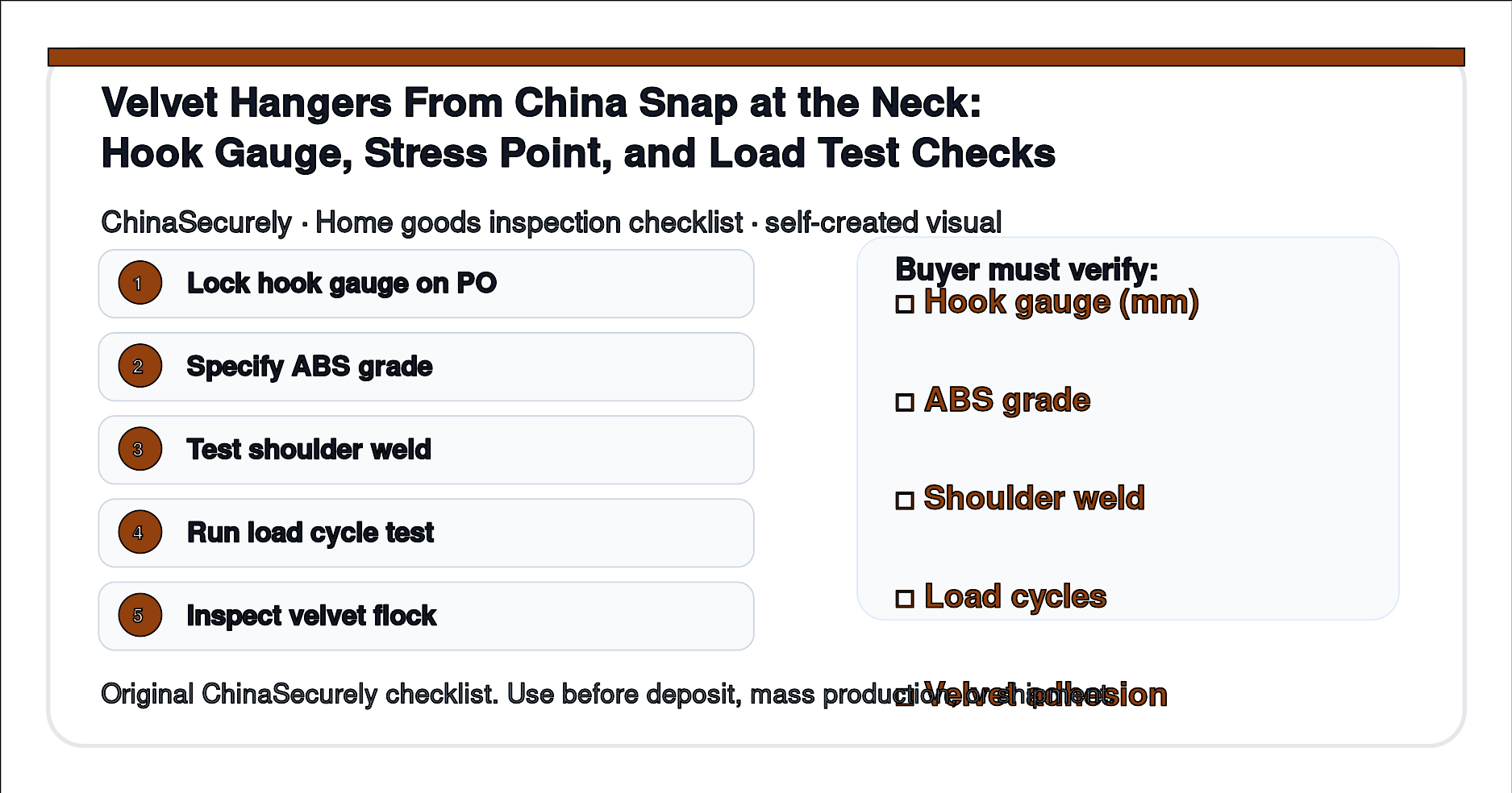
Why velvet hangers snap
Velvet hangers snap for one of three reasons. The first is hook gauge: a metal hook quoted at 2.8 mm wire diameter will snap under the weight of a winter coat if the supplier quietly drops to 2.2 mm for the bulk run, because thinner wire bends at the shoulder where the hook meets the hanger body. The second is ABS plastic grade: virgin ABS has consistent impact strength; recycled ABS has variable impact strength and tends to be brittle in cold weather. The third is velvet flock adhesion: a hanger with poorly bonded velvet flock sheds on the first garment and ends up looking dirty in the customer’s closet.
The China-side explanation is straightforward. Hook gauge is the cheapest component on the hanger, so it is the first item the supplier cuts when costs go up. A factory that quotes 2.8 mm may run 2.5 mm or 2.2 mm in the bulk run without telling the buyer, because the visual difference is hard to spot without a caliper. Recycled ABS is cheaper than virgin ABS but has lower impact strength. The factory that switches from virgin to recycled saves a few cents per hanger and ships the same color.
What to lock on the PO
- Hook wire gauge in millimeters, with a +/- 0.2 mm tolerance.
- ABS plastic grade in writing (virgin or recycled), with a recycled content cap.
- Velvet flock adhesion test method (cross-hatch tape pull) and pass criterion.
- Load test: 5-pound static load for 1,000 cycles without cracking or bending.
- Inner packing: hangers packed in poly bags or shrink wrap, not loose in the master carton.
Buyer must verify before deposit
- Request a 50-piece sample with a hook gauge measurement taken by caliper.
- Run a 5-pound static load test for 1,000 cycles on 5 sample hangers. None should crack.
- Run a cross-hatch tape pull on the velvet flock. Less than 10 percent area loss is acceptable.
- Inspect the shoulder weld with a magnifier. Visible gaps are a red flag.
- Confirm ABS grade with the supplier’s QC team. Recycled content above 30 percent is a red flag.
Source URLs
- ASTM D638 tensile properties of plastics: https://www.astm.org/d638-14.html
- ASTM D790 flexural properties of plastics: https://www.astm.org/d790-17.html
- ISO 180 plastics impact strength: https://www.iso.org/standard/63526.html
- CPSC consumer product safety reference: https://www.cpsc.gov/
- EPA children and chemicals: https://www.epa.gov/children/children-and-chemicals
- QIMA pre-shipment inspection reference: https://www.qima.com/quality-control-inspections/pre-shipment-inspection
This article is for sourcing verification. Confirm hook gauge, ABS grade, and velvet flock adhesion with the supplier’s QC team before signing the bulk PO.