
Short answer: a carton shipper from China that arrives with smudged, faded, or unreadable batch codes usually has one of three root causes: the inkjet ink is not matched to the substrate coating, the laser ablation depth is wrong for the kraft or laminate, or the print resolution is set below the buyer’s spec. Codes are easy to skip during inspection because the carton still looks fine, but a smudged batch code forces a recall at the warehouse. Here is how to lock the spec before bulk.
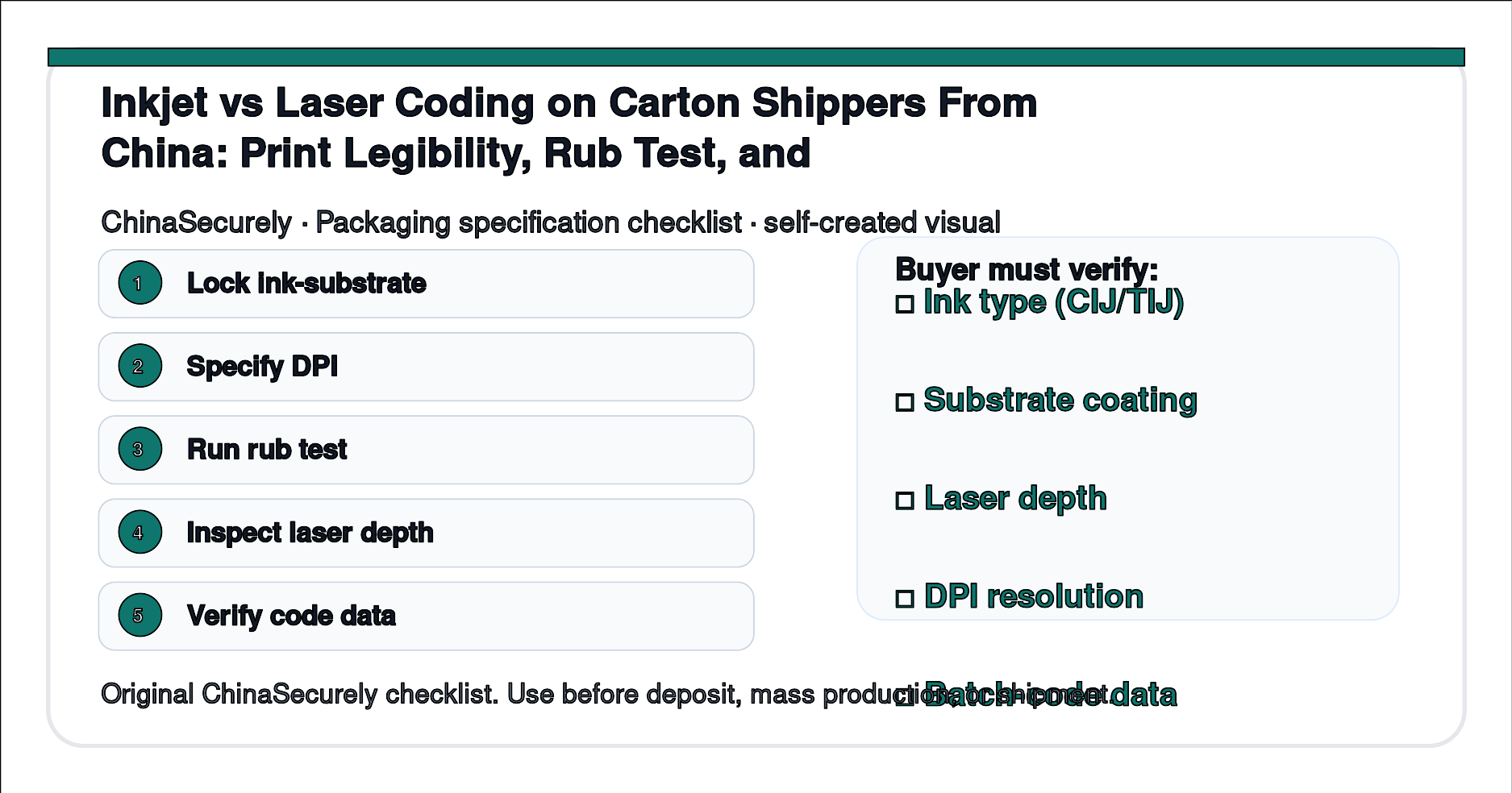
Why batch codes smudge or disappear
Batch codes fail for one of three reasons. The first is ink-substrate mismatch: a continuous inkjet (CIJ) printer running MEK-based ink on an aqueous-coated kraft will bead up and rub off; an aqueous ink on a wax-coated carton will absorb too fast and bleed. The second is laser depth: a CO2 laser set to ablate a kraft shipper at 0.2 mm depth will darken and read fine, but the same setting on a film-laminated shipper will melt the laminate and produce a brown halo around the code. The third is resolution: a CIJ print head rated at 100 DPI will produce a code that scans poorly on a high-speed conveyor; a TIJ print head at 300 DPI will scan reliably but costs more.
The China-side explanation is straightforward. Carton factory inkjet lines are usually shared across multiple jobs, so the ink type and solvent are set for the highest-volume substrate. A small batch on a different substrate (matte lamination versus gloss, kraft versus white-top liner) uses the same line with the same ink until the buyer complains. Laser coding is more substrate-sensitive, but most China factories use one CO2 laser with default power settings across all jobs; the operator rarely re-tunes between runs.
What to lock on the PO
- Coding technology in writing: CIJ with MEK / aqueous / UV-curable, or CO2 laser at specified wattage.
- Substrate type and any coating (gloss/matte lamination, varnish, aqueous coating).
- Print resolution minimum (DPI) and minimum character height (mm).
- Rub-test method: 10 strokes with cotton cloth soaked in 70 percent isopropyl alcohol.
- Code data format and position on the carton (top flap, side panel, end flap).
Buyer must verify before deposit
- Inspect 10 coded cartons from a pre-production sample under bright light.
- Run the isopropyl alcohol rub test on each and check for smearing.
- Scan all codes with the warehouse barcode scanner at production line speed.
- Check laser-coded samples with a magnifier for halo or substrate damage.
- Verify the code data matches the bill of materials and production date.
China-side explanation
CIJ ink pricing tracks solvent and dye markets, so a factory that is squeezed on margin will quietly switch from MEK-based ink to a cheaper alcohol-based ink. The new ink looks identical on the line but fails the rub test on aqueous-coated kraft. Laser coding has no consumable cost, but the laser tube is a wear part; a factory running the same tube past the rated 20,000 hours will see declining ablation depth. A 10 percent decline in laser power looks fine on glossy kraft but produces a brown halo on coated board. Asking the factory for the laser tube age and the ink batch number is fair and lets you lock a sample retention clause against the original batch.
Step-by-step solution
- Send the supplier a written spec with substrate, ink type or laser power, DPI, and rub-test method.
- Order a 50-piece pre-production sample with the real production line.
- Run the isopropyl alcohol rub test on all 50 cartons.
- Add a code legibility clause to the PO: 100 percent of bulk must scan at line speed.
- Inspect 1 percent of bulk at random with a magnifier and a barcode scanner before shipment.
Quick checklist
- Coding technology: CIJ / TIJ / CO2 laser, with ink type or wattage.
- Substrate: kraft / coated / laminated, with coating type.
- Resolution: >= ______ DPI, character height >= ______ mm.
- Rub test: 10 strokes with 70 percent IPA, no smearing.
- Code data: matches BOM and production date.
Sources
- ASTM D5264 — Practice for abrasion resistance of printed materials
- ISO/IEC 15416 — Linear bar code verification
- VideoJet Knowledge Center — CIJ and laser coding basics
- Dominion Technology — CIJ vs Laser coders comparison
- QIMA — Pre-shipment inspection for cartons and shippers
This article is for sourcing verification, not for industrial coding line design. Confirm your final ink or laser settings with a coding line engineer before bulk.