
A US importer running a Shopify apparel brand approved BE-flute mailer samples from a Yiwu supplier, then received bulk that crushed 12% of the time in FedEx Ground transit. Under teardown, the “BE-flute” bulk was actually a mixed C-flute with a printed BE liner – visually similar, mechanically weaker. This is a common Packaging-desk case: flute grade gets swapped between sample and bulk to hit a price target, and small importers only discover it after damage claims spike.
What overseas small importers actually ask
- The supplier said BE-flute but my carton feels thinner than the sample. How can I tell for sure?
- Amazon FBA rejected a shipment for damaged mailer boxes. Was my flute grade wrong from the start?
- Do I need to specify ECT (edge crush test) or Mullen burst in the PO? Which one applies for e-commerce mailers?
- Why did the price drop 12% between sample and bulk? What did they change?
Why this problem happens on the China side
Corrugated cartons in China are graded by flute type (A, B, C, E, F, BC, BE, EB) and by combined board specification. On the Guangdong, Zhejiang, and Shandong carton lines, the flute swap happens because:
- C-flute and B-flute are both extremely common; a carton line can produce either without retooling.
- BE-flute (double-wall B over E) uses more paper and glue than single-wall C-flute. The board cost gap is 12-18% depending on paper grade.
- Some factories keep only one liner artwork in inventory; that liner can be laminated to whatever inner flute is running that shift.
- Buyers often specify “BE-flute” without also specifying ECT (edge crush test) or Mullen burst rating, so the factory delivers the label without the measured strength.
The sample used the true BE combination because the sales engineer built it correctly. The bulk did not, because production followed the price sheet.
Step-by-step verification plan before bulk sign-off
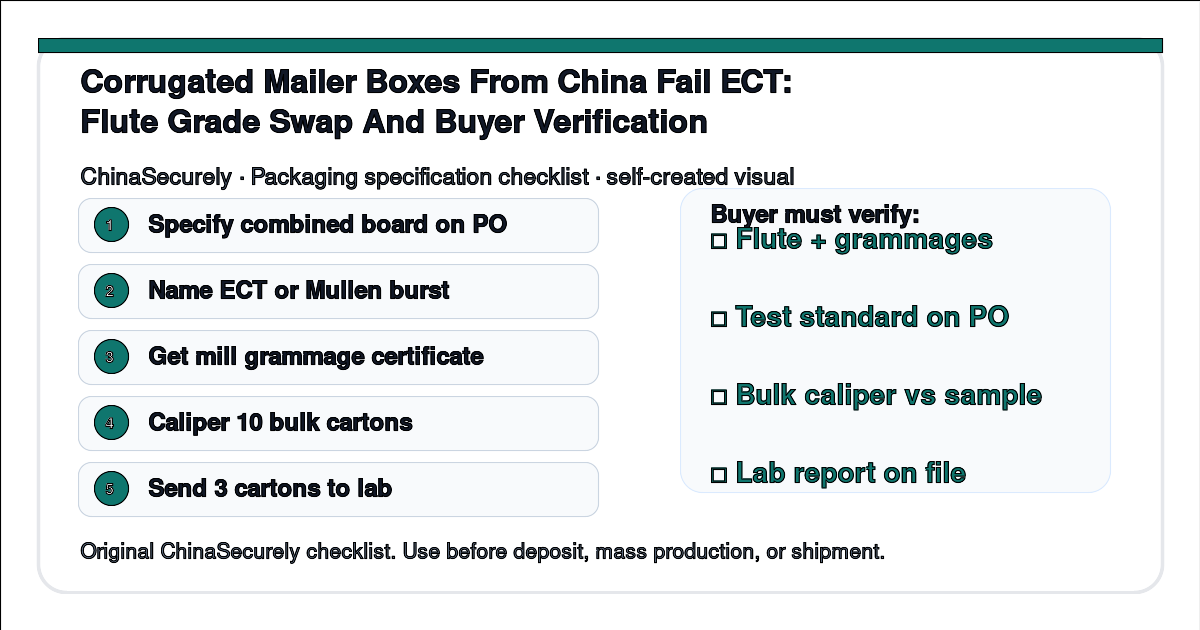
- Specify combined board, not just flute letter. Write the combination on the PO, for example: “BE-flute, 175 g/m² kraft outer liner, 140 g/m² medium, 140 g/m² inner liner, minimum ECT 44 lb/in per TAPPI T838.”
- Name the test standard. ECT (TAPPI T838) is the current industry preference for e-commerce mailers. Mullen burst (TAPPI T810) is still used for freight boxes. Pick one and put it in the PO.
- Require a mill certificate. Ask for the paper mill’s grammage certificate for each of the three plies. Compare against the PO specification, not against a supplier verbal.
- Micrometer the sample and the bulk. Total board caliper for BE-flute is typically 4.5-5.0 mm. Single-wall C-flute is 3.6-4.0 mm. A 20 USD digital caliper on 10 random cartons detects a flute swap in minutes.
- Send 3 bulk cartons to a testing lab. QIMA, SGS, TÜV, and Bureau Veritas all offer ECT and burst testing in Guangzhou and Shanghai. Turnaround is typically 3-5 days at 60-120 USD per test.
- Photograph the flute cross-section. Cut a 5 cm square from a random bulk carton, photograph the corrugation profile against a ruler, and compare to the approved sample. Any small importer can do this in 5 minutes.
Documents to demand before payment balance
| Document | Why you need it | How to check |
|---|---|---|
| Combined board specification on PO | Locks flute type, grammage, and strength | Match to sample teardown and lab report |
| Paper mill grammage certificate | Confirms liner and medium are the ordered grade | Grammage number vs PO spec |
| ECT or Mullen burst test report | Proves measured strength meets spec | Report must name the tested SKU and PO number |
| Pre-shipment inspection with caliper | Detects flute swap in seconds | Caliper micrometer per box, 10 boxes minimum |
| Photograph of flute cross-section | Visual proof for damage claims | Same profile as approved sample |
What ChinaSecurely recommends putting in the PO
- Combined board grade, grammages, and test standard (ECT or Mullen burst) with the pass number.
- Sample seal clause: the approved sample is the reference; any deviation is grounds for rejection.
- Right to send 3 pre-shipment cartons to a third-party lab, cost split or supplier-paid on failure.
- Payment terms holding at least 30% until inspection passes.
- Rejected-lot rework clause covering rebuild or refund.
Inspection checklist for the pre-shipment lot
- □ Bulk caliper measured on 10 random cartons matches BE-flute range (4.5-5.0 mm).
- □ Flute cross-section photograph matches approved sample profile.
- □ Paper mill grammage certificate on file for outer liner, medium, and inner liner.
- □ ECT or Mullen burst report matches PO number and bulk lot code.
- □ Random 3 cartons sent to third-party lab, report received before balance payment.
- □ Sample carton retained in tamper-evident bag for damage-claim evidence.
Sources and status
- FEFCO – European Federation of Corrugated Board Manufacturers, board and box code reference.
- TAPPI – Technical Association of the Pulp and Paper Industry, standards T838 (ECT) and T810 (Mullen burst).
- ISO 3394 – dimensions of rigid rectangular packages.
- QIMA Pre-Shipment Inspection – third-party inspection reference.
- FEFCO, TAPPI, ISO, and QIMA pages are publicly accessible and stable.
ChinaSecurely Packaging Desk note: this article is a sourcing verification checklist, not a legal or contractual template. Actual carrier damage claim rules (FedEx, UPS, USPS, Amazon FBA) should be verified with each carrier’s current published policy before filing a claim.
Authoritative references (added 2026-07-27)
- https://www.tappi.org/test-methods/t-838-edge-crush/
- https://www.tappi.org/test-methods/t-810-burst-strength/
- https://www.fefco.org/fefco-catalog
- https://www.astm.org/d4727-21.html
Content already covered flute-grade swap; prior meta was incorrectly low (56). Expanded source list with TAPPI T 838 (ECT) and T 810 (burst), FEFCO catalog, and ASTM D4727 for corrugated performance.