
A 65W USB-C wall charger sample may negotiate correctly, while random units from the production lot expose a different set of Power Delivery profiles. For a small importer, the key question is not simply whether the supplier sends a USB-IF document. It is whether the exact model, its public listing, its advertised profiles, and the shipped hardware all match.
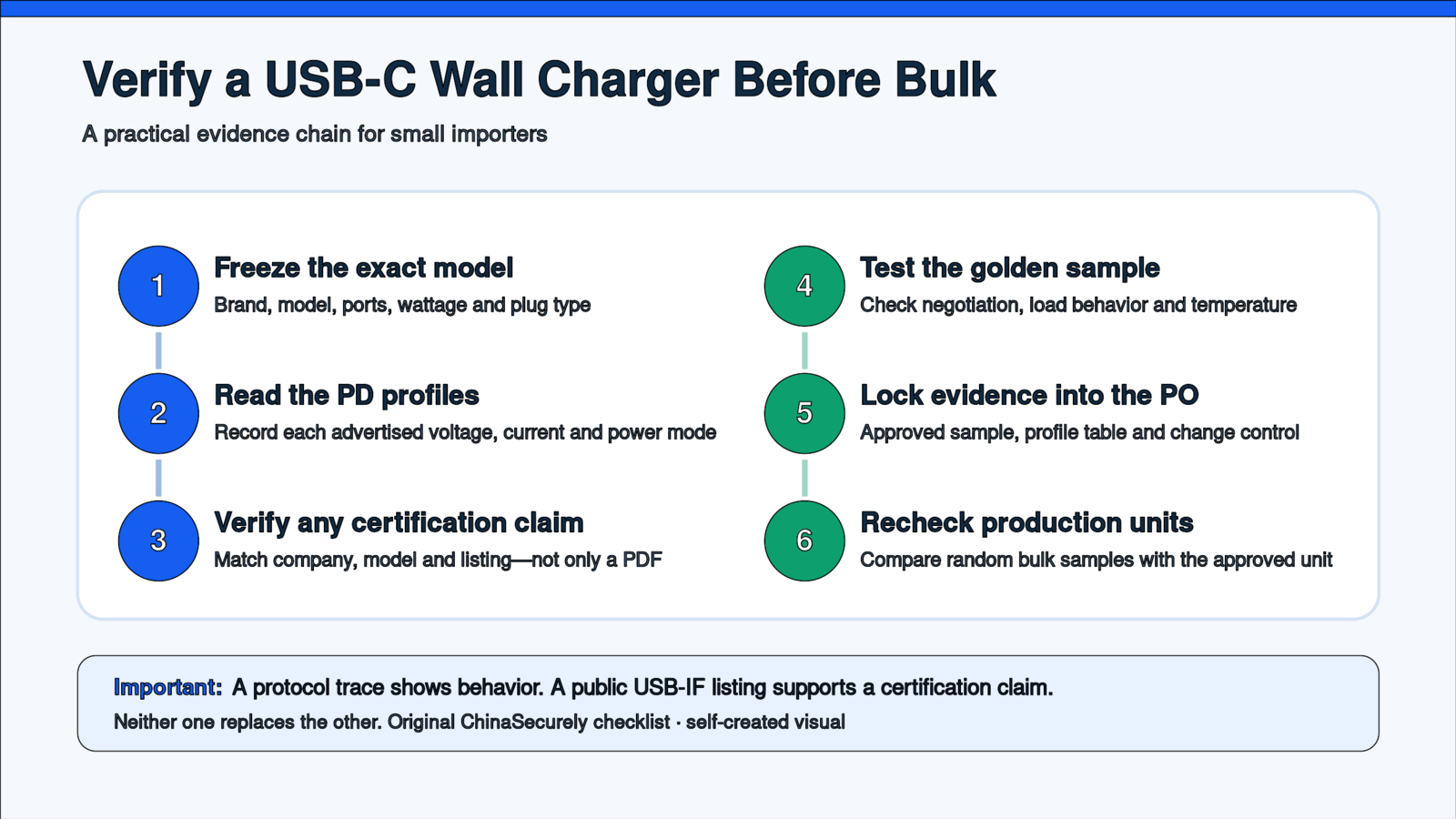
Start with the claim you are actually buying
Ask the supplier to freeze the exact model before you review evidence. Record the brand, model number, port configuration, plug type, maximum output, and every advertised voltage/current profile. If the quote only says “65W PD,” it is too vague: two chargers can carry the same headline wattage while supporting different profiles.
A useful supplier message is:
“Please send the exact model number, the complete PD output table for every port, the public USB-IF product-list entry if you claim certification, and a photo of the production label. Confirm that the sample and bulk order will use the same hardware and firmware.”
Why sample and bulk can differ
Many Chinese charger suppliers coordinate several companies: a brand owner or trading company, a power-supply factory, a controller vendor, and a test laboratory. Similar housings may cover different PCB revisions. Firmware can also be loaded late in production. That does not prove wrongdoing, but it explains why a report or a good sample is not enough by itself.
In practice, the avoidable gap is weak change control. A supplier may approve one configuration, then use another controller, transformer, cable, or firmware build after a component shortage. The buyer should therefore make the approved sample and its measured behavior part of the purchase specification.
Verify a USB-IF claim in two places
USB-IF says its compliance program uses test specifications and a Test ID (TID). Products that pass are added to an Integrators List; the public product search covers products certified to bear the USB-IF logo. This gives buyers two separate checks:
- Public record: search the USB-IF product list and match the listed company and product details to the model being purchased.
- Physical behavior: read the sample’s advertised PD profiles with suitable test equipment and compare them with the supplier’s specification.
A protocol trace does not prove that a product is USB-IF certified. A listing does not prove that every production unit still matches the listed design. Keep these checks separate.
Run a practical golden-sample test
- Inspect the label. Confirm model, rated input/output, manufacturer or responsible party, and plug version.
- Read advertised profiles. Save the voltage, current, and power modes reported by each port, including any claimed extended-power profiles.
- Apply representative loads. Verify stable output at the operating points your customers will actually use. Use qualified equipment and a competent lab for safety-critical testing.
- Check temperature and protection behavior. Do not invent a universal pass temperature; agree a test method, ambient condition, load, duration, and acceptance criteria with the test lab.
- Retain the unit. Seal and identify the approved sample so it can be compared with random units from the production lot.
If the supplier cannot explain a different PD profile, pause before paying the balance. The difference may be harmless, but it needs a documented explanation and approval.
Put the evidence into the PO
The purchase order or specification should identify the approved model and sample, include the complete PD profile table, and require written approval for hardware or firmware substitutions. Add a pre-shipment comparison of random production units against the golden sample.
| Evidence | What it tells you | What it does not prove |
|---|---|---|
| USB-IF public listing | A listed product passed the applicable compliance program | That an unverified bulk unit is identical |
| Supplier test report | What a named sample was tested against | That the report belongs to your exact production unit |
| PD protocol trace | What profiles the tested unit advertises | USB-IF certification or electrical safety |
| Golden sample | The approved physical reference | That the factory will not make an unapproved change |
Pre-shipment checklist
- Exact model, ports, plug type, and label match the PO.
- Supplier’s PD profile table is attached to the specification.
- Any USB-IF certification claim matches the public product list.
- Random bulk units advertise the same profiles as the approved sample.
- Any hardware or firmware change has written buyer approval.
- A qualified lab handles electrical-safety and market-access testing where required.
Sources
- USB-IF — Compliance Program
- USB-IF — Certified Product Search
- USB-IF — USB Charger (USB Power Delivery)
- USB-IF — USB Power Delivery Specification Library
- USB-IF — Logo License and Usage Requirements
This is a sourcing-verification workflow, not certification or electrical-safety advice. Requirements depend on the exact product and destination market. Confirm them with the relevant certification body or an accredited laboratory.