
Short answer: a kraft paper tube from China that arrives crushed, oval, or warped inside the master carton usually has one of three root causes: the wall thickness dropped below the supplier’s quote, the spiral wind density fell a ply, or the end caps are loose on the inner diameter. Kraft tubes look simple, but they are a layered composite, and a single ply drop is enough to fail under the vibration of an ocean container. Here is how to lock the spec before bulk.
Why kraft tubes crush and warp
Kraft tubes fail for one of three reasons. The first is wall thickness: a supplier that quotes a 3 mm wall may run 2.5 mm or 2.0 mm in the bulk run because the visual difference is hard to spot without a caliper. The second is spiral density: a kraft tube is wound from a paperboard strip in a spiral; a tube quoted at 4-ply may drop to 3-ply under cost pressure, which drops radial crush strength by roughly 25 percent. The third is end-cap fit: a loose end cap cannot carry the stacking load through the master carton, so the tube collapses under its own weight.
The China-side explanation is straightforward. Paperboard pricing tracks pulp and recycled fiber markets, so a factory that is squeezed on margin will quietly run a thinner board or a lower ply count without changing the visible diameter. End caps are a separate line item, and a factory that switches from a tight-fit molded cap to a generic slip-on cap saves a few RMB per tube. The buyer sees the same product but the stacking strength drops.
What to lock on the PO
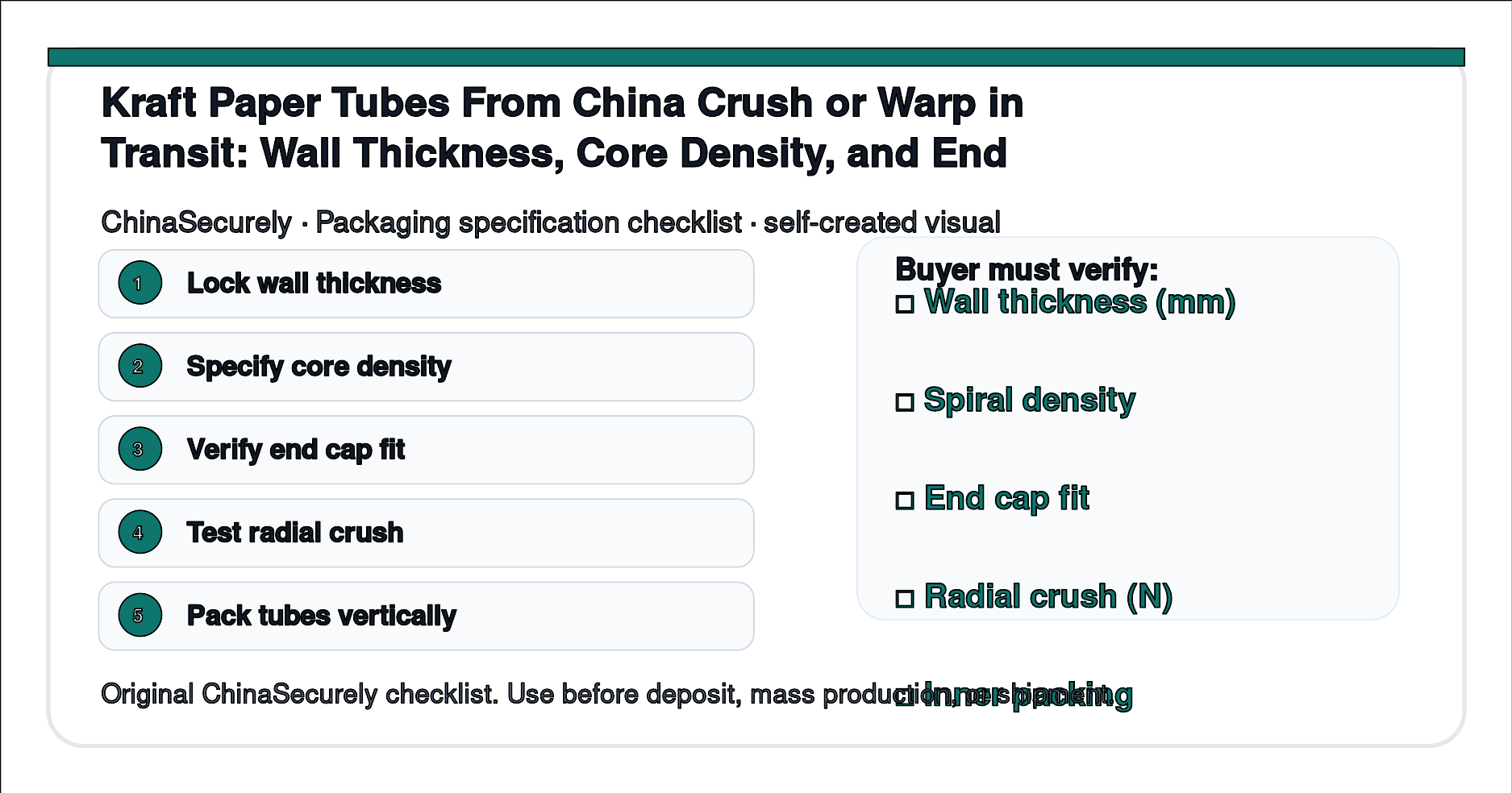
- Wall thickness in millimeters, with a +/- 0.3 mm tolerance and a caliper-check clause.
- Number of spiral plies in writing, with a sample retention clause.
- End-cap type (molded tight-fit, slip-on, or shrink-band) and inner diameter tolerance.
- Radial crush strength minimum in newtons, with a 20-piece crush test.
- Inner packing: tubes packed vertically in the master carton, not horizontal.
Buyer must verify before deposit
- Measure 10 random tubes with a caliper at three points along the length.
- Cut one tube lengthwise and count the spiral plies with a magnifier.
- Press-fit an end cap and check for rotation or vertical play.
- Run a 50 N radial crush test on a 100 mm sample section.
- Inspect master carton for horizontal vs vertical packing orientation.
China-side explanation
Paperboard pricing in China moves with the National Bureau of Statistics pulp and waste-paper indices. A factory that quotes in a low-pulp month may quietly switch suppliers when the index rises, and the substitute board has lower burst strength even at the same caliper. End caps are often sourced from a separate sub-supplier; if the sub-supplier’s tooling wears, the cap inner diameter drifts and the fit goes loose. Asking the factory to disclose their board and cap sub-suppliers is fair and lets you lock a sample retention clause against the original batch.
Step-by-step solution
- Send the supplier a written spec with wall thickness, ply count, end-cap type, and radial crush strength.
- Order a 20-piece pre-production sample and run the caliper, ply count, and crush tests yourself.
- Add a caliper check clause to the PO: the factory must hold +/- 0.3 mm or refund tooling.
- Inspect 1 percent of bulk at random with a caliper before shipment.
- Pack tubes vertically in the master carton and cap both ends during sea freight.
Quick checklist
- Wall thickness (mm): ______, tolerance +/- 0.3 mm.
- Spiral plies: ______, sample cut open and counted.
- End-cap type: molded tight-fit / slip-on / shrink-band.
- Radial crush: >= ______ N at 100 mm section.
- Master carton orientation: vertical only.
Sources
- ASTM D4169 — Transport packaging vibration simulation
- TAPPI — Paperboard test methods (T 494, T 411)
- ISO 11093 — Paperboard tubes for sustained and dynamic loads
- FEFCO — European federation of corrugated and paper packaging
- QIMA — Pre-shipment inspection for paper packaging
This article is for sourcing verification, not for packaging engineering. Confirm your final radial crush and stacking numbers with a packaging engineer before bulk.