
Short answer: a China pallet load that arrives with torn film, shifted cartons, or a collapsed stack usually has one of three root causes: the film gauge dropped below the supplier’s quote, the wrong unitization technology (hood versus shrink) was quoted for the load geometry, or the shrink tunnel temperature drifted out of spec. Pallet film looks like a commodity, but a small gauge drop multiplies across the load and the stack fails at the second or third pallet. Here is how to lock the spec before bulk.
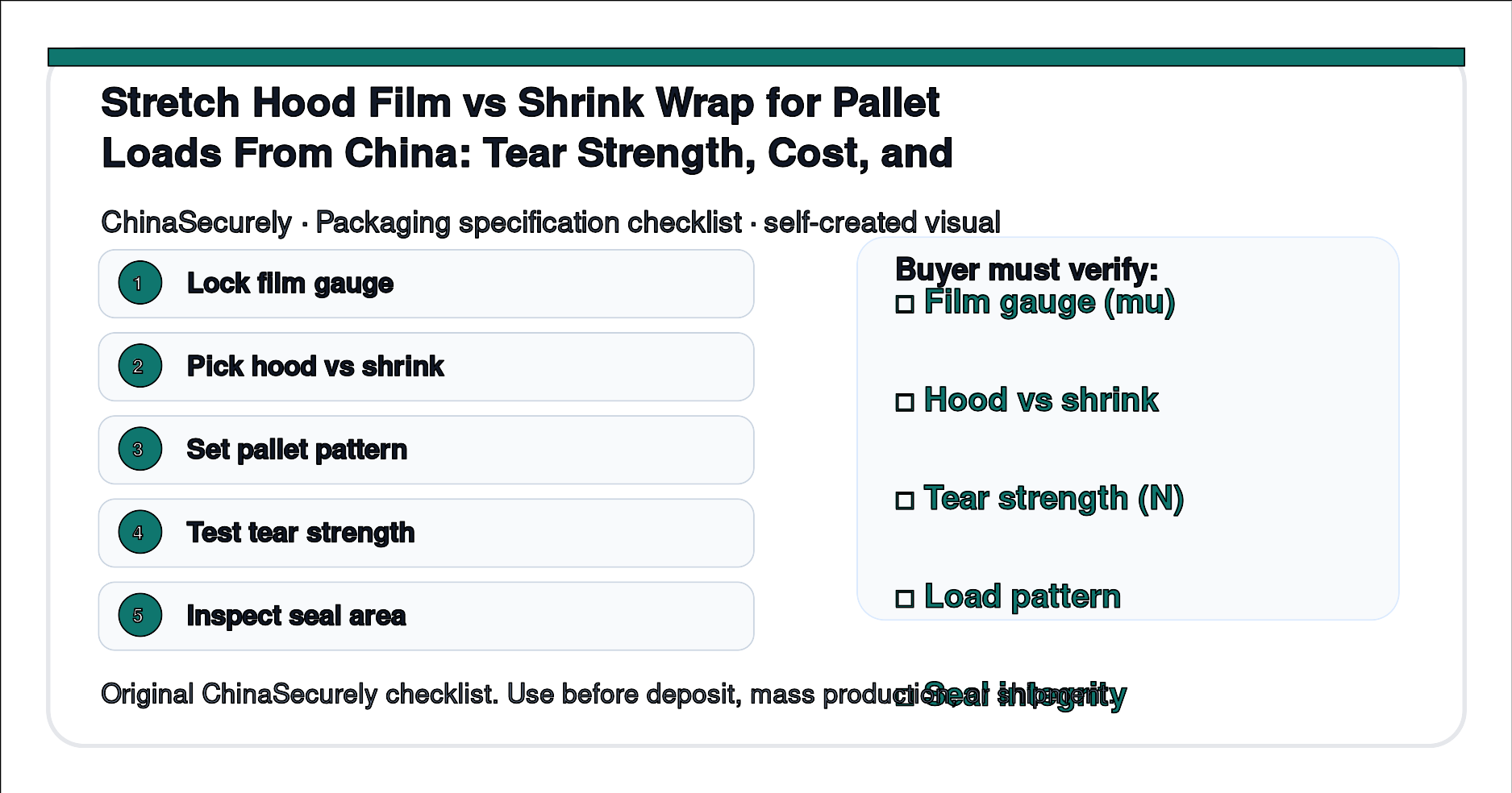
Why pallet film fails
Pallet film fails for one of three reasons. The first is film gauge: a supplier that quotes 100 mu LLDPE stretch hood may run 80 mu or even 70 mu in the bulk run because the visual difference is hard to spot without a micrometer. The second is technology mismatch: stretch hood is applied cold over a pallet frame and requires a uniform load geometry; shrink wrap is applied with heat and conforms to irregular loads but needs a shrink tunnel that some China factories do not have. The third is shrink tunnel temperature: a 20 degree C drift in tunnel temperature moves the shrink ratio and the holding force, so the load passes inspection but fails on the truck.
The China-side explanation is straightforward. LLDPE resin pricing tracks ethylene markets, so a factory that is squeezed on margin will quietly run a thinner gauge or blend in cheaper recycled LLDPE. Shrink wrap suppliers often run both stretch hood and shrink lines, but the line operator is rarely trained on both, so the operator runs whatever is easier on the day. The buyer sees the same pallet shape but the holding force drops by 30 percent.
What to lock on the PO
- Film technology: stretch hood or shrink wrap, with film grade (LLDPE / LDPE / mLLDPE).
- Film gauge in microns with a +/- 5 mu tolerance and a micrometer-check clause.
- Number of wrap passes or hood cycles per pallet.
- Load pattern: pallet size, load height, overhang, and any irregular shapes.
- Transport mode and weather exposure: domestic truck, sea container, outdoor storage.
Buyer must verify before deposit
- Measure 5 random film samples with a micrometer at three points across the roll.
- Run an Elmendorf tear test on a 100 mm sample section.
- Check the shrink tunnel temperature with a surface probe during production.
- Inspect a finished pallet for film uniformity, hood seal area, and load shift.
- Verify load stability by tilting a finished pallet 10 degrees and checking for slip.
China-side explanation
LLDPE resin pricing in China moves with the Sinopec and PetroChina ethylene indices, so a factory that quotes in a low-resin month may quietly switch resin suppliers when the index rises. Recycled LLDPE is widely available and looks identical to virgin on the roll, but it has lower tear strength and breaks at the hood seal area in cold weather. Shrink tunnel temperature drifts because the heating elements wear out; a factory that runs the tunnel past the rated element life will see a 20 degree C drift. Asking the factory for the resin batch number and the tunnel element age is fair and lets you lock a sample retention clause against the original batch.
Step-by-step solution
- Send the supplier a written spec with film technology, gauge, wrap passes, and load pattern.
- Order a 5-pallet pre-production sample with the real production line.
- Run the micrometer gauge check and the Elmendorf tear test on each pallet.
- Add a film gauge clause to the PO: the factory must hold +/- 5 mu or refund tooling.
- Inspect 1 percent of bulk pallets at random with a tilt test before shipment.
Quick checklist
- Film technology: stretch hood / shrink wrap, with film grade.
- Film gauge: ______ mu, tolerance +/- 5 mu.
- Wrap passes or hood cycles: ______.
- Load pattern: pallet size, load height, overhang.
- Tilt test: 10 degrees, no slip or film tear.
Sources
- ASTM D1922 — Elmendorf tear propagation in plastic film
- ASTM D1709 — Impact resistance of plastic film by free-falling dart
- Plastics Industry Association — Film and sheet resources
- ISO 6383 — Tear resistance of plastic film and sheeting
- QIMA — Pre-shipment inspection for pallet unitization
This article is for sourcing verification, not for industrial packaging line design. Confirm your final film gauge and wrap count with a packaging engineer before bulk.