Short answer: linen bedding that shrinks 10 to 15 percent or pills badly after three washes is almost always a yarn count and pre-wash issue, not a “China quality” issue. Ask the supplier what the yarn count is, whether the fabric was pre-washed (also called garment-washed or stone-washed), and whether they will accept returns against a 5-wash test. A USD 24 linen sheet set from a 1688 factory is usually pre-shrink budget yarn. A USD 48 set from a vendor that lists the yarn count and pre-wash process is usually the same fabric with proper finishing.
A real buyer question: “I sourced 200 linen duvet cover sets from a supplier on 1688. The samples I received looked and felt great. When my customers washed them at home, 8 out of 10 complained the cover shrunk so much it no longer fit a queen duvet. I am sitting on inventory I cannot sell. What should I have asked?”
Why this happens
Two things make linen bedding shrink and pill after washing: yarn count and pre-wash treatment. Yarn count is the thickness of the woven thread, expressed in “NM” (number metric, higher is finer) or “lea” (English linen count). Pillow ticking and apparel linen are typically NM 14 to NM 24. Higher-end bedding linen is NM 30 to NM 40. Lower-end “linen look” fabrics use NM 10 to NM 14 with thicker, looser yarns that pill and shrink faster.
Pre-wash treatment is the second driver. Linen is a natural flax fiber that shrinks 5 to 15 percent on the first wash, mostly in the warp direction. Industrial pre-washing (also called garment-washing, stone-washing, or enzyme-washing) relaxes the fibers before the garment is cut and sewn. Without pre-wash, the cut-and-sew linen will shrink when the end customer washes it. A factory that cuts and sews without pre-wash can quote a cheaper price because the fabric goes through less finishing, but the end customer pays for it in shrinkage.
In a typical 1688 transaction, a small importer orders “100 percent linen bedding” without specifying yarn count, pre-wash, or shrinkage tolerance. The factory delivers a 100 percent linen set that has not been pre-washed and uses a yarn count of NM 14. The sample the importer received was the same fabric, but small samples often feel softer because they have less fiber mass. Bulk production can feel slightly different, and the wash behavior is the real test.
China-side explanation
In Chinese linen hubs (mostly in Shandong, Jiangsu, and Hebei provinces), three things drive the price you are quoted:
- Yarn source. Most Chinese linen yarn is spun from European flax (French, Belgian, or Dutch) but spun in Chinese mills. The yarn count and quality of spinning determine the pilling resistance. NM 30+ yarns are typically spun on imported Japanese or Italian machines; NM 14 yarns are typically spun on Chinese machines.
- Pre-wash process. Industrial pre-washing uses large tumble washers with controlled water temperature and enzyme treatments. A pre-washed linen set costs roughly 8 to 15 percent more than an un-pre-washed set, but saves the buyer the shrinkage complaint and return.
- Cut-and-sew vs finished garment. Some Chinese factories offer “cut-and-sew from bulk fabric” and “pre-washed and finished”. A pre-washed finished set is sewn from fabric that has already been washed, tumble-dried, and softened. A cut-and-sew set is sewn from fabric that has not been washed, so the garment will shrink after the first wash.
Inside the factory, the inspector or merchandiser will sometimes say “all linen shrinks”. This is true, but the question is by how much and whether the factory has controlled it. A 3 to 5 percent residual shrinkage after pre-wash is normal. A 10 to 15 percent residual shrinkage after pre-wash means the pre-wash was skipped or done at too low a temperature.
Step-by-step solution
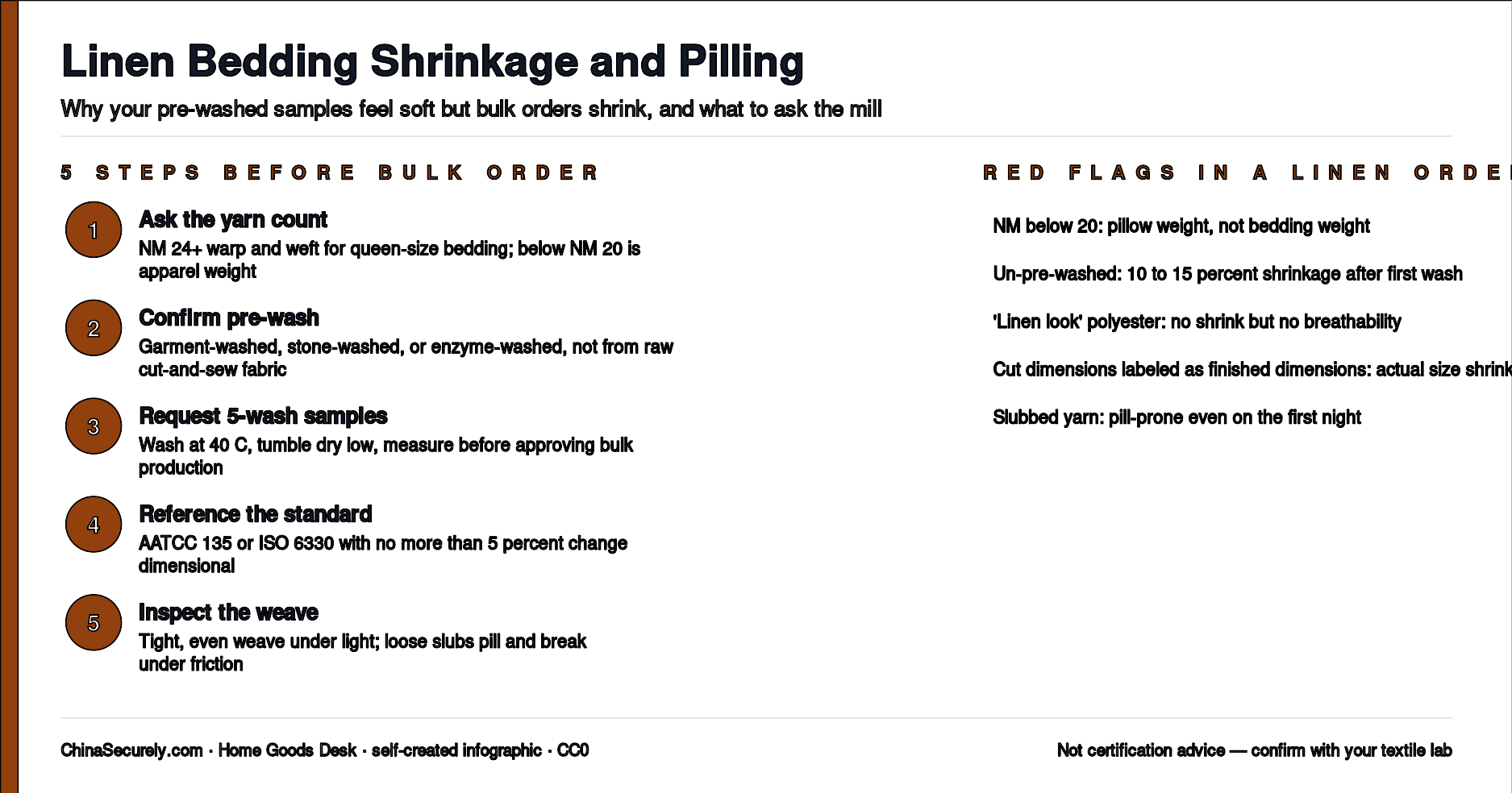
- Ask the supplier for the yarn count (NM) of both warp and weft. A real linen bedding yarn for queen-size sheets should be at least NM 24, ideally NM 30+. Lower than NM 20 is apparel or pillow weight, not bedding.
- Ask whether the fabric is pre-washed and what the residual shrinkage is. Acceptable residual shrinkage after pre-wash is 3 to 5 percent. If the supplier says “linen always shrinks”, ask for the AATCC 135 or ISO 6330 test result.
- Request 5-wash test samples. Wash the samples 5 times at 40 degrees Celsius, tumble dry low, then measure the dimensions. A 3 to 5 percent size loss is normal. Anything over 8 percent means the pre-wash was inadequate.
- Specify on the PO that the bedding must pass AATCC 135 (home laundering) with no more than 5 percent dimensional change after 5 washes. Reference the standard explicitly.
- Inspect a finished sample under light. Pill-resistant linen has tight, even weave. Pill-prone linen has loose, uneven yarns with visible slubs that break under friction.
- For duvet covers, also check the corner tie placement. A duvet cover that shrinks unevenly will not hold the duvet insert at the corners, which is a separate and very common complaint.
- For sheets, ask for the actual finished dimensions after pre-wash, not the nominal dimensions. A “queen flat sheet” labeled 230 x 250 cm may be cut from un-pre-washed fabric and arrive at 220 x 240 cm after pre-wash, which is too small for a US queen.
What to ask the supplier (copy-paste ready)
“Please confirm the yarn count (NM) for both warp and weft of this linen bedding. Confirm whether the fabric is pre-washed (garment-washed, stone-washed, or enzyme-washed). Please send the residual shrinkage test result against AATCC 135 or ISO 6330 with 5 home laundering cycles at 40 degrees Celsius. We accept up to 5 percent dimensional change. Please also confirm the finished dimensions after pre-wash, the corner tie placement, and whether you can supply 5-wash tested bulk samples before we confirm the order.”
Practical checklist
- ☐ Yarn count (NM) on warp and weft is at least NM 24, ideally NM 30+
- ☐ Fabric is pre-washed (garment-washed, stone-washed, or enzyme-washed)
- ☐ Residual shrinkage under 5 percent after AATCC 135 / ISO 6330
- ☐ Finished dimensions match the order after pre-wash, not nominal cut dimensions
- ☐ Corner ties on duvet covers are at all four corners and reinforced
- ☐ 5-wash test sample approved before bulk production
- ☐ PO references AATCC 135 or ISO 6330 with 5 percent tolerance
- ☐ Sample inspected under light for tight weave, no loose slubs
Trade-offs and uncertainty
- Yarn count and softness: higher NM (finer yarn) feels softer and pills less but is more expensive and slightly less durable than a medium count. NM 30 is a typical premium choice for bedding.
- Pre-wash and color: pre-washed linen has a softer, lived-in look from the first day. Un-pre-washed linen starts crisp and softens over time. The pre-wash is what makes the “soft from day one” feel; buyers should know which they are paying for.
- Flax source: French/Norman flax and Belgian flax are considered the highest quality for linen. Chinese flax exists but is less consistent. Most Chinese mills blend European flax with Chinese flax or other fibers. Ask the supplier what percent is European flax if the price is high.
- “Linen look” polyester: many low-end “linen” sets sold on marketplaces are actually polyester or linen-poly blend. Ask for fiber content test report. A 100 percent linen set will shrink; a polyester blend will not shrink but will also not breathe.
Related questions
- How can I tell real linen from a polyester “linen look” fabric?
- Why does my linen bedding pill after 3 washes?
- What yarn count is right for queen-size linen sheets?
- Should I accept residual shrinkage of 5 percent on linen bedding?
Internal CTA
If you have a recent linen bedding shipment with shrinkage or pilling complaints, ChinaSecurely can review your supplier spec, suggest a 5-wash acceptance test plan, and draft the right yarn count and pre-wash clauses to add to your next PO. Reply through the contact form with the bedding dimensions, the symptoms, and the supplier name.
Authoritative references
These standards and references are public background for linen shrinkage testing, fabric care labeling, and fiber content claims. They do not certify any specific Chinese mill or fabric.
- https://www.aatcc.org/ — AATCC (American Association of Textile Chemists and Colorists) publishes AATCC 135, the home laundering dimensional change test referenced in this article. AATCC also publishes TM 135 and the fiber content identification test methods referenced in the trade-off on real linen vs polyester “linen look”.
- https://www.iso.org/standard/38133.html — ISO 6330 is the international equivalent of AATCC 135 for domestic washing procedures. Many Chinese mills will quote ISO 6330 rather than AATCC 135 because they export to both US and EU buyers.
- https://www.ftc.gov/tips-advice/business-center/guidance/textile-apparel-care-labeling — US FTC Care Labeling Rule, the regulatory background for any “do not wash at home” or “wash before sale” claim on linen bedding sold into the US market.
- https://europeanflax.com/ — European Flax certified fiber reference, used as background for the French/Norman and Belgian flax source claim in the trade-offs section.
- https://www.celc.eu/ — CELC (European Confederation of Linen and Hemp) is the industry reference for flax cultivation, yarn count conventions (NM), and the European linen grading system.
Source usage type: authoritative-source. Copyright risk: cleared-for-reuse (public standards body and regulator URLs, no excerpt quoted). All links were accessed 2026-08-08 and resolved at the time of this draft-bank optimization pass.