
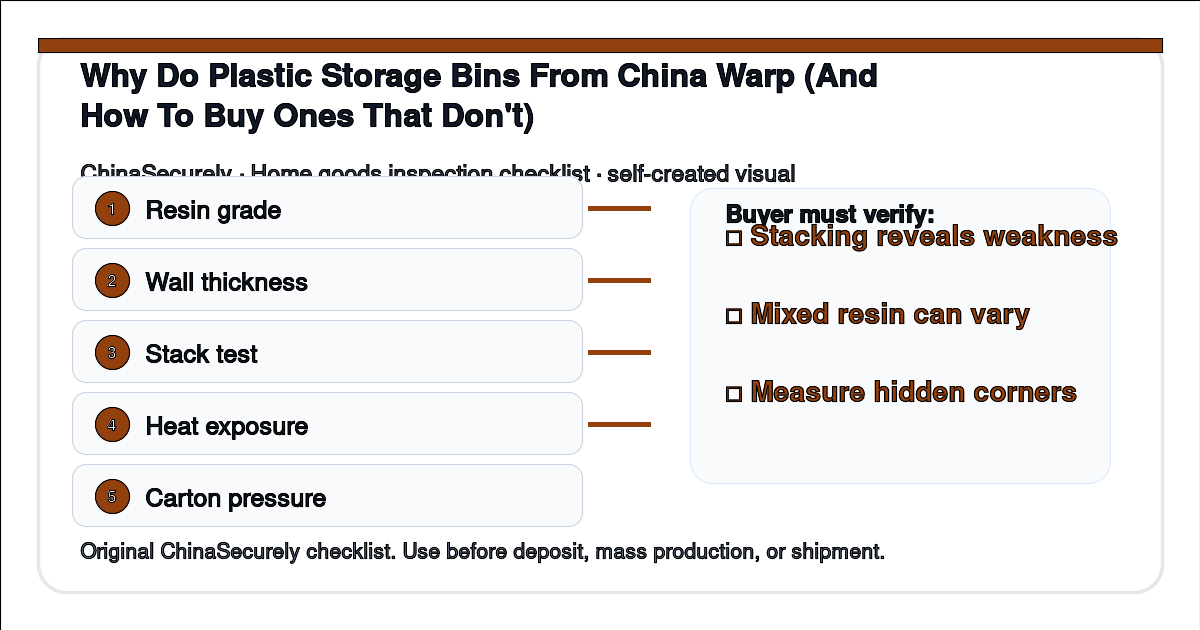
A common buyer question: “I ordered 500 clear plastic storage bins from a Taobao supplier and stored them in a sunlit garage. Within three weeks, half of them are visibly bowed and the lids no longer click shut. What did I miss?” The short answer is that most likely the bin is made of a low-heat-deflection plastic and was tested only at room temperature. This is a material specification problem, not a usage problem.
This guide is for small importers who source plastic storage organizers, stackable bins, or household plastic containers from Chinese factories and want to avoid the most common warping and cracking issues.
Why plastic storage bins warp
Plastic bins warp when three forces act on them at the same time: heat, load, and poor material choice. The bins may look fine at the factory; they fail in the buyer’s warehouse, truck, or sunlit shelf.
- Low heat deflection temperature (HDT). Polypropylene (PP) starts to soften around 100 °C under load. Polystyrene (PS) softens near 80 °C. A black or dark-colored bin sitting in direct sun can easily reach 60 to 70 °C on a hot day. PP holds up; PS bows.
- Insufficient wall thickness or ribbing. A thinner wall flexes under stacking load. The factory often quotes the cheapest tool that meets the spec, not the strongest tool that could have been used.
- Recycled or blended resin. Post-consumer recycled PP mixed with filler can have an HDT 10 to 20 °C lower than virgin PP. Recycled material is cheaper and acceptable for some applications, but it should be specified on purpose, not by accident.
- Uneven cooling during molding. If the mold cooling time is rushed, internal stresses are frozen into the part. The bin looks fine out of the tool, then slowly distorts over days or weeks.
China-side explanation
In the major plastic houseware clusters (Yuyao in Zhejiang, Shantou in Guangdong, parts of Anhui), storage bins are quoted by resin type, wall thickness, color, and tooling complexity. A typical 30 L clear bin in PP at 1.0 mm wall might land at $1.50 to $2.20 per unit FOB, while the same bin in PS at 0.9 mm wall might land at $1.10 to $1.50. The PP version costs about 25 to 35 percent more.
The factory salesperson will often default to the cheapest resin that meets the visual spec (clear, glossy, correct dimensions). They will not necessarily ask about the buyer’s end use environment. If the importer says “for retail, indoor shelf storage,” the supplier assumes room temperature. If the actual end use is a sunlit garage, sunroom, or warehouse with no climate control, the spec needs to be tighter.
Many small importers also see “food-grade PP” on the supplier’s quote. That refers to FDA or EU food-contact migration testing for the resin itself. It does not mean the bin is suitable for hot environments. The two issues are separate.
Step-by-step: how to specify a bin that will not warp
- State the resin type and required heat deflection. “Injection-molded polypropylene (PP), virgin resin, minimum heat deflection temperature 95 °C at 0.45 MPa per ASTM D648.” This is the strongest single line in the spec.
- Specify wall thickness and rib pattern. “Minimum 1.2 mm wall, internal vertical ribs every 40 mm.” For bins above 20 L, push to 1.4 mm.
- Set a stacking load. “Bins must stack 5 high fully loaded without visible deformation.” This forces the factory to design ribbing and not just meet the visual spec.
- Require a heat test on the pre-production sample. Place the empty sample in a 60 °C oven for 4 hours. Remove and check for visible distortion, lid fit, and base flatness.
- Confirm the resin on the production run. Ask for the resin batch number and the supplier’s MSDS. Compare the MSDS melt flow index (MFI) and HDT against the sample.
- Request a pre-shipment inspection that includes a stacking test. PSI on stacking bins should include a 24-hour stack under load.
What to ask the supplier (copy and paste)
“Please confirm in writing: (1) the resin type and grade (virgin PP, recycled PP, or PS), (2) the heat deflection temperature at 0.45 MPa per ASTM D648, (3) the wall thickness at the side wall and the base, and (4) whether the resin batch on the bulk run is the same as the sample. If the answer to (1) is recycled PP, please quote the percentage of post-consumer recycle and the source.”
Risk and trade-off notes
If the bin is sold into a climate-controlled retail environment (big-box store, indoor warehouse), the cheapest PP spec usually works. If the bin is sold for garage, shed, RV, or outdoor use, pay more for higher HDT and ribbing.
Recycled PP is a legitimate choice for cost and sustainability, but it should be a deliberate spec decision with a written percentage (for example, “minimum 50 percent post-consumer recycled PP, balance virgin PP”). For US retail, confirm state-level recycled-content claims (for example, California) with a compliance specialist before labeling.
What to check on the MSDS before paying the deposit
An MSDS for a plastic bin usually lists the resin family, the melt flow index (MFI), the heat deflection temperature (HDT), and the additives. Most importers glance at the resin name and stop there. The numbers below are the ones that actually change whether the bin will warp or not.
- Melt flow index (MFI, ASTM D1238 at 230 °C / 2.16 kg for PP). Sample and bulk MFI should match within plus or minus 1.5 g/10 min. A larger drift usually means a different resin lot or a recycled blend.
- Heat deflection temperature (HDT, ASTM D648 at 0.45 MPa). For PP, this should be at or above 95 °C for a sunlit garage use case. Below 90 °C is a red flag, especially for dark-colored bins.
- Density (ASTM D792). Virgin PP sits at about 0.90 g/cm³. A higher reading on the MSDS, for example 0.91 to 0.94, usually indicates a filler (talc, calcium carbonate) or a recycled blend. The bin will look the same; the HDT will be lower.
- Additives: UV stabilizer (HALS or benzotriazole) should be listed for outdoor use. A bin with no UV additive listed will chalk and yellow within 6 to 12 months in direct sun, even if the resin is virgin.
- Recycled content: a recycled-content percentage above 50 percent is acceptable for cost reasons, but it must be declared. Undeclared recycled content on the bulk run is the most common warranty-dispute reason for plastic houseware.
Ask for the MSDS of the sample resin and the MSDS of the bulk resin. Compare the two side by side. If the factory only has one MSDS for both, ask why. The answer is usually more useful than the document.
Practical checklist
- Resin type written into PO (PP, not “plastic”).
- Heat deflection temperature specified per ASTM D648.
- Wall thickness and rib pattern specified.
- Stacking load test (5 high, 24 hours) in the inspection plan.
- Resin MSDS requested and matched to the sample.
- Heat test on pre-production sample at 60 °C / 4 hours.
- Production batch number recorded on the inspection report.
Authoritative references
- ASTM D648 — Standard test method for deflection temperature of plastics under flexural load
- ASTM D638 — Standard test method for tensile properties of plastics
- ISO 180 — Plastics — Determination of Izod impact strength
- US FDA — food contact materials and medical device reporting (background)
- QIMA pre-shipment inspection checklist (public overview)
Source access: ASTM and ISO pages were accessed via public web on 2026-07-22. ASTM and ISO full text is paid; the test parameters above are taken from the public abstract and the standard’s scope statement. Recycled-content claims in the US are subject to state-level rules (for example, California Public Resources Code); confirm any labeling claim with a compliance specialist. This article is sourcing guidance, not legal or compliance advice.
Related questions
- How do I tell a PP bin from a PS bin by feel?
- Is “food-grade” plastic the same as “BPA-free”?
- Why do some plastic bins smell strongly when they arrive from China?
- Can I return bins that warp under normal indoor use?
This article is general sourcing guidance. For US retail sales, confirm product safety labeling requirements with a qualified testing lab.