Foam Inserts and Blister Cards: Why They Fail and How to Specify Them Correctly
Your fragile electronic product arrives packed in a custom foam insert inside a full-color shipping box. You open it at home and find the product has shifted during shipping. In another shipment, the foam has collapsed after three months in storage.
Foam insert failures usually come down to one thing: the specification was not specific enough.
Why Foam Insert Problems Happen
Wrong foam density: Low-density foam (15–25 kg/m³) compresses under weight or over time. High-density foam (40–60 kg/m³) holds shape but costs more. Wrong cell structure: Closed-cell foam (EVA, PE) resists water. Open-cell foam (PU) absorbs moisture and compresses. Incorrect cut dimensions: If the foam cavity is 1–2mm too large, a lightweight product shifts. Wrong adhesion for blister cards: Wrong heat-seal temperature causes blister pop-off during shipping.
The China-Side Explanation
Chinese foam fabrication shops typically buy foam sheets, cut using CNC machines or hand-finishing, and assemble blister cards on heat-seal machines. If you do not specify the foam type, density, and cell structure, the supplier uses whatever is cheapest or most readily available.
Step-by-Step: How to Specify Foam Inserts Correctly
- Define the product weight and dimensions — provide an actual sample or exact measurements.
- State the foam density range — “EVA foam, closed-cell, density 35–45 kg/m³” is specific.
- Specify the foam color — if brand-relevant, state it. Otherwise the factory uses whatever is in stock.
- Define the cut tolerance — for lightweight products, recommend ≤ 1mm tolerance.
- For blister trays: specify the blister material — PETG is most common. PVC is cheaper. RPET is recycled and increasingly required.
- For blister cards: specify heat-seal temperature — “heat seal at 120–140°C for 1.5 seconds, card stock minimum 300gsm.”
- Request a sample fit test — test with actual product in actual shipping box under simulated conditions.
What to Ask the Supplier
“We need a custom EVA foam insert for [product name, weight Xg, dimensions L×W×H mm]. Please specify the foam density you recommend and confirm the cavity tolerance before production.”
Cost Trade-offs
Moving from 20kg/m³ PU foam to 40kg/m³ EVA foam might add ¥0.3–¥0.8 per insert. But the 20kg foam may collapse within 6 months. For products that spend 12+ months in warehouse, the denser foam is worth the investment.
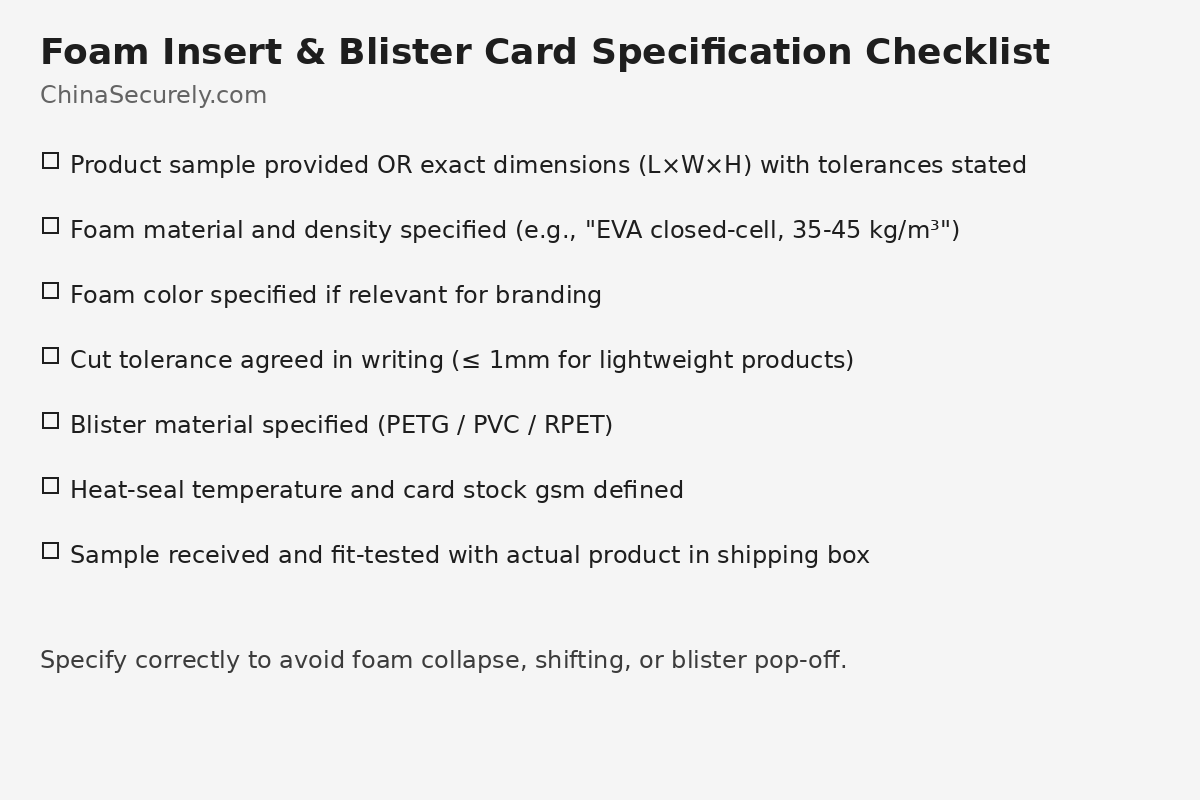
Checklist: Before Ordering Foam Inserts or Blister Cards
- □ Product sample provided or exact dimensions with tolerances stated
- □ Foam material and density specified (e.g., “EVA closed-cell, 35–45 kg/m³”)
- □ Foam color specified if brand-relevant
- □ Cut tolerance agreed in writing (≤1mm for lightweight products)
- □ Blister material specified (PETG/PVC/RPET)
- □ Heat-seal temperature and card stock gsm specified
- □ Sample received and fit-tested with actual product in actual box
Need help specifying foam inserts or blister packaging for a product from China? Send the product dimensions, weight, and the supplier’s quote. ChinaSecurely can help you define the specification before you place the order.