
Short answer: a cutting board that looks flat in the supplier’s sample photo can still warp after washing if the material, thickness, moisture content, glue line, or drying process is not controlled. This is especially common when small importers buy bamboo, wood, or composite boards mainly by appearance and price.
A common buyer question is: “My bamboo cutting board sample was flat, but customers say the bulk boards warped after a few washes. Is this a material problem, a factory problem, or normal?”
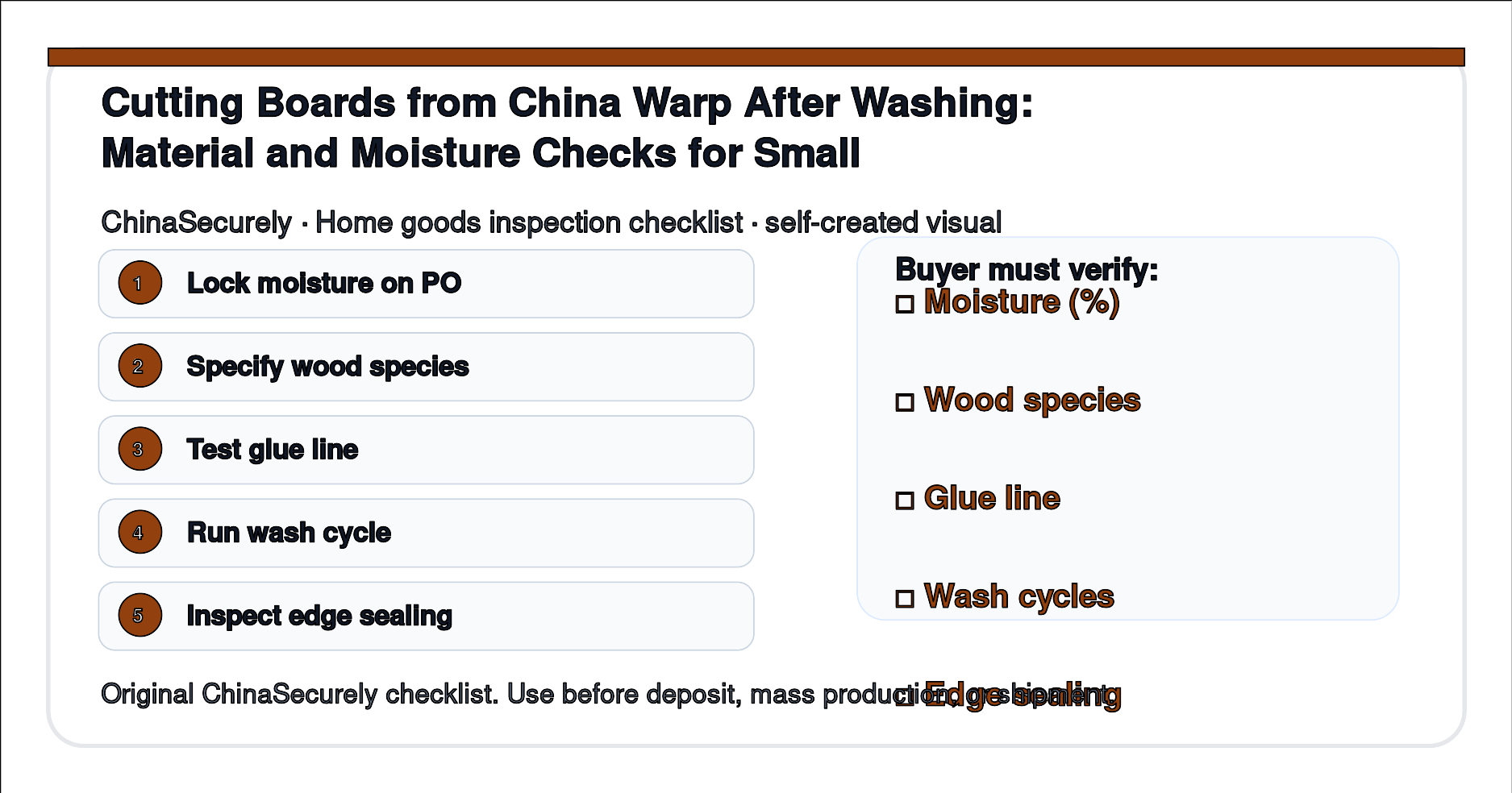
Treat it as a product specification and inspection problem. Before the next order, define the material, thickness, lamination structure, moisture control, finishing, packing, and a simple water exposure check.
Why this happens
Wood and bamboo respond to moisture. If one side absorbs water faster than the other side, the board can bend. If strips are laminated with uneven stress or weak glue, washing and drying can expose the problem.
Thin boards are more vulnerable because they have less structure to resist movement. Boards packed in humid cartons, wrapped too soon after finishing, or stored in changing conditions can also arrive with hidden stress.
For plastic cutting boards, warping may come from heat, thin material, or poor cooling after molding. The causes are different, but the buyer action is similar: define the material and test condition instead of relying on a flat sample photo.
China-side explanation
Many China home goods factories can make a board look good for photos. Sanding, oiling, logo engraving, and packaging are visible. Moisture balance, glue quality, strip selection, and drying time are less visible.
A supplier may pass a quick factory check because the board is flat at the moment of packing. That does not prove it will stay flat after dishwashing, sink soaking, or a customer’s hot kitchen counter. Some factories also assume hand-wash use, while overseas customers may treat the board more roughly.
Small orders can face another issue: the supplier may use mixed material lots to keep cost low. That can create uneven behavior across the same shipment.
Step-by-step solution
- Define the board material clearly: bamboo, acacia, rubberwood, PP, PE, composite, or another material.
- Confirm dimensions and thickness tolerance. A very thin board may be cheap but more likely to bend.
- Ask for construction details: single-piece, laminated strips, end grain, edge grain, or molded plastic.
- Request moisture or drying process information for wood and bamboo. You do not need a perfect lab report for every small order, but the supplier should understand the issue.
- Add a simple pre-shipment check: measure flatness, wipe or rinse a sample, dry it upright and flat, then inspect again after 24 to 48 hours.
- Check packaging. Boards should not be packed wet, compressed unevenly, or sealed in a way that traps moisture.
- Put care instructions on the insert or packaging if the product is hand-wash only.
What to ask the supplier
You can send this message:
“For this cutting board order, please confirm the material, thickness tolerance, construction method, finishing oil or coating, and whether the boards are intended for hand wash only. Before shipment, please randomly select several bulk boards, check flatness, do a light wash or wipe test, dry them for 24 to 48 hours, and send photos showing whether the edges remain flat on a table. Please also confirm boards are fully dry before individual packing.”
This is not an aggressive message. It simply tells the supplier what failure you are trying to avoid.
Warping risk table
| Risk point | What it can cause | Buyer check |
|---|---|---|
| Thin board | Bends more easily after moisture or heat | Confirm thickness and tolerance |
| Mixed strips | Uneven expansion and visual mismatch | Ask for construction and material lot control |
| Weak glue line | Separation or bending after washing | Ask for wash exposure check |
| Trapped moisture | Warping inside packaging | Confirm dry-before-pack process |
| Wrong customer use | Dishwasher or soaking damage | Add clear care instruction |
Practical checklist before shipment
□ Material and construction are written in the order.
□ Thickness tolerance is confirmed.
□ Supplier confirms intended use: hand wash, not dishwasher, if applicable.
□ Random bulk samples are placed on a flat table for photos.
□ A wipe or light wash check is done before final payment.
□ Boards are inspected again after 24 to 48 hours of drying.
□ Packaging does not trap moisture.
□ Care instruction insert is included for customers.
Cost and trade-off notes
A thicker board, better material sorting, better glue, and longer drying time can increase cost. For a cheap promotional board, you may accept a wider flatness tolerance as long as the product is honestly described.
For kitchen brands, gift sets, and marketplace sellers, warped boards are visible and frustrating. The return risk is often more expensive than a slightly better specification.
Source status
The buyer question is based on repeated home-goods sourcing and customer complaint patterns, used as an anonymized demand signal. Public packing references from FedEx and ISTA support the shipment and carton-handling side. Material behavior should still be confirmed with the supplier or a qualified inspector for each board type.
Source URLs:
- https://www.fedex.com/en-us/shipping/packing.html
- https://www.ista.org/test_procedures.php
- https://www.ista.org/
Related questions
- How do I inspect wooden kitchen products before shipment from China?
- What should I ask before ordering bamboo home goods in bulk?
- Should care instructions be printed on home goods packaging?
Light CTA
If your board warps after washing, do not only ask for a discount on the next order. Improve the specification: material, thickness, construction, moisture, washing check, and packaging. That is the part a supplier can actually control.
Authoritative references (added 2026-07-27)
- https://www.astm.org/d1037-12.html
- https://www.astm.org/d4442-20.html
- https://www.fda.gov/regulatory-information/search-fda-guidance-documents/guidance-industry-food-contact-substances
- https://www.usda.gov/inspection-and-grading
- https://www.qima.com/quality-control-inspections/pre-shipment-inspection
Prior source set was thin on wood moisture standards and food-contact policy. Expanded with ASTM D1037 (wood-based panel strength), ASTM D4442 (moisture content), FDA food-contact guidance, USDA inspection overview, and QIMA inspection.