Short answer: 1688 and Alibaba run on the same group technology, but the verification chain, payment rules, and MOQ pressure are not the same. A small importer who moves from Alibaba to 1688 to save 15 to 30 percent on unit cost also takes on the verification work the platform does for them. The savings are real; the risk is real. Here is the verification flow that closes the gap without going back to Alibaba pricing.
Why Alibaba and 1688 feel different to a small importer
Three differences matter. The first is platform escrow: Alibaba’s Trade Assurance holds the payment in escrow until the buyer confirms the goods, while 1688’s Alipay-domestic escrow is designed for RMB-denominated disputes and has a weaker international-buyer path. The second is third-party verification: Alibaba uses SGS, Bureau Veritas, and TUV for supplier verification, while 1688 relies primarily on platform self-attestation. The third is language and documentation: Alibaba is EN/FR/ES with English-language contracts, while 1688 is all-Chinese with Chinese-language contracts. A US importer who reads no Chinese must add a translator or a China-side agent to the workflow.
The China-side explanation is straightforward. Alibaba’s international arm was built around the small imported-buyer segment, with service fees that cover platform escrow, multilingual support, and dispute resolution. 1688’s China-domestic arm was built around the RMB-domestic buyer segment, with no service fee for the platform escrow but also no international buyer protection. The 15 to 30 percent price difference on a given SKU reflects the supplier’s avoidance of the international service fees, not a difference in the underlying product. Most China suppliers list on both platforms; the same factory, the same line, the same components, different service fee structure.
What changes for the buyer
- Trade Assurance escrow: held by Alibaba in USD until the buyer confirms shipment and quality.
- Alipay-domestic escrow: held by Alipay in RMB; international dispute path is weaker.
- Supplier verification: Alibaba uses third-party SGS/Bureau Veritas; 1688 relies on platform self-attestation.
- Language and documentation: Alibaba is multilingual; 1688 is Chinese-only.
- MOQ pressure: Alibaba often accommodates small first orders; 1688 typically requires a larger first order.
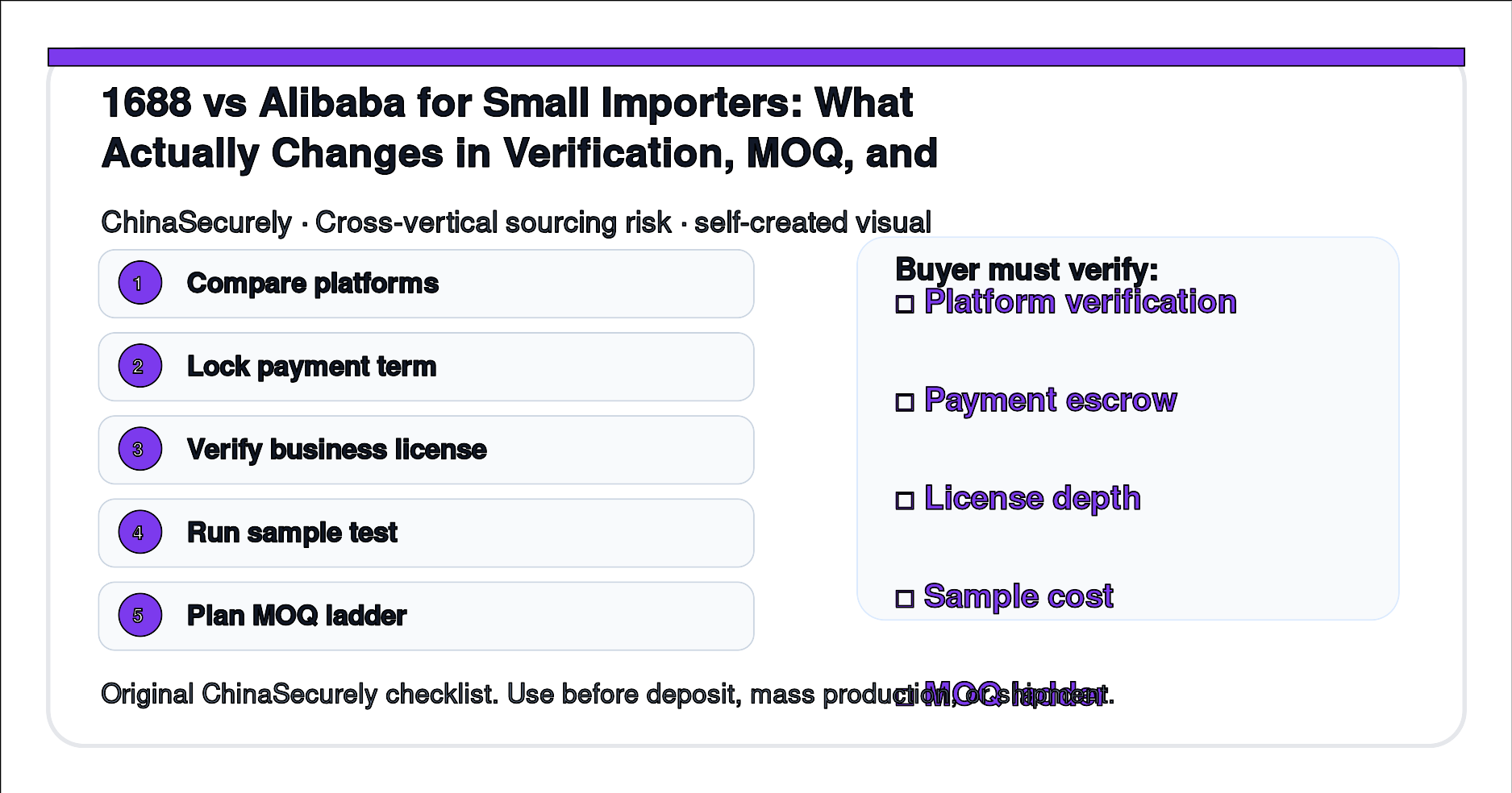
Buyer must verify before deposit on 1688
- Verify the supplier’s business license on the State Administration for Market Regulation (SAMR) public lookup.
- Order a 2 to 5-piece paid sample before any bulk discussion; 1688 sample costs are usually higher than Alibaba.
- Lock a payment term that holds the last 30 percent until the buyer inspects the bulk at the factory.
- Verify the supplier’s export history by asking for a 3-year customs declaration record.
- Use a China-side agent or a bilingual buyer to translate the contract and the PO before signing.
China-side explanation
1688 is built for the China-domestic buyer, who often places the first order on the platform and then moves to a direct WeChat or bank-transfer relationship after one or two successful orders. The platform fee structure does not penalize the move, and the supplier is happy to keep the buyer’s repeat business off the platform. A small international importer who wants to use 1688 for the same flexibility must accept the verification work the China-domestic buyer does informally: site visits, factory inspections, and personal relationships. None of this is impossible, but it is not free. The realistic cost of a 1688-based sourcing workflow is a 2 to 5 percent China-side agent fee plus a 1 to 3 percent translator or documentation fee, which closes half the price gap with Alibaba.
Step-by-step solution
- Compare the Alibaba price and the 1688 price on the same supplier for the same SKU.
- Calculate the all-in landed cost: unit price + Alibaba service fee + 1688 platform fee + sample cost + agent fee.
- If the 1688 landed cost is 10 percent or more below the Alibaba landed cost, run the verification workflow.
- Verify the supplier’s business license on the SAMR public lookup and ask for a 3-year customs declaration record.
- Order a 2 to 5-piece paid sample and run a quality inspection before discussing bulk.
- Lock a 30/70 payment term with the 30 percent held until the buyer inspects the bulk.
Quick checklist
- 1688 price vs Alibaba price recorded on the same SKU.
- 1688 all-in landed cost: unit + platform fee + sample + agent.
- Supplier business license verified on SAMR public lookup.
- 3-year customs declaration record requested.
- 30/70 payment term with bulk inspection clause.
Sources
- 1688 — Buyer protection overview (en)
- 1688 — Platform rules and 1rules
- Alibaba Group — Corporate governance overview
- Alibaba Trade Assurance — Program rules
- Alibaba Group — Compliance and governance
- QIMA — Pre-shipment inspection for small importers
This article is for sourcing workflow and pricing comparison, not for legal or tax compliance. Confirm destination-market import rules with a qualified trade compliance specialist before bulk.