Buyer Question: How do I verify that a Chinese supplier’s ‘food-grade stainless steel’ claim is real? What documents should I ask for?
Sources: Reddit r/ecommerce, Quora, 1688 supplier pages, GB 4806.9-2016 standard public pages
The Buyer Question
“I found a Chinese supplier selling stainless steel mixing bowls marked as ‘food-grade 304 stainless steel’. The price is 40% below other suppliers. How do I verify this claim is real before I place an order for 500 units?”
Buyers importing kitchen products from China commonly face this dilemma. Any supplier can print “304 stainless steel” or “food-grade” on a product page or label. But what does that actually guarantee?
Short Answer
Request three types of documentation: material test reports (MTRs) from the mill, third-party SGS or CTI test reports, and a signed declaration with the supplier’s business license. Then cross-check the mill name against known Chinese stainless steel producers. Do not rely on the supplier’s word alone, a product page screenshot, or a sample visual inspection.
Why This Problem Exists
The gap between claimed and actual material quality has three root causes in the China supply chain:
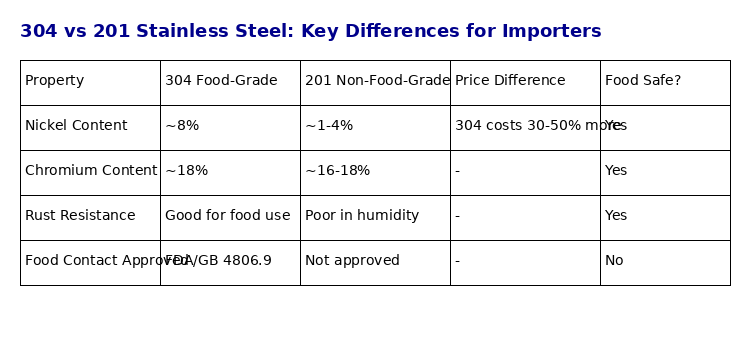
1. Mill grade vs. product grade confusion. Chinese stainless steel mills produce multiple grades. 304 stainless steel has a specific composition (18% chromium, 8% nickel). A cheaper variant called “201 stainless steel” looks similar but contains manganese and less nickel. It is more prone to rust and is not food-safe by US or EU standards. Suppliers sometimes use “304” to describe products that only contain some 304 components.
2. No automatic third-party verification. In China, a supplier can self-declare a product as “food-grade” without any mandatory testing. The 1688 product page, Alibaba listing, and even the product label can all say “304” without a supporting document.
3. Sample vs. bulk production difference. A sample bowl might be made from genuine 304. Mass production might switch to a cheaper material to improve margins, especially on reorders.
4. Testing cost asymmetry. A full material composition test costs $100–$300 USD. Many small importers skip this because it seems expensive relative to a small first order. This is exactly what some suppliers count on.
China Supply Chain Perspective
From the factory floor, here is what actually happens:
- Most Chinese stainless steel kitchenware is produced in Guangdong (Chaozhou, Jieyang) and Zhejiang (Zhengjiang) provinces.
- The mill issues a Material Test Report (MTR) showing chemical composition. This is the most reliable single document.
- A reputable supplier will have SGS or Bureau Veritas (BV) test reports for the specific product model, not just a generic mill certificate.
- The GB 4806.9-2016 standard is China’s food-contact stainless steel requirement. For the US market, buyers should also reference FDA 21 CFR 175.300. For EU, EC 1935/2004.
- The price gap is a real signal: if a 304 stainless steel mixing bowl is 40% cheaper than the market rate, the material claim is the most likely place the supplier is cutting corners.
Step-by-Step Verification Process
Step 1: Request the Mill’s Material Test Report (MTR)
Ask the supplier for the mill certificate or MTR that shows:
- Heat number / batch number
- Chemical composition (Cr, Ni, C, Mn content)
- The mill’s name and location
Cross-check the mill against known producers: Tsingshan, Jisco, Baosteel, TISCO, Huifeng are major stainless steel producers with verifiable public records.
Step 2: Request a Third-Party Test Report
Ask for an SGS, CTI, or Bureau Veritas report for the actual product (not just the raw material). The report should include:
- Product model tested
- Test date (must be within 12 months)
- Whether it meets GB 4806.9-2016 or the equivalent standard for your target market
If the supplier says “we don’t have this, but trust us,” that is your answer.
Step 3: Verify the Business License
Ask for the supplier’s Chinese business license (营业执照). Cross-check the registered capital and address. Suppliers in industrial zones in Guangdong or Zhejiang are more likely to have real manufacturing. A trading company in a city like Yiwu may be a middleman with less control over production.
Step 4: Order a Material Test on the Sample
Before mass production, order a material composition test on your approved sample. Two options:
- XRF scanning (X-ray fluorescence): $30–$80, fast, available at many testing labs. Identifies surface composition.
- Laboratory chemical analysis: $100–$200, more accurate, identifies bulk material composition.
Send the same sample to two different labs to confirm consistency.
Step 5: Add a Material Requirement to Your Purchase Contract
Include language such as:
“All food-contact surfaces must be 304 stainless steel (18/8 composition) per GB 4806.9-2016. Supplier must provide mill certificate and third-party test report before production. If material testing reveals non-compliant material, supplier bears all rework and shipping costs.”
Costs, Risks, and Trade-offs
| Action | Cost | Risk if Skipped |
|---|---|---|
| Request MTR | Free | Order wrong material |
| Third-party test report | $100–$300 | Legal liability if product fails food safety |
| XRF sample test | $30–$80 per sample | Sell unsafe product |
| Material clause in contract | Free | No legal recourse if problem occurs |
| Pre-shipment inspection | $100–$200 | 40% of goods wrong material |
The real cost of skipping verification is not just a bad product — it is an Amazon listing suspension or a customs hold. Food-contact products without proper documentation are routinely detained at US ports.
Practical Checklist for Importers
- □ Supplier provided mill name and location
- □ Mill name verified against known stainless steel producers
- □ Material Test Report (MTR) shows 18/8 composition
- □ Third-party test report (SGS/BV/CTI) provided for the actual product
- □ Test report date is within 12 months
- □ Supplier’s business license verified
- □ Sample tested by XRF or lab analysis
- □ Material requirement written into purchase contract
- □ Pre-shipment inspection includes material spot-check
- □ FDA/US or EU food-contact compliance reference included in contract
Related Questions
Can I rely on the supplier’s Alibaba Trade Assurance as proof?
No. Trade Assurance protects the order process (payment, shipping) but does not verify material claims. It will not help you if the product you receive contains the wrong stainless steel grade.
The supplier sent me a test report from their own lab. Is that valid?
No. A self-funded lab report has a conflict of interest. Require a report from an independent third party (SGS, CTI, Bureau Veritas, Intertek).
What if the product looks fine visually but fails the test?
This is common. 201 stainless steel can look identical to 304 in photos and even in hand. XRF or lab testing is the only reliable verification.
Need Help Checking a China Sourcing Route or Supplier?
Send the product, target country, order size, and current quote. ChinaSecurely can help you understand the risks before you pay.
Article Metadata
Featured Image: Comparison table — “304 vs 201 Stainless Steel: What Importers Need to Know”
Tags: stainless steel, food-grade, verification, kitchen products, supplier documents
Author: Nora Lin, Home Goods Desk
Sources: Reddit r/ecommerce, Quora, 1688 supplier pages, GB 4806.9-2016 standard public pages