
A small percentage of dead-on-arrival (DOA) units is normal in consumer electronics sourcing — but 5% is on the high end of acceptable, and anything above that points to a problem with the factory’s quality control, packaging, or the shipping conditions. The buyer usually bears the cost unless you have a written agreement that says otherwise. Here is what normal looks like, how to reduce your rate, and what to put in writing before you pay.
Why This Problem Happens
The nature of electronics manufacturing
Every production run includes a statistical spread. Even well-run factories have some percentage of units that leave the production line with latent defects — a cold solder joint that passes visual inspection but fails under thermal stress, a capacitor that was already degrading at the time of packing, or a USB port that does not meet the specified insertion cycle count. This is not fraud; it is physics and statistics.
Sample runs vs. mass production
When a factory produces your sample, they are building units one at a time with extra attention. Mass production runs happen fast, on automated lines, with units packed into bulk bins before being placed in retail boxes. The attention to detail is different. A factory that produced a perfect sample can still deliver a batch with an elevated DOA rate if their mass production quality control is not matched to the sample quality.
Shipping stress
International shipping is hard on electronics. Vibration during transit can loosen connections. Humidity in sea freight containers can cause corrosion on metal contacts. Temperature swings — especially for units shipped by air through climates very different from southern China — can cause components to expand and contract past their tolerance. Chargers that were functional when they left the factory can arrive non-functional after a rough journey.
What It Looks Like from the China Side
Most Chinese factories that produce for export have a known DOA rate they consider acceptable — typically somewhere between 1% and 3% for well-managed facilities. When you place an order, the factory’s sales team is often aware that some units will arrive dead. They have usually factored a small allowance into their pricing. The factory’s preference is to ignore individual DOA claims, because handling single-unit replacements is disproportionately expensive for them.
Good factories run a burn-in test before shipping — powering the units on for a period to catch early failures. They also use anti-static bags, desiccant packs, and box-in-box packaging for fragile items. The difference between a 1% and a 5% DOA rate is often the difference between a factory that does these things and one that skips them to save cost.
The factory’s commercial incentive is to deliver a container, not to ensure every individual unit works in your warehouse in another country. Their quality control is oriented around the average, not the tail. If 95 out of 100 units work, the production run looks successful from their side of the transaction. The cost of the 5 dead units is your problem, not theirs — unless you have a contract that says otherwise.
Step-by-Step Solution
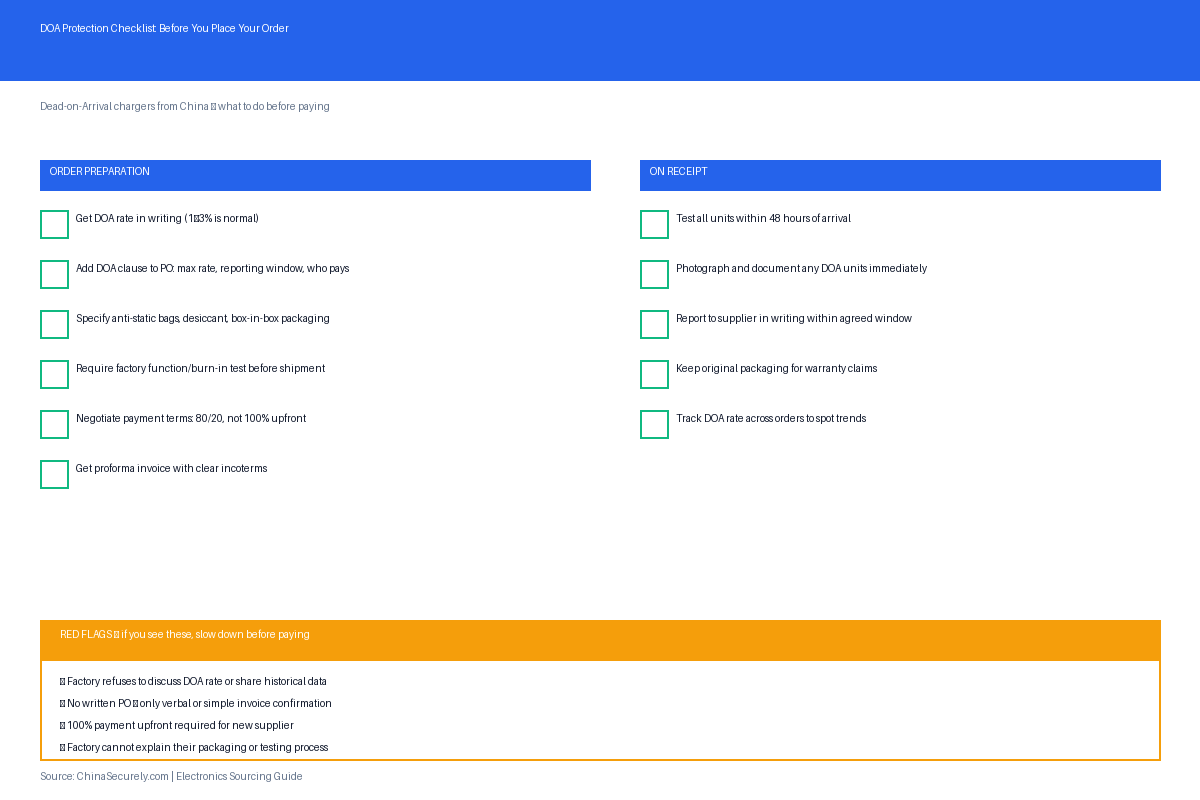
Step 1: Establish a written DOA clause before placing the order. Never rely on a verbal agreement about defect rates. Your purchase order or sales contract should specify: maximum acceptable DOA rate (1–2% is standard for well-run factories), what qualifies as DOA, who pays for replacement shipping, the time window for reporting DOA units (typically 7–14 days after receipt), and whether the factory replaces units, provides credit, or refunds.
Step 2: Document everything at receipt. When your shipment arrives, open every box and test every unit if possible, or use a third-party inspection service. Photograph any dead units with visible damage. Keep original packaging — factories often require it for warranty claims. Report in writing within the agreed window.
Step 3: Request a DOA rate benchmark upfront. Ask the factory what their historical DOA rate is for your specific product. A confident answer with a specific percentage is a good signal. A vague answer or refusal to discuss it is a red flag.
Step 4: Include a burn-in or function test requirement. Specify that all units must pass a power-on and basic function test before shipping. Third-party inspection companies in China can perform this on your behalf for a reasonable fee.
Step 5: Negotiate payment terms to protect yourself. Paying 80% upfront and 20% after confirming receipt is a common structure for new supplier relationships. Do not pay 100% before shipment unless you have a long and trusted relationship with this supplier.
Step 6: Choose the right shipping method. Air freight is less damaging than sea freight for electronics because the journey is shorter and containers are pressurized. If sea freight is the only economical option, insist on controlled humidity containers and adequate packaging standards in your order.
DOA Protection Checklist
Costs, Risks, and Tradeoffs
For Amazon sellers, DOA units affect your Order Defect Rate (ODR) and can threaten your selling account. A third-party inspection in China for a shipment of 1,000–5,000 units typically costs $200–$500. For a shipment of 2,000 chargers at $3/unit, a 5% DOA rate means 100 dead units — a loss of $300 before you even account for replacement shipping. The math usually favors inspection for orders above a certain threshold.
Related Questions
Is a 2% DOA rate normal for electronics imports from China?
Yes, most experienced importers consider 1–3% DOA normal for well-run factories producing standard consumer electronics. Anything above 3–5% suggests a quality control issue at the factory or during shipping.
Who pays for DOA units — the buyer or the factory?
Without a written agreement, the buyer bears the cost. Always negotiate a DOA clause before placing the order, specifying the maximum acceptable rate and how replacements are handled.
Can I get a refund for dead-on-arrival chargers?
Most factories will offer replacement units for future orders rather than an immediate cash refund. For significant orders, a partial refund proportional to the DOA rate is sometimes negotiable.
Does air shipping cause fewer DOA units than sea shipping?
Generally yes — shorter transit time and less vibration stress mean air-freighted electronics typically arrive with fewer shipping-related failures. The cost premium is often worth it for higher-value items.
What is a function test and should I require one?
A function test powers on each unit and verifies basic operation — for a charger, that means it delivers voltage to a test device without overheating or shutting off. Requesting a function test at the factory before shipment is one of the most effective ways to catch DOA units before they reach you.
Need help reviewing a charger order or drafting a DOA clause? Send the product spec, order quantity, unit price, and current supplier quote. ChinaSecurely can help you identify the quality control points before you pay.