
Why Acrylic Organizers From China Have Wrong Dimensions (And How to Fix It)
Short Answer
Acrylic organizers from China often end up with dimensions that don’t match your drawing or sample because most small acrylic factories cut sheets manually rather than with CNC machines, and they don’t always check tolerance after cutting. The good news is that specifying a clear tolerance and requiring a dimensional check before shipping solves most of these problems. Most of the dimension mistakes you see after you receive the order start with unclear tolerances in your original specification.
Why This Problem Happens
Manual cutting vs CNC cutting
Most small acrylic factories in China charge two different prices: one for manual cutting and one for CNC cutting. If you don’t specify that you need CNC cutting for tight tolerance dimensions, they will use manual cutting to save 10-15% of the manufacturing cost. Manual cutting is accurate enough for large display cases, but not for drawer organizers where pieces have to fit together perfectly.
Different thermal expansion
Acrylic expands and contracts more with temperature changes than wood or metal. If your factory cuts the acrylic in a cold workshop in winter, the dimensions will shrink a little when it gets to a warmer climate. In summer, cutting in a hot workshop means the pieces will be smaller when they cool down. Good factories store the acrylic sheet at room temperature for 24 hours before cutting to stabilize it. Cheap factories cut it right out of the cold storage truck.
Tolerance is not clearly specified
Many importers just give the dimensions without specifying the allowed tolerance. For example, they write “200mm wide” but they don’t say “±1mm” or “±2mm”. The factory assumes that any dimension that looks close is acceptable. If you need tight tolerance because the pieces have to fit into a drawer or fit together, you have to write that tolerance clearly on your drawing.
What It Looks Like from the China Side
How factories price acrylic work
When a factory gives you a quote, they price based on the tolerance they think you need. If you don’t mention tolerance, they assume the loosest possible tolerance to give you the lowest price. If you need tighter tolerance later, they have to charge more, but they won’t tell you that until after you’ve placed the order.
Checking tolerance takes extra time
Even if they cut with CNC, good quality factories have to check every dimension after cutting and sort out the pieces that are outside tolerance. This adds 5-10% to the labor cost. If you don’t say you need every piece checked, they will ship everything — including the pieces that are outside tolerance — because it’s faster and cheaper for them.
What to watch for with assembled acrylic organizers
When your organizer has multiple pieces that fit together (like drawers, doors, or removable dividers), the tolerances add up. If each piece is off by 1mm, the final assembled size can be off by 3-4mm. That’s enough to make the whole organizer not fit where you need it. Your drawing needs to specify both individual piece tolerance and final assembled tolerance.
Step-by-Step Solution
Step 1: Specify cutting method on your drawing
Clearly mark on your technical drawing what you need:
- “CNC cutting required” for all pieces that need tight tolerance
- “Manual cutting OK” only for large, non-critical pieces
- Note that all outside dimensions must match the drawing
Step 2: Write the maximum tolerance for each critical dimension
Don’t just give dimensions — specify tolerance:
- For pieces that need to fit together: ±1mm maximum tolerance
- For overall outer dimensions that need to fit in a drawer: ±1.5mm maximum tolerance
- For non-critical pieces where exact size doesn’t affect fit: ±2-3mm is OK
Put a tolerance note on your drawing that says “All dimensions unless otherwise noted: ±Xmm”.
Step 3: Require acclimatization before cutting
Ask the factory to:
- Store acrylic sheets at room temperature for 24 hours before cutting
- This lets the sheet stabilize to the current temperature and prevents dimension changes after cutting
This doesn’t add cost, but many factories skip it unless you ask.
Step 4: Confirm how many dimensions get checked
Require the factory to check every critical dimension on every finished piece. Rejecting out-of-tolerance pieces at the factory means you don’t have to deal with them after you receive the order. This adds a small labor cost but avoids bigger problems later.
Step 5: Get a sample and check dimensions before full production
After you approve the sample, measure every critical dimension yourself. If the sample is already out of tolerance, you can adjust the specification before you start full production. Fixing the problem before production is much cheaper than fixing it after the entire order is done.
Step 6: Add dimensional check to pre-shipment inspection
If you use a third-party inspector, add “verify critical dimensions against drawing tolerance” to your checklist. The inspector can randomly pull 5-10 finished organizers from the batch and check that the dimensions are within tolerance.
Costs, Risks, and Tradeoffs
Cost of CNC cutting vs manual cutting
CNC cutting costs about 10-20% more than manual cutting for most small acrylic organizers. For a $10-$20 retail product, this adds $1-$2 to your factory cost. If your product needs to fit perfectly, the extra cost is worth it — you avoid returns from customers who can’t fit the organizer in their drawer.
Risk of cumulative tolerance error
When multiple pieces fit together, each small tolerance error adds up. If you have 5 pieces that each can be off 1mm, you can end up with a total error of 5mm — that’s enough to make the whole thing not fit. If you have an assembled organizer, specify tighter tolerances on individual pieces.
Tradeoff: thicker vs thinner acrylic
Thicker acrylic (5mm+) is more dimensionally stable than thin acrylic (3mm or less). Thicker material is less likely to warp after cutting, which keeps dimensions more accurate. Thicker material costs more, but it makes the finished organizer feel more solid and holds dimensions better.
Practical Pre-Production Checklist
□ Drawings clearly show all critical dimensions
□ Tolerance is specified for every critical dimension (±1mm for fit)
□ Cutting method is specified (CNC for tight tolerance, manual for loose)
□ Factory confirms they will acclimatize sheets before cutting
□ Factory confirms they will check every critical dimension
□ One sample is produced and all critical dimensions are measured
□ Tolerance is adjusted if sample dimensions are outside range
□ Dimensional check is added to pre-shipment inspection scope
Related Questions
Can I fix out-of-tolerance acrylic organizers after I receive them?
You can sometimes sand or file small dimension errors if they are only 1-2mm too big, but this takes a lot of labor time and it’s hard to get a clean, professional finish. It’s almost always cheaper and better to fix the specification at the factory before production.
Does laser cutting give better tolerance than CNC cutting?
Laser cutting gives good tolerance for thin acrylic (up to 5mm), but it can leave a slight discoloration on the cut edge that needs polishing. For thicker acrylic, CNC routing usually gives a cleaner edge and better dimensional accuracy for assembly.
Why do the inner compartments sometimes not line up with the product photos on the listing?
If the factory changes the dimensions to save material without telling you, the compartment sizes end up wrong. This is why getting a sample before full production is so important — check that every compartment size matches what you ordered.
Need help writing clear tolerance specifications for acrylic organizers or other custom plastic products from China? Send your drawing and how the product will be used, and ChinaSecurely can help you write the tolerance notes and cutting requirements your factory needs to get it right.
Why Acrylic Organizers From China Have Wrong Dimensions (And How To Prevent It)
Are your acrylic storage organizers from China arriving with the wrong dimensions? Learn why it happens and what specifications you need to get the sizes you ordered.
Suggested internal links:
- /home-goods/acrylic-storage-tolerance-china/
- /home-goods/custom-storage-organizer-sourcing/
- /packaging/what-tolerance-should-i-specify-china/
Sources:
- Buyer question pattern: Google “acrylic organizer from China wrong dimensions”
- Chinese acrylic product manufacturing experience
- Plastic manufacturing dimensional tolerance guidelines
- Note: general guidance; tolerance depends on product size and assembly requirements
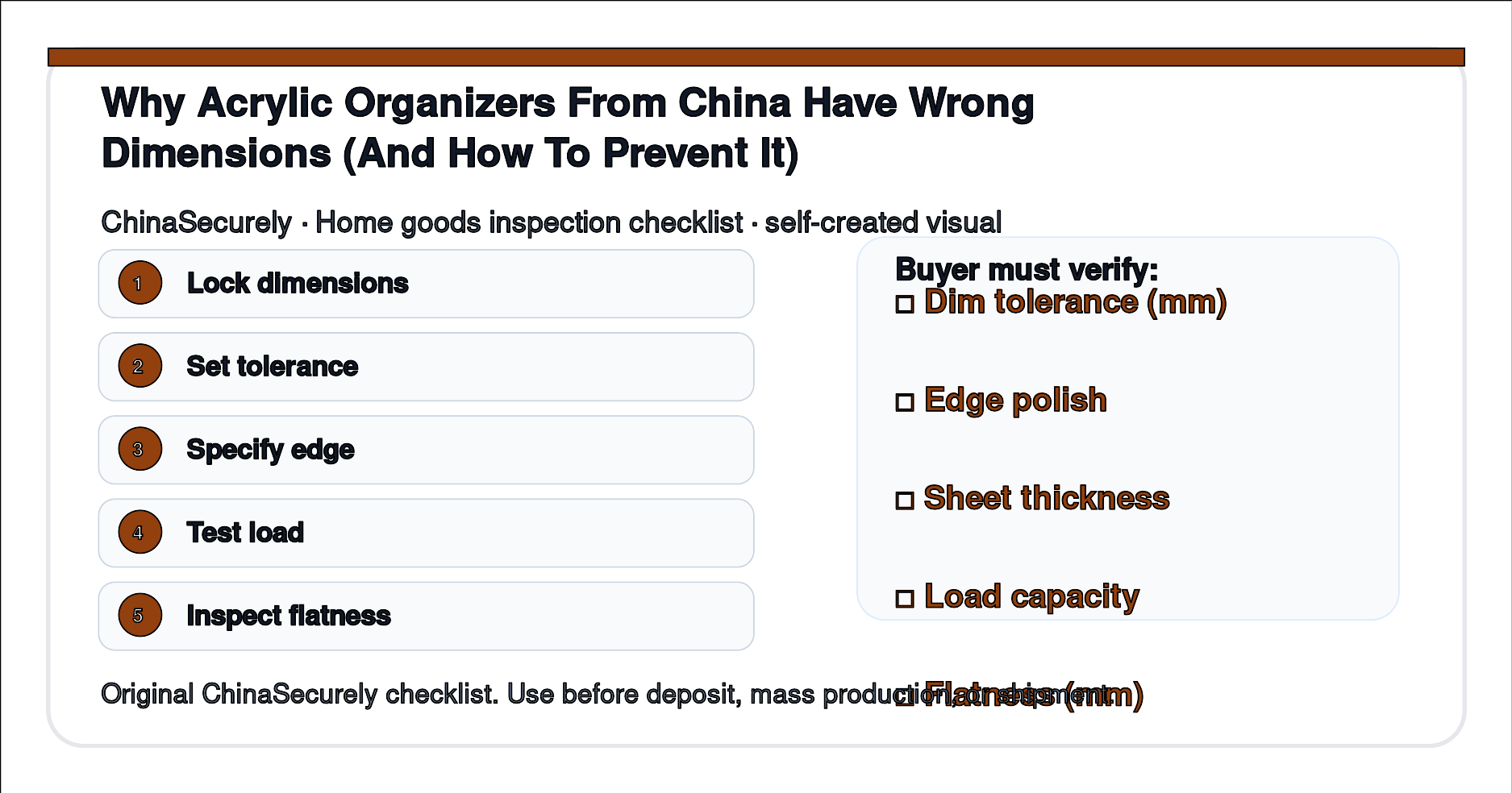
Visual needed: Tolerance specification checklist for custom acrylic organizers
Authoritative references (added 2026-07-24)
- https://www.astm.org/d4802-15.html
- https://www.astm.org/d638-14.html
- https://www.iso.org/standard/51021.html
- https://www.plasticsindustry.org/
- https://www.qima.com/quality-control-inspections/pre-shipment-inspection
Prior source set was missing authoritative acrylic and dimension tolerance references. Expanded with ASTM D4802 (poly(methyl methacrylate) acrylic sheet specifications), ASTM D638 (tensile properties of plastics), ISO 7823 (acrylic sheets — types, dimensions, and characteristics), Plastics Industry Association material resources, and QIMA inspection reference.