
Short Answer
When you source home goods from China, it’s very common to receive products that don’t match the material and size specifications you agreed on. A sofa that’s supposed to be 100% cotton feels more like polyester, or a kitchen cabinet that’s 1cm too big to fit through your customer’s door. The good news is that you can catch almost all these issues before shipping with a simple pre-shipment inspection.
Why This Happens
Material and size variations happen for a few common reasons in Chinese home goods factories:
-
Material substitution: If the original material you ordered is out of stock, some factories will substitute a cheaper material without telling you to keep production on schedule.
-
Cumulative tolerances: When multiple parts are assembled (like a table or cabinet), small 1mm tolerances add up. At the end, the whole product can be several millimeters or even centimeters off.
-
Cost cutting: If material prices went up after you placed the order, some factories might use less material or a thinner grade to maintain their margin.
China-Side Explanation
In Chinese home goods manufacturing, most factories are used to domestic buyers who accept small variations in material and size. Domestic trade in China is more flexible — if there’s a small issue, the buyer usually accepts a small discount and moves forward. Factories don’t always understand that international importers can’t accept those same variations because we have to sell the products to end customers who expect exact specifications.
Another reason is that many small factories don’t have dedicated quality control staff. The worker who assembles the furniture also checks the quality. They’re paid by how many units they produce, so they’re more focused on speed than on exact measurements.
Step-by-Step Solution
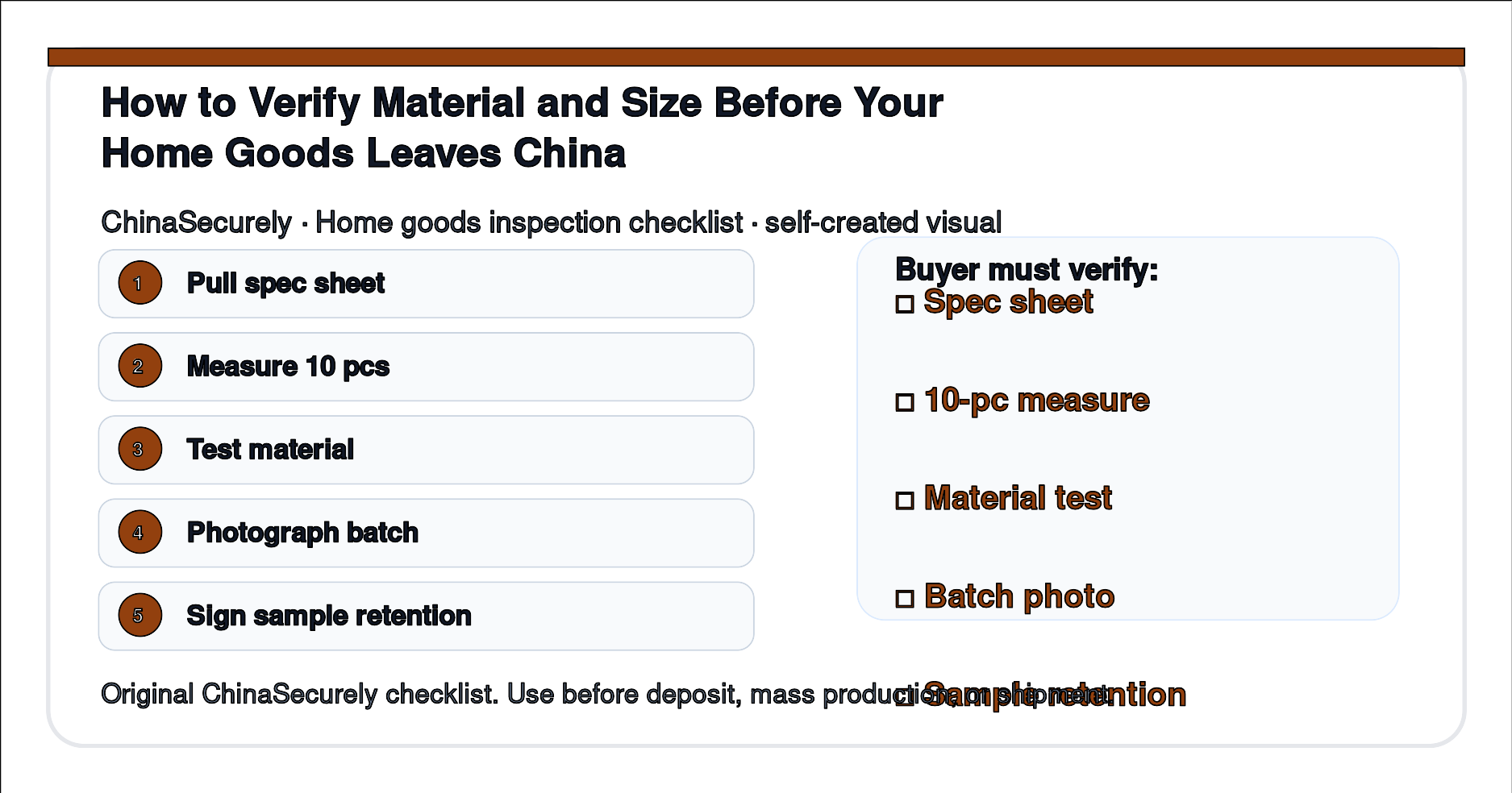
Step 1: Write down all your specifications clearly
Don’t just say “wood table” — specify:
- Exact external dimensions (length × width × height) with tolerances (e.g. ±5mm)
- Material type and grade (e.g. “solid oak, not veneer, not pine”)
- Thickness of all major components
- Any fabric composition percentages
Step 2: Approve a sample first
Always ask for a full production sample before mass production starts. Measure the sample yourself and check the material. If the sample is wrong, fix the specification before production starts.
Step 3: Schedule a pre-shipment inspection
When production is 80-100% complete, hire an independent third-party inspection company to check:
- Randomly select 10% of units for measurement
- Check material composition against your specification
- Verify all dimensions against your drawing
Step 4: Re-inspect if issues are found
If the inspection finds material or size issues, ask the factory to correct the problem and schedule a second inspection before shipping. Don’t accept “it’s close enough” — insist on corrections.
What To Ask Your Supplier (Copy-Paste Ready)
Please confirm:
- You will use exactly the materials I have specified in our contract, no substitutions without my written approval
- You will check all dimensions during production to ensure they are within the tolerance limits we agreed
- You will allow access for an independent third-party inspection before shipping
- If any products don't meet our specifications, will you correct them before shipping at your cost?
Pre-Shipment Material and Size Verification Checklist
| Check Item | Tolerance | Checked | Notes |
|---|---|---|---|
| Overall length | ±5mm | ☐ | |
| Overall width | ±5mm | ☐ | |
| Overall height | ±5mm | ☐ | |
| All critical component dimensions | ±2mm | ☐ | |
| Main material matches specification | 100% match | ☐ | |
| Finish/color matches sample | Visually acceptable | ☐ | |
| No missing parts or components | Complete | ☐ |
Cost and Trade-Off Notes
- A standard pre-shipment inspection for a 20-foot container costs $200-$300 — worth it to avoid containers of wrong-sized furniture
- If you place repeated orders with the same factory, you can do inspections less often (every 2-3 orders)
- Material substitution is harder to spot than size issues — ask your inspector to check material documentation if you’re unsure
- 1-2mm tolerance is realistic; demanding 0mm tolerance will increase your cost significantly
Related Questions
- How do I handle packaging damage for home goods from China?
- What should I check during a pre-shipment inspection?
- How do I find a reliable inspection company in China?
Conclusion
The key to avoiding material and size problems is documentation and inspection. If you write all your specifications down clearly, approve a sample, and do an independent inspection before shipping, you’ll catch 95% of all common issues before they leave China.
SEO Information:
Source URLs:
- https://www.reddit.com/r/FulfillmentByAmazon/comments/12n2x4f/furniture_from_china_wrong_size_issues/
- https://www.quora.com/How-can-I-check-product-quality-before-shipping-from-China
- https://inspection-canada.com/how-to-inspect-furniture-from-china-checklist/
Authoritative references (added 2026-07-27)
- https://www.astm.org/d5034-21.html
- https://www.astm.org/d3776-20.html
- https://www.astm.org/d7269-08.html
- https://www.iso.org/standard/34195.html
- https://www.qima.com/quality-control-inspections/pre-shipment-inspection
Prior source set was thin on textile and dimension tolerance standards. Expanded with ASTM D5034 (grab tensile), ASTM D3776 (mass per unit area), ASTM D7269 (laptop luggage tests), and ISO 34195 (textiles tolerances).