
Short Answer
Cutting boards from China warp after washing mostly because of two material problems: the wood isn’t properly dried before manufacturing, or the cutting board uses glued joined wood with different moisture content in each piece. Even high-quality wood will warp if it isn’t kiln dried to the correct moisture content for your climate. Choosing the right material specification and asking the right pre-shipment checks prevents most warping problems.
Why This Problem Happens
Moisture content is everything
Wood naturally expands when it absorbs moisture and shrinks when it dries out. If a cutting board is manufactured in China (a relatively humid climate) with 12-15% moisture content, and you sell it into a drier climate like Arizona or Northern Europe, the wood will dry out unevenly and warp. If the moisture content is too high for your climate, the board will shrink and warp as it dries.
Joined board construction increases risk
Many cutting boards from China are made by gluing several smaller pieces of wood together into one large board. If the different pieces have different starting moisture content, they expand and shrink at different rates after manufacturing. Over time, this internal stress causes the whole board to warp — sometimes within weeks of first use and washing.
Poor finishing increases water absorption
If the cutting board isn’t properly sealed with food-safe oil or finish on all six sides (including the edges and the end grain), water absorbs into the wood after washing unevenly. The top surface absorbs more water than the bottom, expands more, and the board bends. Cheap factories often only finish the top and bottom and skip the edges.
What It Looks Like from the China Side
How factories cut drying costs
Kiln drying wood to the correct moisture content takes time and energy, and it adds cost. Many smaller factories cut costs by air drying only, or by kiln drying to a higher moisture content than needed for export. They know the board will be fine when it leaves the factory in a humid climate, but they don’t consider what will happen after it ships to a drier climate. If you don’t specify moisture content, you get whatever moisture they normally use for the domestic Chinese market.
Joined boards save material cost but add warp risk
Using smaller joined pieces lets factories use up wood offcuts that would otherwise be thrown away, which keeps the cost lower. This is fine if all the pieces are dried to the same moisture content and properly glued. If they just glue whatever pieces they have, you get internal stress and warping later.
What your supplier probably won’t tell you
Most suppliers won’t tell you they didn’t dry the wood to your required moisture content unless you ask. They will say “it’s solid wood” and leave out the drying details. The warping problem usually doesn’t show up until after the customer washes the board for the first time, which is long after the shipment has left China.
Step-by-Step Solution
Step 1: Specify the maximum moisture content for your climate
Tell your supplier exactly what moisture content you need:
- For humid climates (annual average RH > 65%): 10-12% moisture content
- For moderate climates (average RH 45-65%): 8-10% moisture content
- For dry climates (average RH < 45%): 6-8% moisture content
Require a written statement from the factory that they kiln dried to this range before manufacturing.
Step 2: Ask about joined board construction
If the board is made from multiple joined pieces:
- Require all joined pieces to be dried to the same moisture content range
- Ask that the glue line is fully cured and the board is stabilized after gluing before final planing
- Avoid glued end-to-end joints for thick cutting boards if possible
Step 3: Require finishing on all six sides
Insist that the factory seals all surfaces of the cutting board: top, bottom, and all four edges. This prevents uneven water absorption after you receive the product. Ask them to show you photos of the finishing process if you don’t have an inspector on the ground.
Step 4: Request a sample and test it yourself
Before you place a full order, order one or two sample cutting boards. Wash them by hand several times and let them dry. If they don’t warp after two weeks of regular washing and drying, the specification is probably correct. If they warp, you can adjust the moisture content requirement before you commit to a large order.
Step 5: Add moisture content check to pre-shipment inspection
If you hire a third-party inspector, add “verify moisture content” to your inspection checklist. Good inspection companies can test moisture content on-site with a moisture meter, and they will confirm the factory is meeting your specification.
Costs, Risks, and Tradeoffs
Cost of proper kiln drying
Proper kiln drying to a specific moisture content adds 5-10% to the factory cost of a wooden cutting board. This is much cheaper than dealing with returned warped boards from your customers. A small increase in unit cost avoids much larger costs in returns and bad reviews.
Risk of buying undried boards
The risk is simple: a percentage of your boards will warp after your customers wash them, and you will have to issue refunds or replacements. For small importers, one bad batch of warped cutting boards can erase an entire season’s profit. Specifying moisture content upfront eliminates most of this risk.
Material choice tradeoffs
- Solid one-piece wood: lower warp risk than joined if correctly dried, higher material cost
- Joined wood: lower cost, higher warp risk if pieces aren’t uniformly dried
- Bamboo: very stable if properly processed, lower warp risk than most solid woods
- Plastic: no warping at all, but customers often prefer natural wood for cutting boards
Choose your material based on your price point and your customer expectations.
Practical Pre-Order Checklist
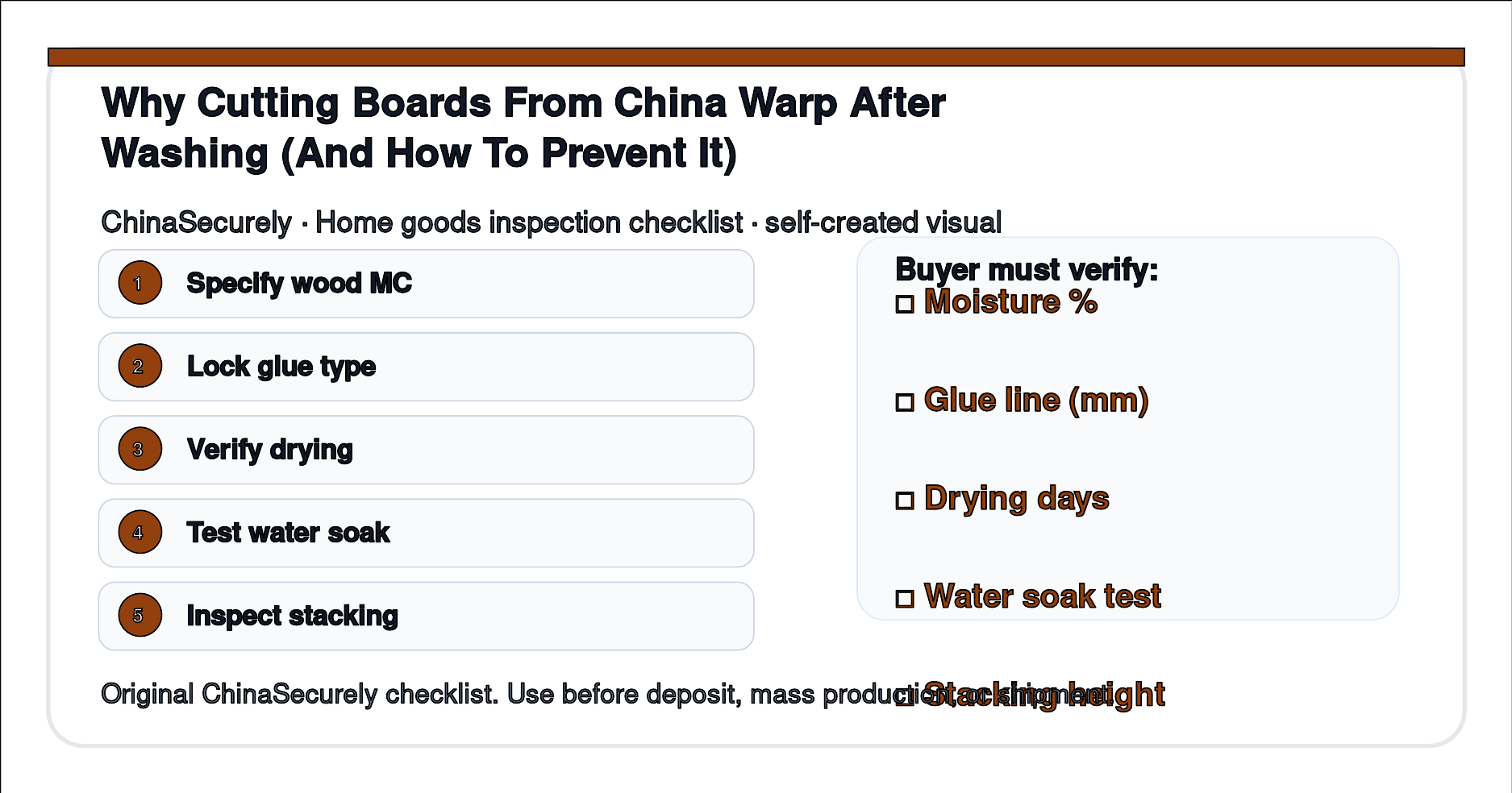
□ Specify maximum moisture content matched to your target climate
□ Confirm all wood is kiln dried (not just air dried) to your specification
□ If joined construction: require all pieces dried to same moisture content
□ Require food-safe finishing on all six sides (top, bottom, all edges)
□ Order 1-2 samples and test them by repeated washing before full production
□ Add moisture content verification to your pre-shipment inspection
□ Ask for a written statement of moisture content with the shipment documentation
Related Questions
Can I fix a warped cutting board after it happens?
You can sometimes flatten a slightly warped board by wetting the concave side, weighting it flat, and letting it dry slowly, but this doesn’t work for badly warped boards. It’s better to prevent the problem at the factory than to try to fix it later.
Is bamboo more stable than solid wood for cutting boards?
Yes, properly processed bamboo is more dimensionally stable than most solid hardwoods because it’s laminated from thin strips that are already dried. Good bamboo cutting boards from reputable Chinese suppliers rarely warp if they are correctly processed.
Does thickness affect warping risk?
Thicker boards (1.5 inches or more) are more resistant to warping than thin boards (half inch or less). Thin boards warp more easily because they have less mass to resist internal stress from uneven moisture changes.
Need help writing a moisture content specification for cutting boards or other wooden kitchen products from China? Send your product size, your target climate, and what material you’re thinking of using. ChinaSecurely can help you write the technical requirements your factory needs to follow.
Why Cutting Boards From China Warp After Washing (And How To Prevent It)
Why do cutting boards from China warp after washing? Learn the real China supply chain reasons and what specifications you need to prevent warping in your kitchen product orders.
Suggested internal links:
- /home-goods/cutting-boards-warp-prevention/
- /home-goods/kitchen-product-inspection-checklist/
- /home-goods/wood-kitchenware-moisture-spec/
Sources:
- Wood processing industry technical information on moisture content and dimensional stability
- Buyer question pattern: Google “why do cutting boards from China warp after washing”
- Chinese kitchenware factory production experience
- Note: general guidance; specific requirements depend on product thickness and target climate
Visual needed: Pre-order moisture content checklist for wooden cutting boards
Authoritative references (added 2026-07-24)
- https://www.astm.org/d143-22.html
- https://www.astm.org/d1037-12.html
- https://www.iso.org/standard/74446.html
- https://www.fs.usda.gov/research/centers/forest-products
- https://www.qima.com/quality-control-inspections/pre-shipment-inspection
Prior source set was missing authoritative wood and moisture references. Expanded with ASTM D143 (small clear wood specimen testing), ASTM D1037 (wood-base fiber and particle panel material testing), ISO 3129 (wood sampling and general requirements for physical and mechanical testing), USDA Forest Products Laboratory wood technical resources, and QIMA inspection reference.