
Buyer Question: PP plastic storage boxes smell strongly of plastic even after airing for a week. Is this a safety issue for food storage? What material standard should I request?
Sources: Reddit r/ecommerce, FDA 21 CFR 177.1520 public pages, 1688 PP food container supplier pages, EU Regulation 10/2011 public pages
The Buyer Question
"I ordered 200 PP plastic food storage containers from a Chinese supplier. After unpacking and airing for 7 days, they still smell like chemical plastic. The supplier says this is normal for new products. Can I still use these for food storage, or did I receive the wrong material?"
Persistent chemical smell from plastic containers after airing is a warning sign, not a normal "new product" condition. Legitimate food-grade plastic should have minimal odor that dissipates within 24–48 hours.
Short Answer
Persistent smell after one week means either non-food-grade plastic was used, recycled plastic was mixed into the material, or the plastic contains unreacted monomers or additives that should not be present in food-contact products. For food storage, only use plastic that meets US FDA food-contact standards or EU food-contact regulations — and request proof. A simple water test and smell test can screen products before you risk using them with food.
Why This Happens
1. Recycled plastic contamination is common in cheap containers. Virgin polypropylene (PP) for food contact costs more. Some suppliers mix in recycled PP (often from industrial waste) to reduce cost. Recycled plastic has more volatile organic compounds (VOCs) and residual odors.
2. Non-food-grade resin looks identical to food-grade. PP resin comes in food-grade and industrial grades. They look identical in pellet form and in the finished product. Only laboratory testing distinguishes them.
3. Unreacted additives. Plastic production uses catalysts, stabilizers, and plasticizers. In properly processed food-grade plastic, these are reacted or bound into the material. In poorly processed or non-food-grade plastic, these additives can outgas, creating persistent odors.
4. Colorants and pigments. Some pigments used in colored plastic containers are not food-safe. Dark pigments with heavy metals (though increasingly rare) or inappropriate dyes can cause odor and potential leaching.
5. The " airing out" myth. Some suppliers tell buyers to "air out" products for a week. For genuinely food-grade plastic, airing for more than 24–48 hours is unnecessary. If a week doesn’t fix the smell, the material is wrong.
China Supply Chain Perspective
The main PP food container production areas in China:
- Guangdong (Shantou, Chaozhou) — largest PP food container cluster, primarily for domestic and export
- Zhejiang (Hangzhou, Ningbo) — higher-specification PP products
- Hebei — more industrial plastics
A critical distinction: homopolymer PP vs. copolymer PP. Homopolymer PP is standard for food contact. Copolymer PP has different thermal properties and is more common in industrial applications.
Food-grade PP resin price is approximately 20–30% higher than industrial-grade PP. For a container priced at $1.00 material cost, that is a $0.20–$0.30 difference per unit — significant at 200-unit orders.
Step-by-Step Verification Process
Step 1: The Smell and Visual Test
Take one container and:
- Smell it immediately after opening — note the intensity and type of odor
- Fill with hot water (80°C) for 10 minutes, then smell again
- Fill with room temperature water for 30 minutes, then smell
- Leave empty and uncovered overnight, smell again in the morning
- Normal food-grade PP: Faint plastic smell, no chemical odor, no change when heated
- Problem indicator: Strong chemical smell, odor increases with heat, smell does not dissipate overnight
Step 2: Request Food-Grade Material Documentation
Ask the supplier for:
- FDA 21 CFR 177.1520 test report (PP food contact) — for US market
- EU 10/2011 test report — for EU market
- GB 4806.7-2016 test report — China’s own food-contact plastic standard (also acceptable reference)
The report must be for the specific product model, dated within 24 months.
Step 3: Ask for the Raw Material Supplier’s Name
Legitimate food-grade PP comes from known petrochemical companies:
- Sinopec (China)
- CNPC (China)
- ExxonMobil (US)
- LyondellBasell (Netherlands/US)
- Borealis (Europe)
If the supplier cannot name their resin supplier, that is a red flag.
Step 4: Conduct a Simple Density Test
Food-grade PP has a density of approximately 0.90–0.91 g/cm³. Non-food-grade or filled PP may have a higher density.
Fill a container with water and weigh it (or use a simple water displacement test). This is not conclusive but can flag suspicious products.
Step 5: Order from a Different Sample if the First Fails
If your first sample fails the smell test, request a new sample from a different production batch before giving up on the supplier. If the second sample also fails, the material specification is wrong.
Costs, Risks, and Trade-offs
| Action | Cost | Risk if Skipped |
|---|---|---|
| Raw material documentation request | Free | Order non-food-grade plastic |
| Food-contact test report | $100–$300 | Legal liability for food contamination |
| Smell/heat test on sample | Free | Use non-compliant product |
| Upgrading to glass or stainless steel | +50–200% cost | Eliminate plastic concern |
| Pre-ship inspection | $50–$100 | Defective goods shipped |
Practical Checklist for Importers
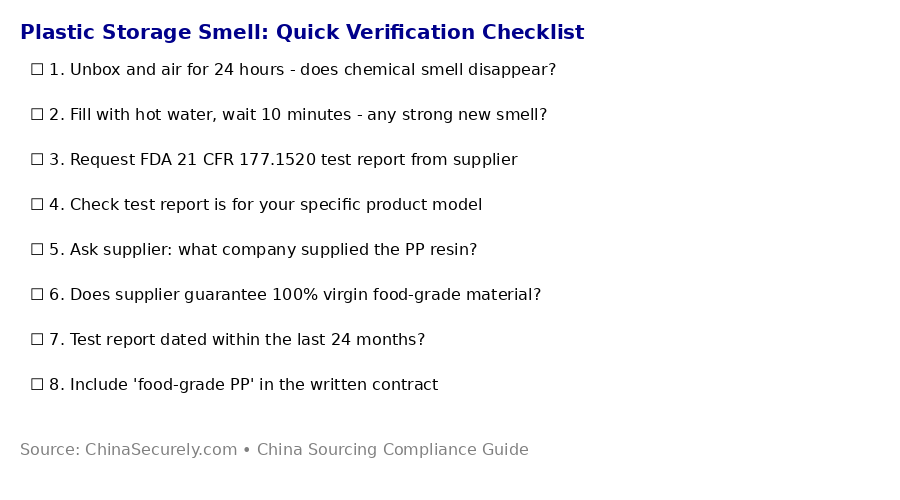
- ☐ Food-grade test report requested (FDA 21 CFR 177.1520 or EU 10/2011)
- ☐ Test report is for the specific product model
- ☐ Supplier named the raw material resin supplier
- ☐ Sample passed smell test after 24 hours airing
- ☐ Sample passed hot water smell test
- ☐ No persistent chemical odor after one week
- ☐ "Food contact" explicitly stated in purchase contract
- ☐ Non-food-grade alternative considered and rejected with documented reason
- ☐ Pre-ship inspection includes smell check
- ☐ Label clearly states food-grade material
Related Questions
Is the smell dangerous even if it fades eventually?
The smell itself is not the only concern. If the smell is from unreacted monomers or inappropriate additives, these can migrate into food even after the odor dissipates. Products with persistent smell after one week should not be used for food contact.
Can I sell these as non-food storage containers?
Possibly, but you must clearly label them as non-food-use. Many buyers will still complain about the smell, and returns will be high. It is better to source the right material from the start.
What types of plastic are food-safe?
- Polypropylene (PP) — most common for food containers, heat-resistant
- High-density polyethylene (HDPE) — milk jugs, some containers
- Polyethylene terephthalate (PET) — soda bottles, some containers
- Borosilicate glass — highest safety, higher cost and weight
Avoid: PVC (not food-safe without specific additives), polycarbonate (contains BPA in most forms), and any unmarked "plastic" without resin identification.
Need Help Checking a China Sourcing Route or Supplier?
Send the product, target country, order size, and current quote. ChinaSecurely can help you understand the risks before you pay.