
Short answer: a wireless charging pad from China that charges slowly, overheats, or stops when a phone case is on it usually has one of three root causes: a coil that is too small for the claimed wattage, a missing or weak Foreign Object Detection (FOD) sensor, or a WPC Qi certification that does not match the actual product. The buyer cannot tell from the housing. The buyer has to lock the coil size, verify the Qi cert ID on the Wireless Power Consortium database, and run a thermal test before bulk.
Why this problem happens
Wireless charging pad failure is one of the most common returns on Chinese electronics. The pad works on the sample line. The pad fails in the field. Three things drive the gap:
- The coil diameter is reduced for bulk to save cost. A sample may use a 40 mm coil for 10 W output, while bulk uses a 28 mm coil that tops out at 5 W. The pad looks identical and the packaging claims the same wattage.
- The FOD sensor is dropped between sample and bulk. A genuine FOD sensor uses a resonant frequency shift detector; a cheaper design uses only a thermal cutoff. The cheaper design lets the pad charge through metal objects and overheat.
- The WPC Qi certificate ID belongs to a different product. Suppliers sometimes show a Qi certificate from an older or unrelated product. The buyer must verify the certificate ID on the Wireless Power Consortium database.
China-side explanation
Most Chinese wireless charging factories do not design the Qi protocol stack themselves. They license a reference design from a chip vendor such as IDT (now Renesas), NXP, or a Chinese chip vendor. The reference design comes with reference PCB layout, reference coil spec, and reference firmware. The factory adapts the reference design to its housing and submits the finished product to the WPC for Qi certification.
The silent variable is firmware. A factory may certify a product with one firmware build, then ship bulk with a different firmware build that fails FOD or that limits output wattage. The Qi certificate is for the certified firmware, not for the bulk firmware.
Step-by-step solution
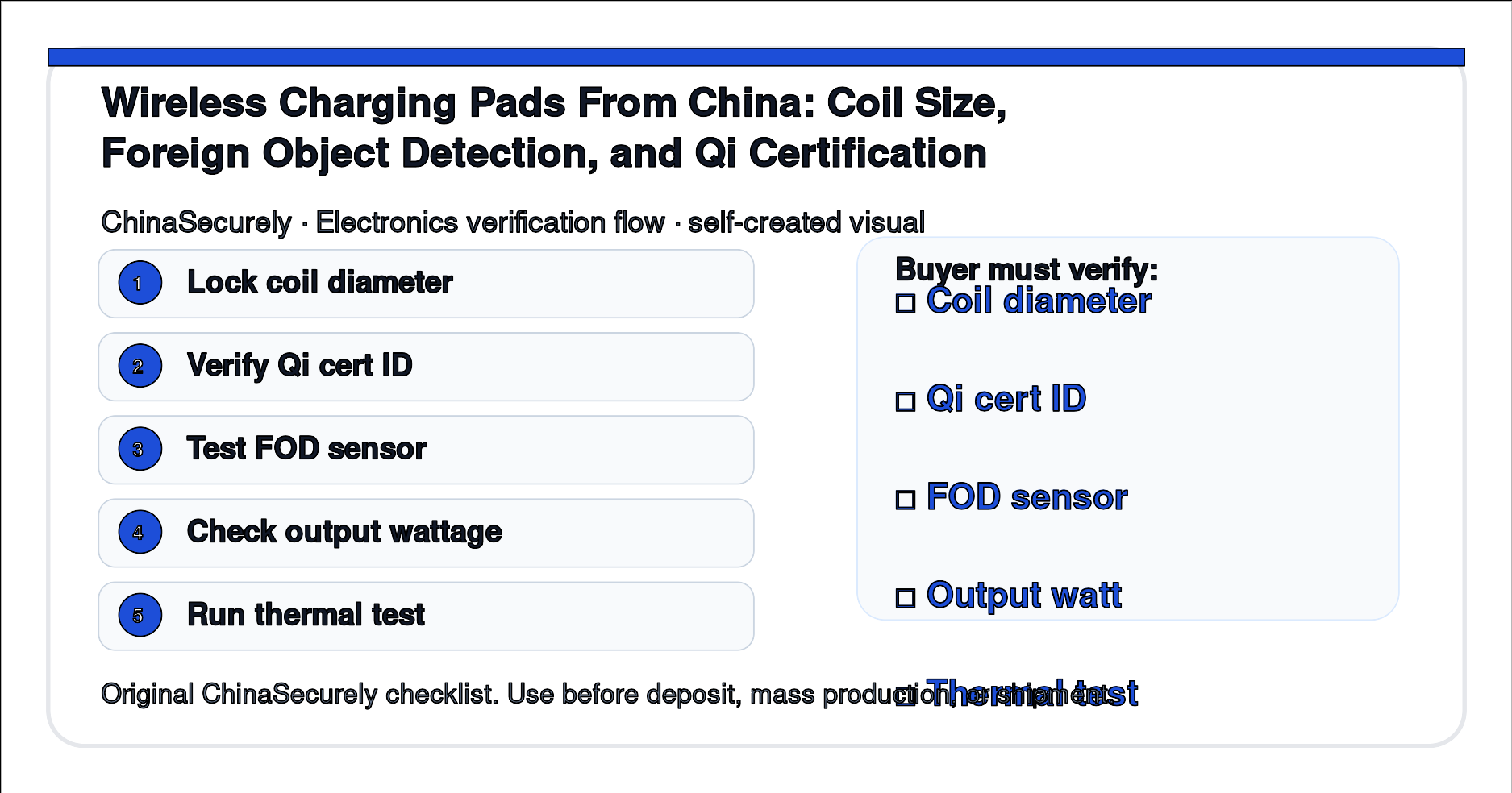
- Lock the coil diameter on the PO: 40 mm minimum for 10 W single-coil pads, 45 mm or triple-coil for 15 W.
- Specify the FOD sensor type: resonant frequency shift detection, not thermal cutoff.
- Verify the WPC Qi certificate ID on the Wireless Power Consortium database before paying the deposit.
- Test the output wattage with a USB power meter and a Qi-compliant phone. The pad must deliver at least 80 percent of the claimed wattage within five minutes.
- Run a thermal test: place the pad under load for 30 minutes. Surface temperature must stay under 45 degrees Celsius.
- Test with a metal foreign object (coin): the pad must stop charging and indicate the error within 10 seconds.
Wireless charging verification table
| Check | What to verify | Where to look |
|---|---|---|
| Coil diameter | 40 mm min for 10 W | Supplier datasheet |
| FOD sensor | Frequency shift, not thermal | Supplier datasheet |
| Qi certificate ID | Verified on WPC database | wirelesspowerconsortium.com |
| Output wattage | 80% of claim within 5 min | USB power meter test |
| Thermal test | Under 45 degrees C at 30 min | Thermal probe |
| Foreign object test | Stops within 10 seconds | Coin test |
What to ask the supplier
A safer way to ask the supplier:
“Please send the WPC Qi certificate ID for this exact model, the coil diameter in mm, the FOD sensor type (frequency shift vs thermal cutoff), and the firmware version that ships in bulk. The Qi certificate ID must be verifiable on the Wireless Power Consortium database.”
Buyer checklist before signing the PO
- Coil diameter is named on the PO (40 mm minimum).
- FOD sensor type is named (frequency shift).
- Qi certificate ID is verified on the WPC database.
- Output wattage tested with USB power meter.
- Thermal test passes (under 45 degrees C at 30 min).
- Foreign object test passes (stops within 10 sec).
Authoritative references
- Wireless Power Consortium – Qi certified products database
- FCC – equipment authorization database
- eCFR Title 47 Part 15 – radio frequency devices
- ISO 7206 – reference standards for electronic components
- IEC – International Electrotechnical Commission
- QIMA – pre-shipment inspection and supplier verification
Coil size, FOD sensor, and Qi certification are specification decisions, not preference choices. WPC, FCC Part 15, ISO 7206, and IEC are the public references for this category. Run an output wattage test and a thermal test before bulk. This article is a sourcing verification checklist, not a wireless engineering specification.