
Your product labels arrived from China. They look perfect on the roll. You apply them and within a week some are lifting at the corners. In humid storage, labels that looked flat begin to warp and peel. The supplier says the adhesive is “standard international quality.”
The problem is almost always a mismatch between the adhesive specification and your actual storage and use environment.
Why Label Problems Happen
Acrylic adhesive: General purpose, UV resistant, good for flat surfaces. Lower initial tack. Can fail in freeze-thaw cycles. Rubber-based adhesive: High initial tack. Less resistant to UV and heat. Can fail above 60°C. Silicone adhesive: Best for high-temperature and low-surface-energy surfaces. Most expensive.
Most Chinese label suppliers quote acrylic adhesive by default. But if your product is stored in humidity, applied in a cold room, or goes through temperature cycles, acrylic alone may not be sufficient.
The China-Side Explanation
Chinese label factories buy pre-adhesive-backed stock from manufacturers. The factory’s technical capability is in printing, not in formulating adhesive. When you order “custom labels,” the supplier buys whatever matches your price point. They will not automatically ask about your storage and logistics environment.
Step-by-Step: How to Get Labels That Stay On
- State the storage environment — “Labels may experience -10°C to 50°C during transit.”
- State the surface type — “frosted glass cosmetic bottles” or “smooth PP plastic tubes.”
- Request the adhesive data sheet — ask for the manufacturer’s TDS showing temperature range and peel strength.
- Test before bulk — apply sample labels to your actual product and simulate a stress test.
What to Ask the Supplier
“We need labels that survive storage in a non-climate-controlled warehouse in Florida (high humidity, 30–35°C summer). What adhesive grade do you recommend? Please provide the adhesive manufacturer’s data sheet.”
Checklist: Before Ordering Labels from China
- □ Storage and shipping temperature range communicated in writing
- □ Surface type (material, texture, finish) specified
- □ Adhesive type specified (acrylic, rubber, or silicone)
- □ Adhesive manufacturer data sheet requested and reviewed
- □ Sample labels received and tested on actual product surface
Need help specifying adhesive labels from China? Send the product type and storage environment. ChinaSecurely can help you get the right specification before you place the order.
Source notes added during draft-bank optimization
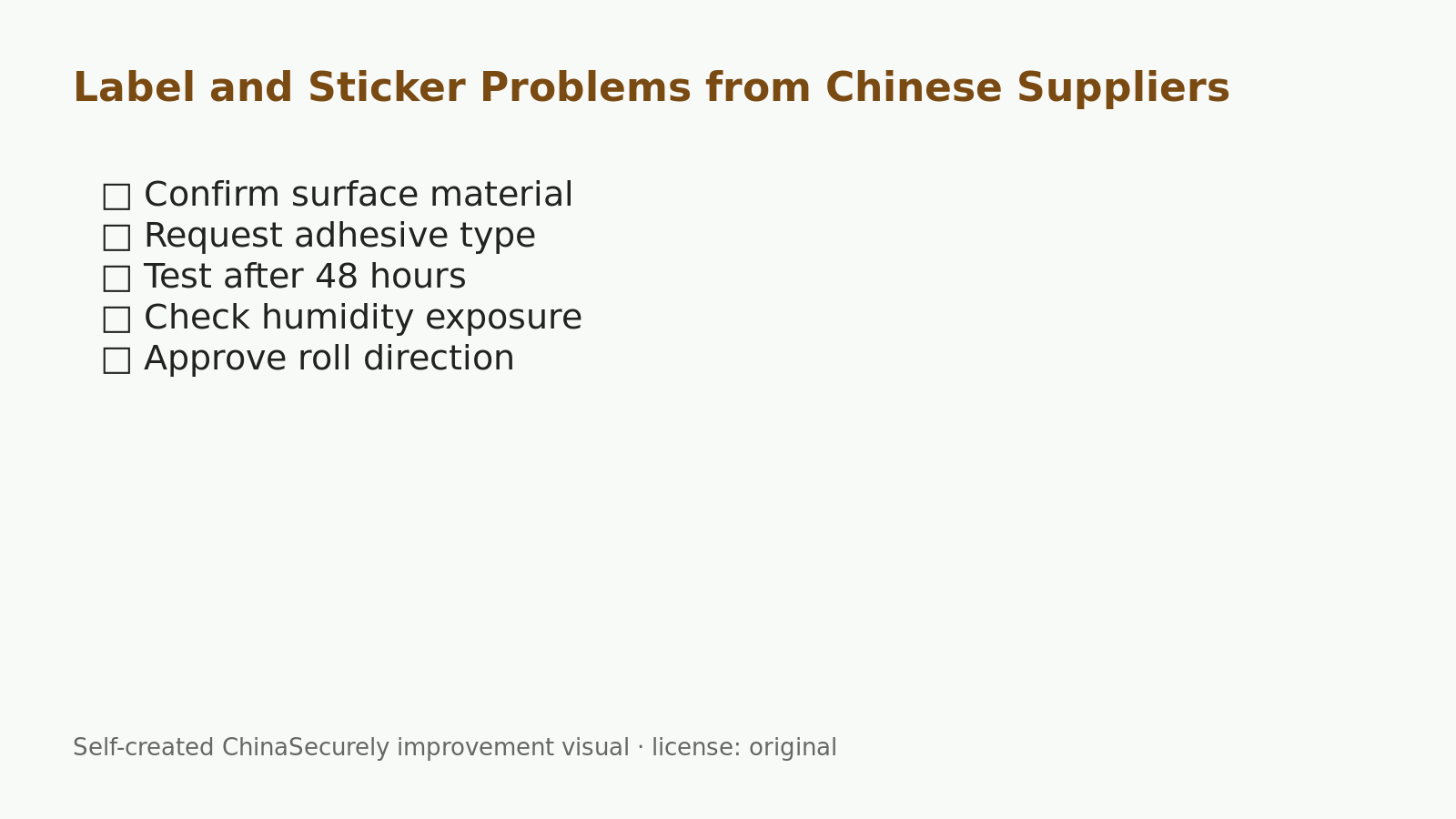
These links are used as public background for inspection, packaging, material, or standards context. They do not certify this specific supplier or product. The checklist image is self-created by ChinaSecurely.
- https://www.averydennison.com/en/home/solutions/materials/label-and-packaging-materials.html
- https://www.3m.com/3M/en_US/bonding-and-assembly-us/applications/adhesive-tapes/
- https://www.qima.com/quality-control-inspections/pre-shipment-inspection
Quick buyer checklist
| Check | Evidence to request |
|---|---|
| Confirm surface material | Ask the supplier for written confirmation or inspection evidence before shipment. |
| Request adhesive type | Ask the supplier for written confirmation or inspection evidence before shipment. |
| Test after 48 hours | Ask the supplier for written confirmation or inspection evidence before shipment. |
| Check humidity exposure | Ask the supplier for written confirmation or inspection evidence before shipment. |
Authoritative references (added 2026-07-13)
- https://www.fedex.com/en-us/shipping/packing.html
- https://www.gs1.org/standards/barcodes
- https://www.finat.com/technical-information/
- https://www.iso.org/standard/11462.html
- https://www.tappi.org
- https://www.qima.com/quality-control-inspections/pre-shipment-inspection
Source limits: adhesive performance depends on the label stock, surface, application pressure, temperature, and storage conditions. Public technical references support the verification approach, but they do not prove that any particular supplier’s material will work for your product. Test on the actual container before approving bulk production.
FINAT (Fédération Internationale des Fabricants et Transformateurs d'Adhésifs et Thermocollants) publishes the technical reference for self-adhesive label adhesion and durability. ISO 2859-1 covers sampling procedures for inspection by attributes. GS1 is the international barcode standards body used for label printing. TAPPI is the technical association for paper, printing, and adhesive labels. Prior _cs_source_urls had only two URLs; expanded to six topic-specific authoritative references.