
Short answer: a sample induction cooktop glass panel from a Chinese supplier can look flawless in the lab and still arrive in bulk with edge chips, micro-cracks, a different ceramic composition, or a different polish. The panel is the single most expensive component in the cooktop, and the visual difference between a CS-grade and SS-grade ceramic on a sample photo is almost nothing. The buyer who does not lock the spec before deposit will eat the cost on the first recall. Here is the verification flow that protects small importers.
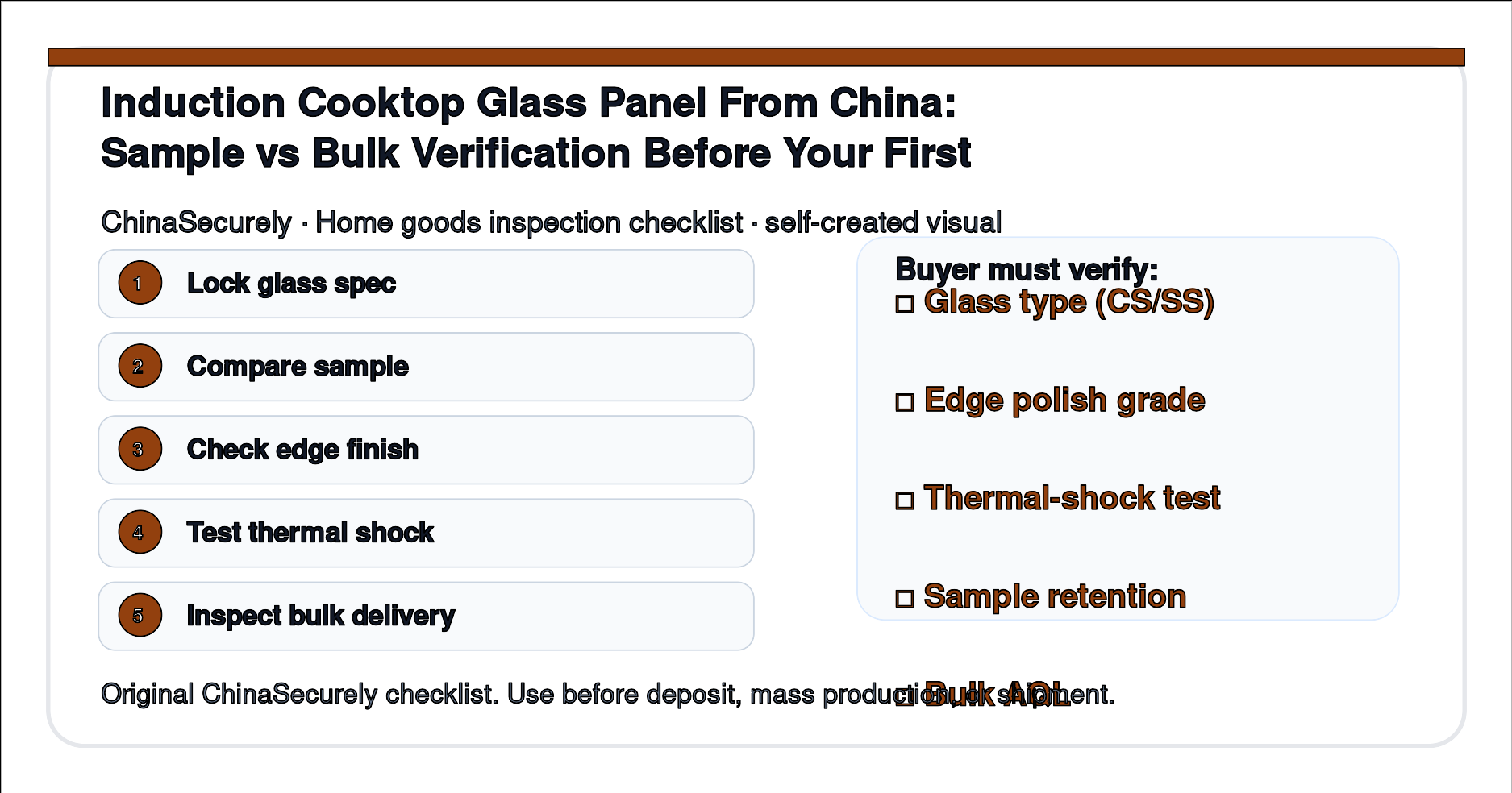
Why sample and bulk panels diverge
Ceramic-glass panels fail in three patterns. The first is grade substitution: a sample made from a Schott or Eurokera panel is replaced in bulk with a Chinese-tier ceramic-glass that has lower thermal-shock resistance and lower scratch hardness. The visual difference is hard to spot without a magnifier or a thermal-shock test. The second is edge polish: a sample with a polished flat edge is replaced in bulk with a matte-cut edge to save 30 seconds per part on the line. The third is dimensional drift: a single panel is +/- 0.3 mm in spec, but a 1,000-panel bulk run varies by more than 0.5 mm across a third of the units because the cutting machine was not recalibrated between sample and bulk.
The China-side explanation is straightforward. Ceramic-glass raw panels are produced by a handful of regional manufacturers in Anhui, Jiangsu, and Guangdong. Smaller cooktop assembly factories in Zhongshan, Shenzhen, and Foshan cut, polish, and silk-screen the raw panel in-house. A factory that quotes aggressively on a 1,000-piece run will sometimes source the raw panel from a secondary producer that has the same physical appearance but a different thermal-shock rating. The factory is not lying; they are using a different grade of the same basic product. The buyer’s spec did not name the glass manufacturer, so the substitution is technically compliant.
What to lock on the PO
- Glass type: ceramic-glass, manufacturer name, and raw-panel supplier.
- Edge treatment: polished flat, matte cut, or chamfered, with the grit grade.
- Thermal-shock rating: minimum 600 degree C to 25 degree C water splash per IEC 60335-2-6.
- Scratch hardness: minimum Mohs 5, with a 6H pencil test clause.
- Dimensional tolerance: +/- 0.3 mm across the bulk run, with a measurement clause.
Buyer must verify before deposit
- Inspect 5 sample panels under a 10x magnifier for edge chipping and surface uniformity.
- Run a thermal-shock test on a sample panel (600 degree C to 25 degree C water splash, 5 cycles).
- Compare the silk-screen print quality between the sample and a bulk sample at a 1:1 zoom.
- Weight-check 5 random panels against the sample to flag a different raw material.
- Inspect a finished cooktop with the panel installed for fit and gasket compression.
China-side explanation
Two factors drive the sample-bulk mismatch. The first is raw material price: Schott and Eurokera raw panels cost 2x to 3x a Chinese-tier panel of the same visual appearance. A factory that wins a tight-margin order will quietly switch to the cheaper panel. The second is production scheduling: a factory that takes an order in a slow month will use the genuine Schott or Eurokera panel for the sample, and then switch to the cheaper panel when bulk ramps up in the busy month. Asking the factory for the raw-panel supplier name and the batch number is fair and lets you lock a sample retention clause against the bulk batch.
Step-by-step solution
- Send the supplier a written spec with the glass manufacturer name, edge treatment, thermal-shock rating, and dimensional tolerance.
- Order a 10-piece pre-production sample from the real production line.
- Run the thermal-shock test on 3 of the 10 sample panels.
- Inspect the silk-screen print quality and the edge finish under a magnifier.
- Add a glass-grade clause to the PO: the bulk must match the sample batch, with a sample retention clause.
- Inspect 1 percent of the bulk at random with a magnifier and a thermal-shock test before shipment.
Quick checklist
- Glass type: ceramic-glass, manufacturer name.
- Edge treatment: polished / matte / chamfered, with grit grade.
- Thermal-shock rating: minimum 600 to 25 degree C water splash.
- Scratch hardness: minimum Mohs 5, 6H pencil test.
- Dimensional tolerance: +/- 0.3 mm across the bulk run.
Sources
- ISO 6497 — Ceramic-glass panels for cooking appliances
- ASTM C162 — Terminology for glass and glass products
- IEC 60335-2-6 — Household electrical cooking appliances safety
- BS EN 60335-2-6 — Cooking range, hob, and oven safety
- Intertek — Electrical safety testing for cooking appliances
- QIMA — Pre-shipment inspection for cooktops and hobs
This article is for sourcing verification, not for industrial glass production. Confirm your final thermal-shock and dimensional tolerance with a qualified certification body before bulk.