
Short answer
A custom corrugated mailer or product box from China that arrives with bent corners, scuffed flaps, or a white dust haze along the die-cut edge almost always fails on one of three things: the die-cut knife height is set too high, the waste-stripper is misaligned, or the die-cut board has higher recycled-paper content than the sample. A small importer sees a clean-looking box on the line but the bulk fails at the warehouse because corners crease or the print smears at the dust flap. The supplier’s QC photo is usually taken on the first 50 boxes; the bulk run drifts after that.
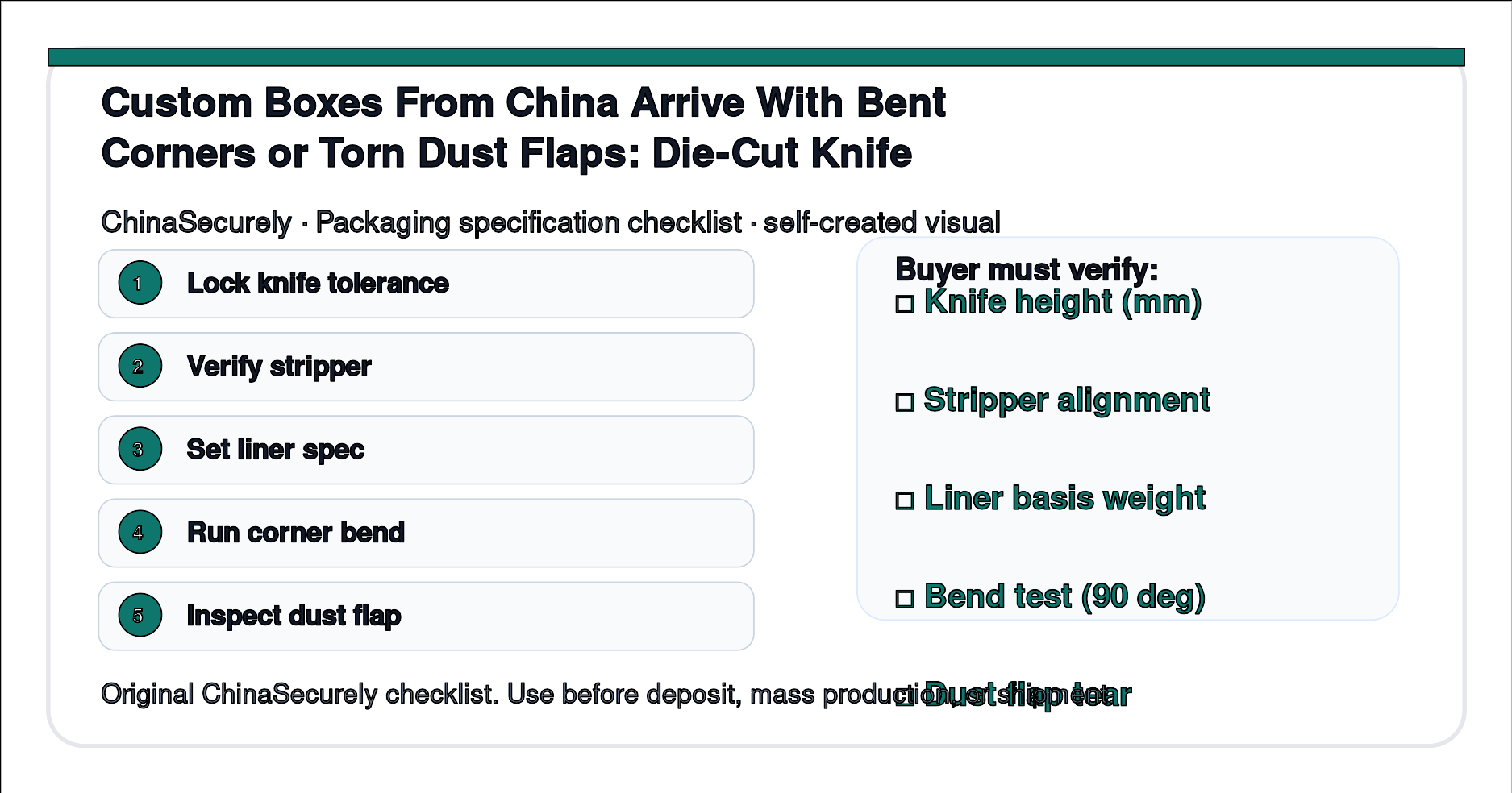
Why this problem happens
A die-cut box fails at the corner for one of three reasons. The first is knife height: a die-cut tool with a knife that is 1 mm too high cuts through the top liner cleanly but crushes the corrugation medium at the bend line, leaving the corner to crease in transit. The second is waste-stripper alignment: a worn or misaligned stripper leaves a partial die-cut at the dust flap so the buyer has to force-open the box and the flap tears unevenly. The third is board composition: a 100 percent virgin kraft liner on the sample and a 30 percent recycled liner in the bulk produce different die-cut behaviour, different bend strength, and a different feel.
The China-side explanation is straightforward. Die-cut tool life in China is dominated by large integrated mills in Guangdong, Zhejiang, and Shandong that run mixed SKUs on the same flatbed die-cutter. A buyer who orders a clean corner cut at the start of the month may receive bent corners at the end of the month because the die knife has dulled and the operator compensates by lowering the press pressure. Recycled liner paper in China is widely available and is used to cushion margin pressure on low-MOQ runs, so the sample that the sales engineer shipped from the showroom is rarely the same paper that the production line runs in bulk.
What to lock on the PO
- Die-cut tool: steel rule grade (hard or spring steel), minimum knife height tolerance in mm.
- Corner bend test: method and pass criteria (for example, 90-degree fold with no visible crease).
- Liner composition: virgin kraft / recycled content percentage, with the basis weight.
- Sample seal clause: the approved sample is the reference; any deviation is grounds for rejection.
- Pre-shipment inspection clause: pull 10 random boxes from the bulk and bend each corner.
Buyer must verify before deposit
- Cut a 5 cm cross-section from a bulk sample and inspect the die-cut edge with a magnifier.
- Bend each corner 90 degrees by hand and check for visible creasing or liner tear.
- Compare the bulk liner texture and colour against the approved sample under daylight.
- Measure the liner basis weight with a scale and a square cutter; refuse any box more than 10 percent off.
- Pull 10 random boxes from the bulk run and check that all dust flaps open cleanly without fibre tear.
China-side explanation
Die-cut knife wear in China is the most common cause of bent corners, but it is almost never flagged by the factory’s own QC because the inspection happens at the line speed where a 1 mm crush of the corrugation medium is invisible. Recycled liner paper is blended in by the liner supplier, not by the box factory, so the box factory often does not know that the sample liner is not the bulk liner. The sales engineer sends the sample from a hand-picked batch, and the production team uses whatever liner is in stock that week. A small importer who does not specify basis weight and recycled content on the PO gets whatever the factory can ship.
Step-by-step solution
- Send the supplier a written spec: die-cut tool, knife height tolerance, liner composition, and corner bend test method.
- Order a 50-piece pre-production sample built on the production line, not from the showroom.
- Bend 10 random sample corners 90 degrees and compare to the approved sample.
- Cut a 5 cm square from one bulk box and inspect the die-cut edge under a magnifier.
- Add a corner bend clause to the PO: 100 percent of bulk must pass the 90-degree bend test, or the lot is rejected.
- Inspect 1 percent of bulk at random with the corner bend test before shipment.
Quick checklist
- Die-cut tool: hard or spring steel, knife height tolerance: ______ mm.
- Liner composition: virgin / recycled, basis weight: ______ g/m².
- Corner bend test: 90-degree fold, no visible crease or liner tear.
- Dust flap: opens cleanly without fibre tear.
- Sample seal clause: approved sample is the reference for the bulk run.
Sources
- https://www.astm.org/d4727-21.html
- https://www.tappi.org/test-methods/t-410-grab-tensile-strength/
- https://www.tappi.org/test-methods/t-411-thickness-caliper-of-paper/
- https://www.astm.org/d4169-22.html
- https://www.qima.com/quality-control-inspections/pre-shipment-inspection
- https://www.fefco.org/fefco-catalog
Uncertainties
Die-cut knife height tolerance depends on the corrugation flute (B-flute ~2.5 mm, C-flute ~4.0 mm, E-flute ~1.5 mm, BC-flute ~6.5 mm). A 0.5 mm knife height error is acceptable on E-flute but produces visible crushing on BC-flute. Recycled liner content varies from 30 percent to 100 percent in Chinese kraft liner supply; virgin kraft is more consistent but 15 to 25 percent more expensive. Corner bend test method is not standardized across the industry; TAPPI T 511 and ASTM D4727 provide related fold and tear methods but do not prescribe a specific corner bend pass criterion. Buyer should always request a 50-piece sample from the production line, run the 90-degree corner bend test, and inspect under a magnifier before bulk.