
"
A Chinese packaging supplier sends you a “sample approval sheet” to sign before bulk production. You sign it. Three weeks later the bulk order arrives with problems. The supplier points to the signed approval sheet.
The approval sheet is a legal document in the supplier’s view. You need to treat it the same way.
What a Sample Approval Sheet Contains
Product description, SKU, paper grade and weight (e.g., “350gsm CCNB, 2mm E flute”), box dimensions, color specification (CMYK or Pantone), surface finishing, quantity approved, and signatures with dates.
The China-Side Explanation
When a Chinese factory engineer drafts a sample approval sheet, they summarize what they understood from your communication. If you said “matte finish,” they write “matte lamination” — without specifying whether it is soft-touch, standard, or OPP matte. They are not trying to deceive you; they are filling in reasonable assumptions that may not match your expectations.
Step-by-Step: How to Review It
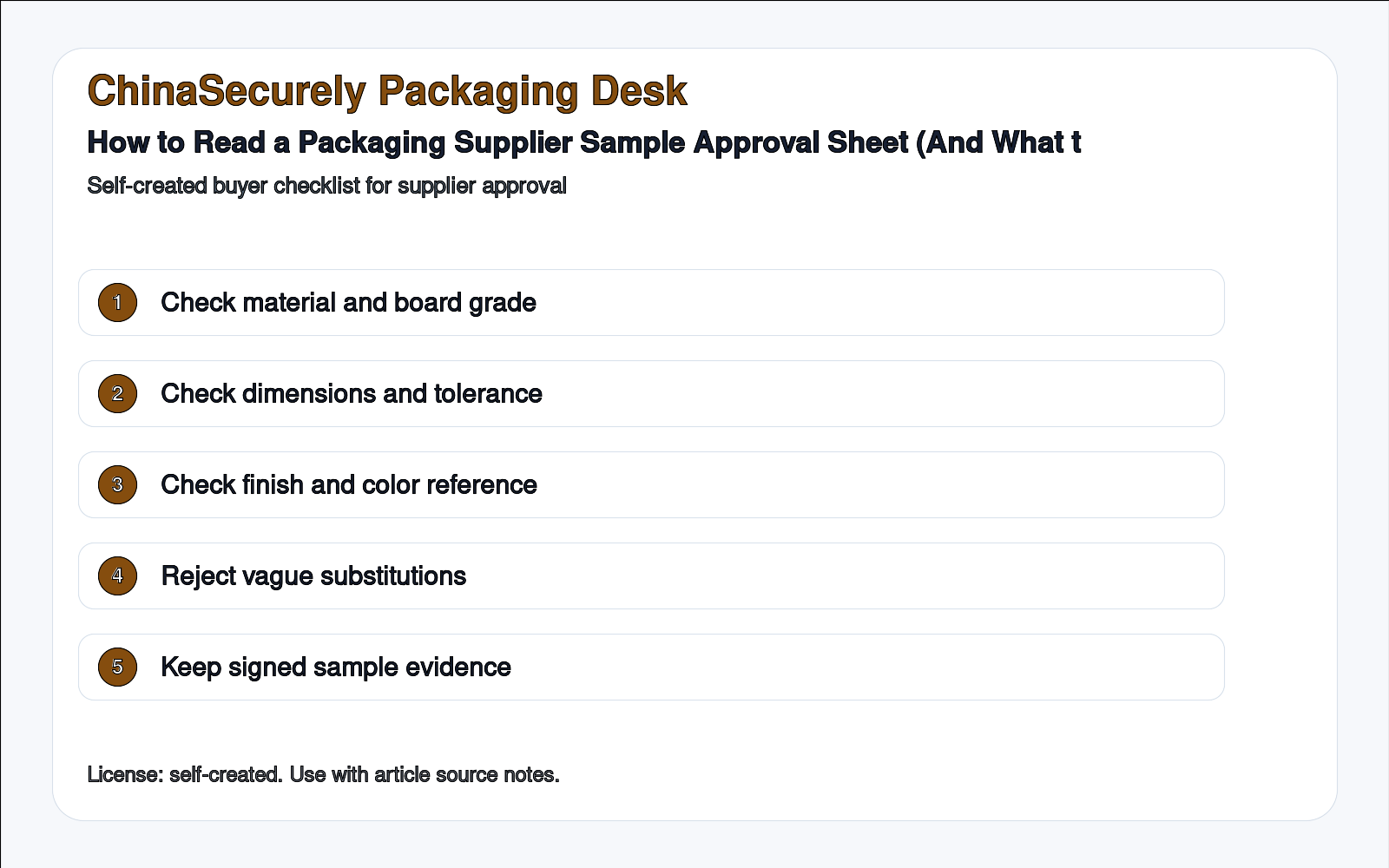
- Check the paper grade and weight — confirm GSM and board type.
- Verify dimensions with your product present — measure internal dimensions against actual product.
- Read the color specification carefully — look for Pantone numbers or specific CMYK values.
- Check surface finishing — “matte lamination” is not specific enough.
- Look for tolerance language — dimension tolerance (±2mm) and color tolerance (ΔE 3.0) should be stated.
- Add your own language via an attached addendum with your additional terms.
What to Reject
Generic descriptions like “quality OK” or “as agreed,” missing paper weight and board grade, no color specification, no dimension tolerance, and no defect tolerance percentage.
Checklist: Before Signing
- □ Paper grade and GSM confirmed
- □ Internal dimensions verified with actual product
- □ Color specification includes Pantone or CMYK values
- □ Dimension tolerance written (≤2mm)
- □ Color tolerance written (ΔE ≤3.0)
- □ Defect tolerance rate agreed (≤2%)
Need help reviewing a sample approval sheet? Send the document and your product specs. ChinaSecurely can help you identify the gaps before you sign.
Updated source and visual note
This draft was updated with a self-created ChinaSecurely checklist image and public source notes. Buyer-forum access was degraded during the run, so any buyer scenario should be treated as a common demand pattern, not a direct quotation.
Authoritative references (refreshed 2026-07-12)
- https://www.qima.com/quality-control-inspections/pre-shipment-inspection
- https://www.tappi.org
- https://www.iso.org/standard/74849.html
- https://www.astm.org/d4169-22.html
QIMA pre-shipment inspection is the primary practical reference for sample-approval reviews. TAPPI publishes the test methods for paper and board. ISO 12647 covers process control for offset printing. ASTM D4169 is the standard practice for performance testing of shipping containers and systems. Prior _cs_source_urls contained only one URL; expanded to four authoritative references covering inspection, print, and shipping.