
Short answer
A bamboo cutting board that looks fine on arrival can crack along the glue line or grow black mold within two to four weeks of regular kitchen use. The cause is almost always the adhesive used to glue bamboo strips together, the surface finish on the board, and the kiln-dry state of the bamboo before pressing. None of these are visible on the approved sample. All three are controllable if the buyer locks them on the PO.
The buyer complaint we keep seeing
A US small importer sources 600 bamboo cutting boards from a Fujian supplier for a home goods brand on Amazon. The sample board is heavy, smells of bamboo, and looks smooth on the face. Bulk production looks identical on arrival. After three weeks of customer use, reviews start mentioning “split along the side,” “black spots in the groove,” and “smells sour after washing.” A returns inspection shows the glue joint between strips has failed and the bamboo has absorbed water along that joint. The supplier’s response: “natural bamboo, normal use.” The PO never named the adhesive type, the moisture content at pressing, or the surface finish.
Why “bamboo cutting board” on a quote is not enough
Bamboo cutting boards are not a single product. They are pressed laminated assemblies. To survive regular kitchen use, the board has to control:
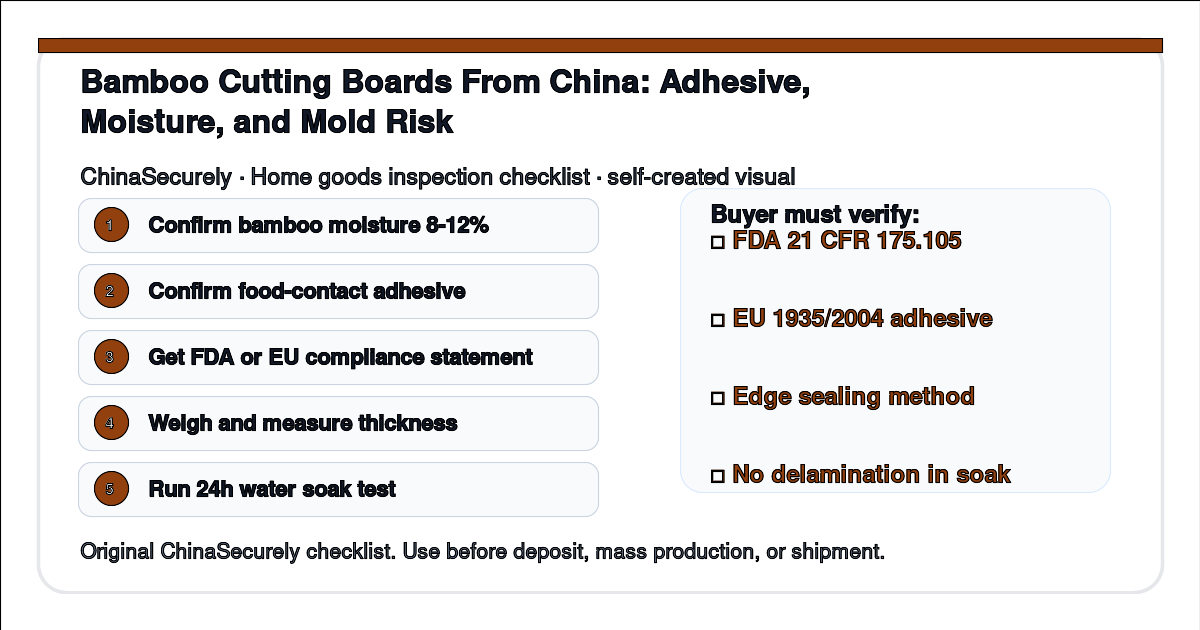
- The bamboo strip moisture content at the time of pressing. Industry reference is 8 to 12%. Above 14% the glue joint cures against wet bamboo and the joint fails once the board dries in use.
- The adhesive. Food-contact adhesives are restricted under FDA 21 CFR 175.105 and EU Regulation 1935/2004. Common choices are cross-linking PVA, EPI, or melamine. Melamine resists water but is restricted for food contact in some markets.
- The pressing pressure and press time. Under-pressed boards delaminate; over-pressed boards crush the bamboo fibers.
- The surface finish. Food-grade mineral oil is common. Lacquer or varnish seals the board but is not always food-safe.
- The edge sealing. End-grain bamboo absorbs water along the glue line if the edge is not sealed.
The PI usually says “bamboo cutting board, 30 x 20 x 2 cm” and nothing about adhesive, moisture, or finish. None of the failure modes show on the approved sample, which is usually built with extra care.
China-side explanation
Bamboo cutting boards in Fujian, Zhejiang, and Anhui are commonly produced from three to four stock construction tiers. Public 1688 listings describe them as:
- Entry tier: strips air-dried, not kiln-dried, pressed with generic white PVA glue, finished with a light mineral oil rub, sold for low-cost export.
- Middle tier: strips kiln-dried to 10 to 12% moisture, pressed with cross-linking PVA or EPI, double-sided fine sanding, food-grade mineral oil finish. Sold with a generic “FDA” claim.
- High tier: strips kiln-dried to 8 to 10% moisture, pressed with EPI or melamine, edge-sealed with waterproof glue, finished with multiple coats of food-grade mineral oil or beeswax blend. Sold to home goods brands.
If the PO does not specify the moisture content at pressing, the adhesive type and food-contact grade, the surface finish, and edge sealing, the factory usually builds the middle tier. When bamboo costs rise between sample approval and bulk production, the kiln-drying step is often shortened and the adhesive is swapped.
What actually verifies a bamboo cutting board
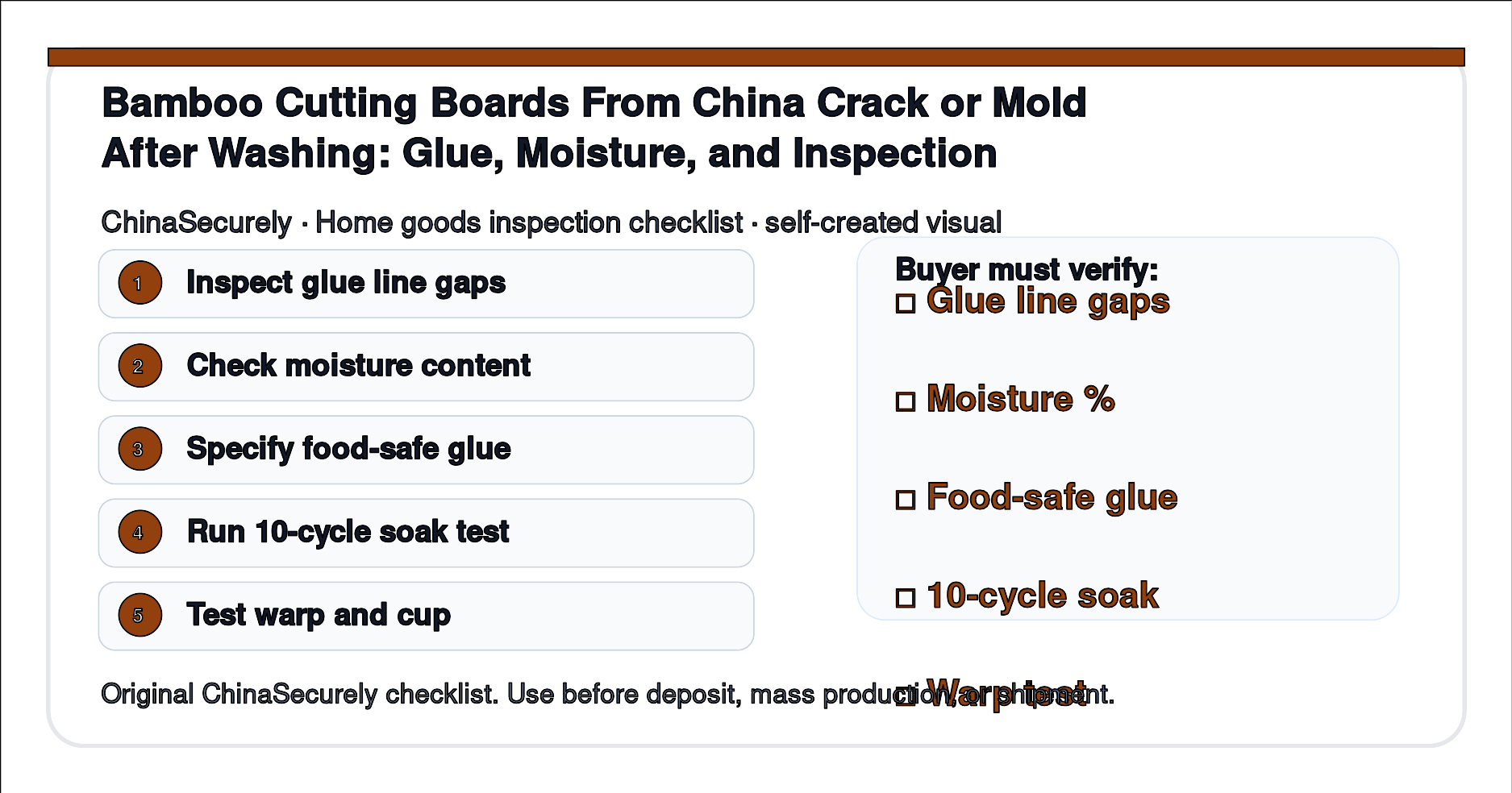
- Ask the supplier for the moisture content at pressing (target 8 to 12%), the adhesive type and food-contact grade, and the surface finish.
- Ask for the FDA 21 CFR 175.105 or EU 1935/2004 compliance statement for the adhesive.
- Weigh the sample board and ten bulk boards. A drop of more than 10% usually means under-dried bamboo or thinner strips.
- Measure the thickness of ten bulk boards with calipers. The average should be within plus or minus 0.5 mm of the PO.
- Run a 24-hour water soak test on a sample board. The weight gain should stay below 8%, and there should be no visible delamination at the glue line.
- Cut a sample board in half and inspect the glue line. The adhesive should be a continuous bead with no gaps and no dark spots.
Sample-to-bulk risk matrix
| Risk | Sample impact | Bulk impact | Buyer check |
|---|---|---|---|
| Bamboo not kiln-dried at pressing | Low, sample stored indoors | High, joint fails as board dries | Ask for moisture reading at pressing |
| Adhesive swapped to non-food-grade | None visible | High, restricted substance in food contact | FDA or EU food-contact compliance statement |
| Edge not sealed | None visible | High, water enters glue line | Inspect edge finish on bulk units |
| Surface finish skipped | Low, sample oiled by hand | Medium, board looks dry and absorbs water | Smell and touch test on bulk units |
| Strip thickness reduced | None visible | Medium, lower weight, weaker board | Weigh and measure thickness |
What to ask the supplier before the deposit
“Please confirm on the PO: bamboo moisture content at pressing (target 8 to 12%), adhesive type with FDA 21 CFR 175.105 or EU 1935/2004 food-contact compliance, surface finish (food-grade mineral oil or beeswax blend), and edge sealing method. Please share the adhesive technical data sheet, a photo of the kiln moisture meter reading, and a sample board for our own 24-hour soak test before bulk production.”
If the sales rep answers “natural bamboo, food-safe” without naming the adhesive or the moisture content, treat the claim as unverified. That answer usually means the middle tier with a generic FDA claim.
Buyer checklist before releasing the balance payment
- PO specifies bamboo moisture content at pressing, adhesive type with food-contact compliance, surface finish, and edge sealing.
- FDA 21 CFR 175.105 or EU 1935/2004 statement on file for the adhesive.
- Bulk board weight is within 10% of the sample board weight.
- Bulk board thickness on ten samples averages within plus or minus 0.5 mm of the PO.
- 24-hour water soak test on a sample board shows weight gain below 8% and no delamination at the glue line.
- Cut sample inspection shows a continuous glue bead with no gaps or dark spots.
Authoritative references
- FDA 21 CFR Part 175 — Indirect food additives: Adhesives and components of coatings
- EU Regulation (EC) No 1935/2004 — materials and articles intended to come into contact with food
- ASTM D4442 — Standard Test Methods for Direct Moisture Content Measurement of Wood and Wood-Based Materials
- FDA — Food Contact Substances (FCS) database
- QIMA — pre-shipment inspection for home goods and kitchenware
- ISO 4211 — Furniture — Assessment of surface resistance to cold liquids
Bamboo cutting board performance depends on the moisture content of the bamboo at pressing, the food-contact grade of the adhesive, and the surface finish. FDA Part 175 and EU 1935/2004 are the public technical references for food-contact adhesives. Confirm current food-contact requirements with your destination market regulator and your retailer before shipping.