
Short answer
When fabric storage cubes from China collapse after delivery, the usual weak points are the inner board, side-wall support, handle stitching, fabric weight, folding memory, and tight carton packing. Small importers should approve a real production sample and add simple load, shape, and handle checks before shipment.
Buyer question: “The fabric storage cubes looked fine in supplier photos, but after customers unfolded them, the sides collapsed and the handles tore. What should I check before ordering again from China?”
The product looks simple, but the buyer has to specify the hidden structure, not just the outside fabric color.
Why this problem happens
A storage cube may be made with nonwoven fabric, polyester, cardboard, MDF-like board, plastic board, or other support material. Two cubes can look almost identical in a photo while feeling very different in hand.
Collapse often happens when the side board is too thin, the bottom insert is weak, the handle stitching is too shallow, the cube is folded too tightly, or heavy cartons compress the goods during transit. Carrier packing guidance generally focuses on preventing movement and compression damage. That same principle applies here: if the storage cubes are crushed in export cartons, the customer may receive a product that never regains its intended shape.
China-side explanation
Chinese home goods suppliers often quote storage organizers in several grades. A low price may mean lighter fabric, thinner board, fewer stitches, weaker handles, or tighter carton packing. The salesperson may not mention these changes unless the buyer asks for the exact construction.
Factories also like efficient packing because storage cubes are bulky. Tight folding saves freight cost, but it can create deep creases and weak corners. The best order file makes clear which cost savings are acceptable and which quality points must not change.
Step-by-step solution
- Ask for fabric type, fabric weight if available, board material, and board thickness.
- Request a production-style sample, not only a showroom sample.
- Open and assemble the cube several times to see whether it holds shape.
- Put a realistic load inside and lift by the handles.
- Inspect handle stitch length, stitch density, and reinforcement area.
- Check whether corners stand straight after being folded in the carton.
- Confirm units per inner pack and export carton.
- Add inspection checks for collapsed sides, torn handles, broken bottom inserts, stains, and odor.
- Keep photos of the approved sample next to a ruler for comparison.
What to ask the supplier
Copy and adapt this message:
Please confirm the fabric material, board material, board thickness, bottom insert thickness, handle stitching method, and carton packing quantity. For the pre-shipment inspection, please open sampled cubes, check whether the sides stand straight, load the cube with our target weight, lift it by the handles, and check for torn stitching or permanent folding marks.
This gives the factory and inspector a shared standard instead of arguing after shipment.
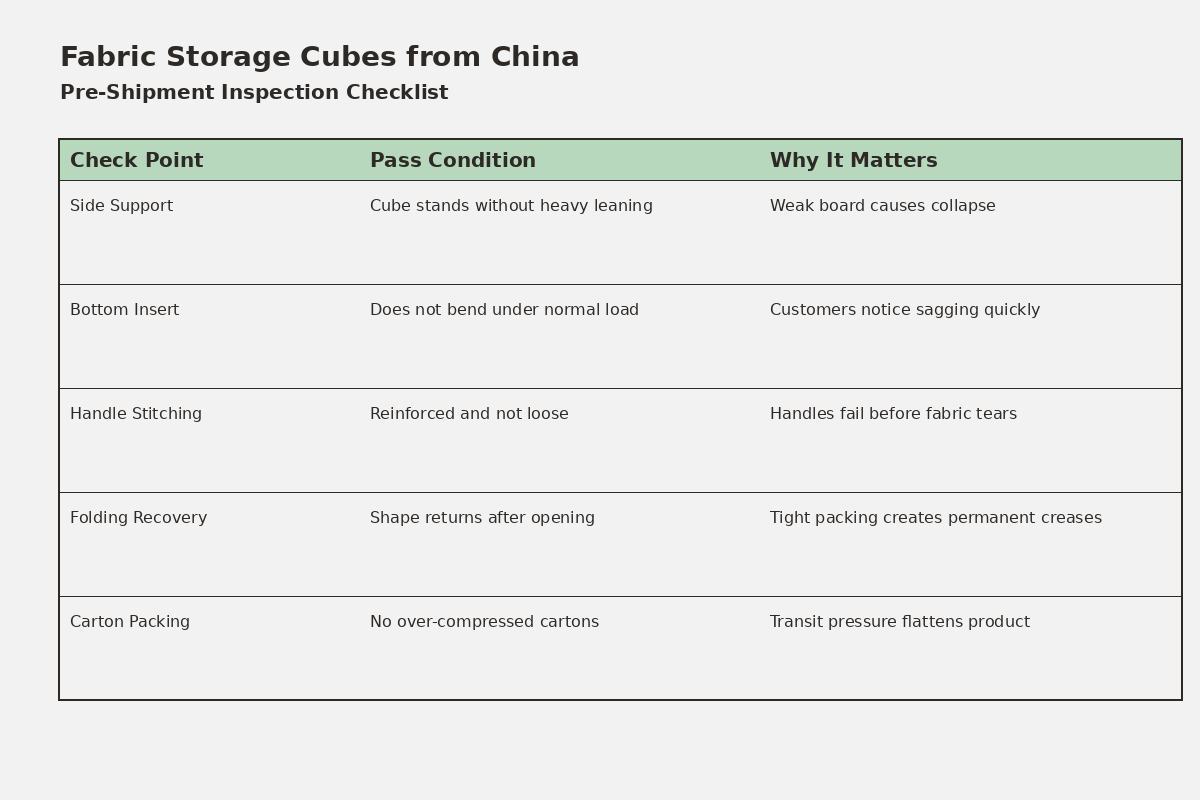
Storage cube inspection checklist
| Check point | Pass condition | Why it matters |
|---|---|---|
| Side support | Cube stands without heavy leaning | Weak board causes collapse |
| Bottom insert | Does not bend under normal load | Customers notice sagging quickly |
| Handle stitching | Reinforced and not loose | Handles fail before fabric tears |
| Folding recovery | Shape returns after opening | Tight packing can create permanent creases |
| Carton packing | No over-compressed cartons | Transit pressure can flatten the product |
Cost and trade-off notes
A stronger cube may need heavier fabric, thicker board, better stitching, or looser packing. That can raise unit cost or freight volume. For a dollar-store style product, a light construction may be acceptable. For marketplace photos, closet storage, or gift packaging, collapsed sides create returns and bad reviews.
Ask the supplier for a budget version and a stronger version, then compare the exact material and packing differences.
Sources and source status
- FedEx packing guidance for protection from compression and handling: https://www.fedex.com/en-us/shipping/packing.html
- UPS packaging support page, used as a general packing reference; access may need manual review from some locations: https://www.ups.com/us/en/support/shipping-support/packaging-tips.page
Related questions
Is thicker fabric enough?
No. The inner board, bottom insert, and stitching often matter more than the visible fabric.
Should I approve from supplier photos?
Photos help with color and appearance. They do not prove handle strength, board thickness, or shape recovery.
Can tighter packing be accepted?
Sometimes, but only after testing whether the product recovers its shape after being folded and compressed.
Light CTA
For foldable home goods, ask how the product behaves after packing, not only how it looks before packing.