
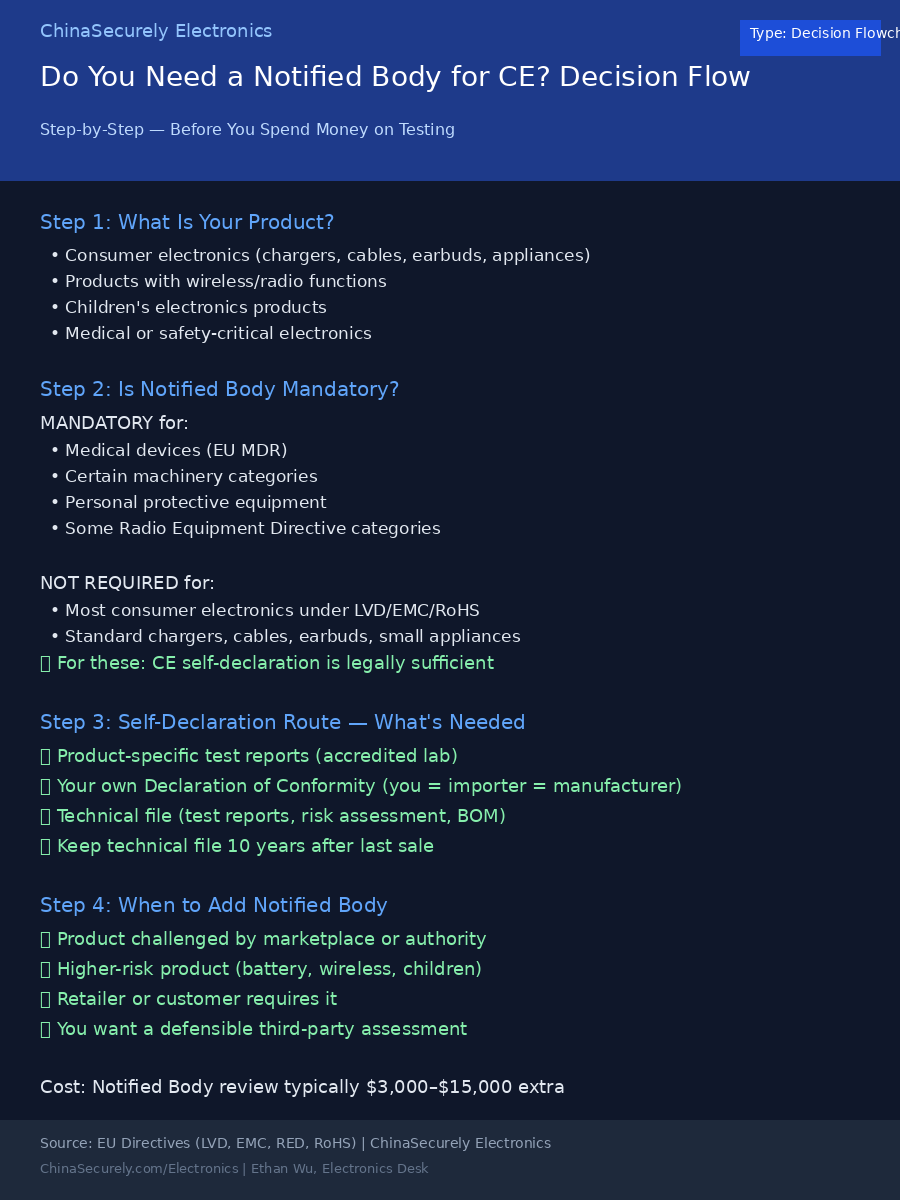
Short Answer
For most consumer electronics imported into the EU, CE self-declaration is legally sufficient — the manufacturer (or the importer if you are bringing the product in under your own brand) declares that the product meets the applicable EU directives. Using a Notified Body adds an extra layer of verification and can reduce the risk of your CE declaration being challenged, but it is not legally required for most products. The choice depends on your product type, your risk tolerance, and what your marketplace or customers require.
Why This Problem Happens
Confusion between legal minimum and practical reality
The EU CE marking system is based on self-declaration for most product categories — the manufacturer declares conformity, assumes responsibility, and affixes the CE mark. This is the legal minimum. However, in practice, importers and marketplaces often face situations where a simple self-declaration is not enough. Amazon EU, for example, requires CE declarations for many product categories and may request supporting technical documentation at any time. Products that are investigated by market surveillance authorities can have their CE declarations challenged if they are not properly supported.
What “Notified Body” actually means
A Notified Body is an organization designated by an EU member state to assess products against specific directives before they enter the market. Notified Bodies conduct testing and/or document reviews and issue certificates. For some product categories — medical devices, certain machinery, personal protective equipment — use of a Notified Body is mandatory. For most consumer electronics under the Low Voltage Directive, EMC Directive, or RoHS Directive, a Notified Body is optional. The Notified Body’s role is advisory and verification — it does not absolve the manufacturer of final responsibility.
Why Chinese factories produce generic CE declarations
Chinese factories that produce for export often create a generic CE Declaration of Conformity (DoC) that covers the broadest applicable directive. This declaration is often not tied to actual testing of your specific product. It may have been written for a similar product years ago, or copied from a template. When you buy a product from a Chinese factory and sell it under your own brand in the EU, you become the “manufacturer” for CE purposes — and your CE declaration is what matters, not the factory’s generic declaration.
What It Looks Like from the China Side
How Chinese factories handle CE
Most Chinese factories that produce for export have some form of CE documentation for their main product lines. They typically have:
- A CE Declaration of Conformity (DoC) — a one-page document with the factory’s name, product, and applicable directives
- Test reports from a Chinese laboratory (sometimes accredited, sometimes not) for the applicable standards
The factory’s CE documentation is their documentation. When you import and sell under your own brand, you need your own CE documentation.
What happens when documentation is challenged
If a product is investigated by an EU market surveillance authority, the authority will ask the importer for the full technical file — including test reports, risk assessments, design files, and the DoC. If the documentation is incomplete, missing, or clearly inadequate, the product can be pulled from the market and the importer fined. If a product causes harm and the documentation does not support the CE declaration, the importer’s liability exposure is much higher.
The difference a Notified Body makes
When a Notified Body reviews your technical file and issues a certificate, you have a defensible position: a third-party expert assessed your product and found it compliant. For products where the risk is higher — battery-powered devices, products with wireless functions, products used by children — this additional layer can be worth the cost and time.
Step-by-Step Solution
Step 1: Determine which EU directives apply to your product
Common directives for consumer electronics:
- Low Voltage Directive (2014/35/EU): products operating at 50–1000V AC or 75–1500V DC
- EMC Directive (2014/30/EU): electromagnetic compatibility
- RoHS Directive (2011/65/EU): hazardous substance restriction
- Radio Equipment Directive (2014/53/EU): products with wireless/radio functions
- Ecodesign Directive: energy efficiency requirements for certain products
Each directive requires specific technical documentation. Know which ones apply before you start.
Step 2: Understand whether your product requires mandatory Notified Body involvement
Mandatory Notified Body involvement applies to:
- Products covered by the EU Machinery Directive (certain categories)
- Medical devices
- Products subject to the EU Construction Products Regulation
- Some categories under the Radio Equipment Directive for specific radio frequencies
For most standard consumer electronics (chargers, cables, earbuds, small appliances), mandatory Notified Body involvement is not required.
Step 3: Get product-specific testing, not generic factory reports
Regardless of whether you use a Notified Body, you need test reports for your specific product — not the factory’s generic report. The test must be performed against the correct harmonized European standard for your product’s applicable directives. Obtain these reports from an accredited laboratory.
Step 4: Create your own Declaration of Conformity
Your CE Declaration of Conformity must:
- Be in the language of the EU country where you sell
- Identify you as the manufacturer (your company name and address)
- Identify the product (model number, description)
- List the applicable directives and harmonized standards
- State the date and your signature
You cannot legally use the factory’s CE declaration as your own.
Step 5: Build the technical file
The technical file is the documentation package that supports your CE declaration. It should include:
- Product description and design drawings
- List of components and sub-assemblies
- Test reports from accredited laboratories
- Risk assessment
- Manufacturing process description
- Declaration of Conformity
Keep this file for 10 years after the last product is placed on the market.
Step 6: Decide whether to use a Notified Body
Consider a Notified Body if:
- Your product has been challenged by a marketplace or surveillance authority
- Your product is higher-risk (battery-powered, wireless, children’s products)
- Your customers or retailers require Notified Body involvement
- You want additional confidence before investing in large inventory
The cost of Notified Body review typically ranges from $3,000 to $15,000 depending on the product complexity and the scope of review.
Costs, Risks, and Tradeoffs
Cost of self-declaration route
Self-declaration requires product-specific testing at an accredited laboratory ($2,000–$8,000 depending on product complexity), plus your time to prepare the CE documentation and technical file. This is the minimum cost path for CE compliance.
Cost of Notified Body route
Notified Body review adds an additional $3,000–$15,000 to the testing cost, and typically adds 4–8 weeks to the timeline. The benefit is a defensible third-party assessment and a certificate that can satisfy demanding marketplaces or retailers.
Risk of inadequate CE documentation
The risk of inadequate CE documentation is asymmetric: most of the time, no one checks. When someone does check — a marketplace investigation, a market surveillance authority inquiry, a product incident — the consequences can include product removal, fines, and liability exposure. The cost of proper documentation is predictable; the cost of inadequate documentation is not.
Tradeoff: cost vs. risk tolerance
For a small importer selling on Amazon EU, self-declaration with solid product-specific testing is typically sufficient. For an importer selling to European retailers or dealing with higher-risk products, Notified Body involvement reduces risk and can be a competitive advantage when presenting to professional buyers.
Practical Checklist
Before placing your order:
- □ Identify which EU directives apply to your product (LVD, EMC, RoHS, RED)
- □ Determine whether mandatory Notified Body involvement is required for your product category
- □ Request product-specific test reports from an accredited laboratory — not the factory’s generic report
- □ Obtain a CE Declaration of Conformity template that identifies you as the responsible manufacturer
For your CE documentation package:
- □ Prepare a CE Declaration of Conformity in the language of your target EU market
- □ Assemble the technical file with test reports, risk assessment, and product description
- □ Ensure the test reports cover the specific harmonized standards for your directives
- □ Keep the technical file accessible for 10 years after last product placement
When deciding on Notified Body:
- □ Assess product risk level (battery, wireless, children’s use)
- □ Consider whether your sales channels (Amazon EU, retailers) require it
- □ Weigh the additional cost and time against your risk tolerance
Related Questions
Is a CE declaration from a Chinese factory valid for selling in the EU?
No. When you import a product from China and sell it under your own brand in the EU, you become the “manufacturer” under EU law. You must issue your own CE Declaration of Conformity based on testing of your specific product. The factory’s CE declaration belongs to the factory.
How long does it take to get CE certification for a consumer electronics product?
Product-specific testing at an accredited lab typically takes 2–6 weeks. Preparing the CE Declaration and technical file takes 1–2 weeks. The total self-declaration route typically takes 4–8 weeks. Adding Notified Body review adds another 4–8 weeks.
What is the cost of CE testing for a typical charger?
A typical charger requires testing under the Low Voltage Directive (LVD) and EMC Directive. Combined testing at an accredited laboratory typically costs $3,000–$6,000 for a standard charger product, depending on the specific harmonized standards applied and the laboratory used.
Can I sell a product in the EU without CE marking?
No. CE marking is mandatory for products within the scope of the EU directives that require it. Selling products without CE marking where required can result in product seizure, fines, and in some cases criminal liability. Customs authorities in EU countries routinely check for CE marking on electronics.
Need help understanding which CE directives apply to your electronics product or reviewing whether your factory’s documentation is sufficient? Send the product type, target EU countries, and any existing test reports or declarations. ChinaSecurely can help you map the requirements before you import.
CE Self-Declaration vs Notified Body for China Electronics: What Importers Need to Know
Does your China electronics product need CE self-declaration or Notified Body involvement? Learn the difference, the costs, and when each approach makes sense for EU importers.
Suggested internal links:
- /electronics/china-electronics-certification-ce-fcc/
- /factory-test-report-photos-verify-electronics-testing-china/
- /electronics/charger-certification-ce-fcc/
Sources:
- EU directives: publicly available from eur-lex.europa.eu
- Buyer question pattern: Google Search suggestion “CE self-declaration vs notified body difference”
- Note: article is general guidance; specific directive applicability depends on product details and should be verified
Visual needed: Decision flowchart — “Do You Need a Notified Body for CE?”