
Short answer: a 3.5mm audio cable that looks identical to a known-good cable can still pop, hiss, or play only one channel because of three things the eye cannot see: jack pin length tolerance, TRRS wiring order, and shield termination. Test each cable class on a known reference device before you bulk order, especially if you are selling into a market where the buyer plugs into a phone case or a specific headphone model.
A real buyer question: “We bought 5,000 flat 3.5mm aux cables from a Shenzhen trading company to bundle with our Bluetooth-to-3.5mm adapter. About 6 percent of the cables either popped loudly when plugged in, played only the left channel, or had a constant hiss. The samples we approved were fine. What should I have asked and tested?”
Why this happens
The 3.5mm TRS or TRRS jack looks like a simple metal cylinder. In practice, the pin length, sleeve width, and contact spring tension vary across factories by a few tenths of a millimeter. The mating socket on a phone, a car stereo, or a headphone amplifier has its own tolerance. When the plug is at one end of the tolerance, the contact spring barely touches the tip ring, and you get channel drop or crackle.
TRRS (the four-conductor version used for headsets with microphone) adds another layer of risk. The standard lists several wiring orders: OMTP, CTIA, and various proprietary orders used by specific phone makers. A cable wired CTIA (the modern default) plugged into an OMTP-only socket will swap left and right audio channels. A cable wired for one phone maker’s mic/ground pinout can short the microphone bias on another device, causing a loud pop.
Shield termination is the third issue. A cable with the shield (the braided or foil wrap around the signal wires) properly terminated at the jack ground gives clean audio. A cable where the shield is only tied at one end, or where the shield wire is folded back into the cable and touches a signal conductor, will hiss, especially near a phone or a USB charger.
China-side explanation
In the Shenzhen and Dongguan cable cluster, the cheapest 3.5mm cables are made in high-volume workshops that buy jacks in 50,000-piece reels from a small set of suppliers. The jack itself varies across batches: the same model number can come from two different factories, with different spring tensions and different pin lengths.
The trading company that quotes you “flat aux cable, 1 meter, black” usually picks the cheapest jack in stock, the cheapest cable, and the cheapest TRRS pinout that matches what their last customer ordered. They rarely test against a phone or a reference headphone.
Inside the workshop, three knobs get turned to hit a price:
- Jack source: a name-brand jack (e.g., from a known connector maker) costs 30 to 50 percent more per piece than a generic jack. The generic often has looser pin length tolerance and softer spring contacts.
- Cable shield: a properly braided shield with 85 percent coverage costs roughly 10 to 15 percent more than a spiral-wound shield with 60 percent coverage. Both work in a lab, only the braided one works in a noisy RF environment.
- TRRS wiring: the factory wires to whatever spec the last order used. If your order is the first one with CTIA wiring, the factory may wire to whatever the line is set up for that day.
When you ask a Shenzhen trading company for “3.5mm aux cable, 1 meter, with mic,” what you get is whatever they have on the line. The samples may have been made on a different line with a different jack.
Step-by-step solution
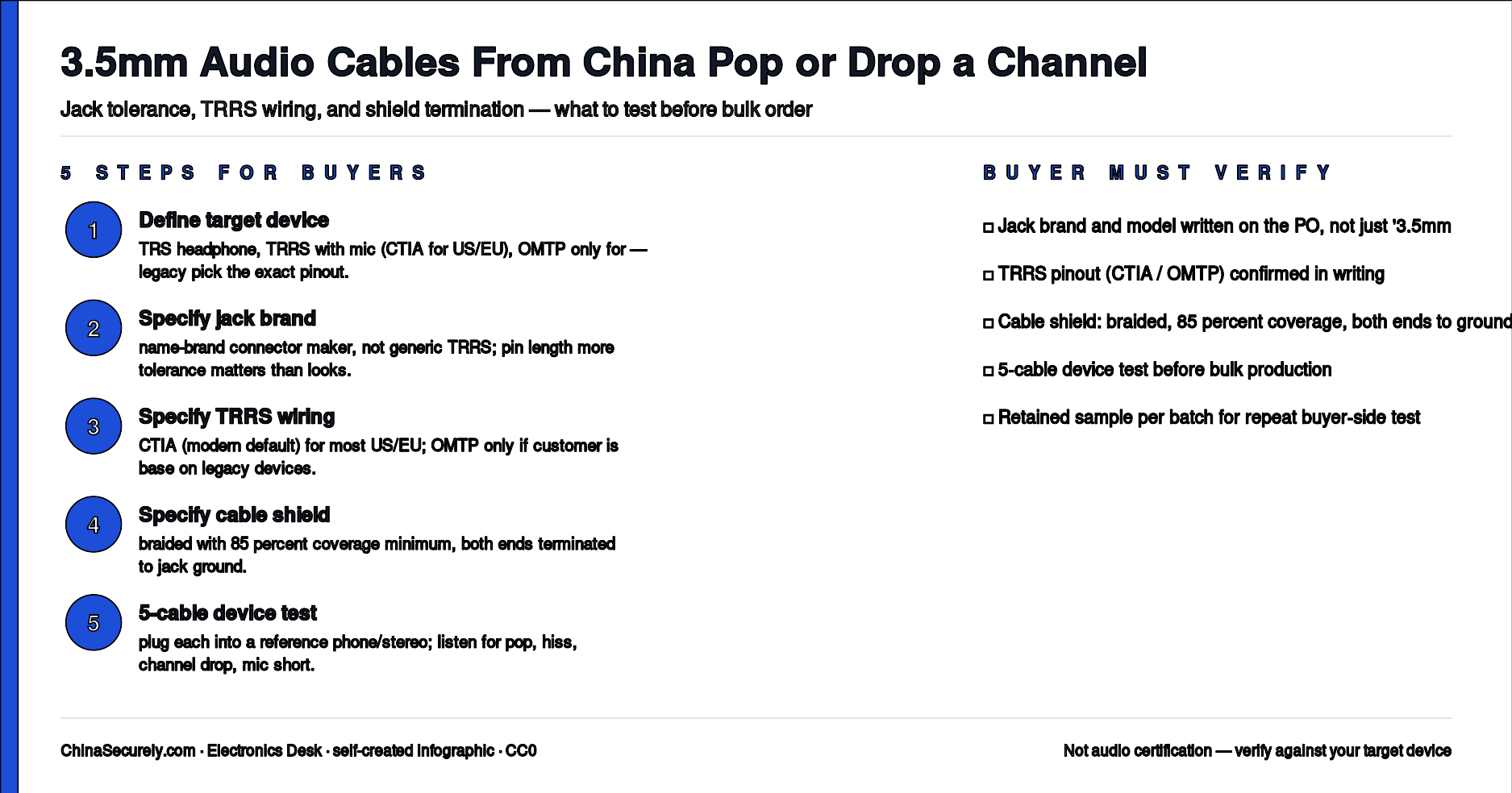
- Decide the exact device class you need to support: standard TRS headphone, TRRS with mic for Android (CTIA), TRRS with mic for older Nokia/Apple (OMTP), or a specific phone maker’s pinout.
- Ask the factory for the jack brand and model, not just “3.5mm TRRS jack.” Name-brand jacks (e.g., from recognized connector makers) have tighter tolerance.
- Specify the TRRS wiring order on the PO: CTIA (modern default) for most US/EU markets, OMTP only if you know your customer base is on legacy devices.
- Specify the cable shield: braided with 85 percent coverage minimum, both ends terminated to jack ground.
- Request a 5-cable buyer-side test before bulk order: plug each into a known reference device, run a 30 second audio sweep, listen for pop, hiss, channel drop, and mic short.
- Ask for a retained sample from each cable batch (not just the golden sample) for your own repeat test.
- Photograph and document any defective cable at receiving with the batch number; many factories will agree to a 5 percent credit on a documented failure rate above 3 percent.
What to ask the supplier (copy-paste ready)
“Please confirm the exact 3.5mm jack brand and model used (e.g., a recognized connector maker, not just ‘generic TRRS’). Please confirm the TRRS wiring order (CTIA, OMTP, or proprietary) and the cable shield type (target braided with 85 percent coverage, both ends terminated to jack ground). We will be bundling this cable with our Bluetooth adapter for US retail, so it must work cleanly with iOS and Android phones. Please send 5 pre-shipment samples for our own device test before bulk production.”
Practical checklist
- Specify TRS vs TRRS, and the exact TRRS pinout (CTIA for most US/EU)
- Specify jack brand or model, not just “3.5mm jack”
- Specify cable shield type and coverage
- Specify both-ends shield termination to jack ground
- 5-cable buyer-side test on reference device before bulk order
- Listen for pop, hiss, channel drop, mic short
- Retained sample per batch for repeat test
- Document defective cables with batch number at receiving
Trade-offs and uncertainty
- Name-brand jack vs generic: 30 to 50 percent cost increase per cable, but failure rate drops from 5 to 10 percent to under 1 percent. For a 5,000-piece order, the math usually works.
- Braided vs spiral shield: 10 to 15 percent cost increase. For cables used near phones or USB chargers, braided is worth it. For cables used only with home stereos, spiral is fine.
- CTIA vs OMTP: CTIA is the modern default and works with iOS and most Android phones. OMTP is legacy. If your customer base includes older devices, you may need to carry both wiring orders.
- Buyer-side test takes 30 to 60 minutes per cable class. For a 5-cable sample test, budget 4 hours of listening time on a reference setup. This is much cheaper than a 5 percent defect rate at receiving.
Related questions
- What is the difference between TRS and TRRS 3.5mm jacks?
- Why do some 3.5mm cables work on Android but not iPhone?
- How do I test an audio cable for channel balance?
- Are flat aux cables more prone to failure than round ones?
Internal CTA
If you need help reviewing a Chinese supplier’s audio cable spec or designing a buyer-side cable test plan, ChinaSecurely can review your existing quote, identify the right jack and shield spec for your target device, and suggest specific spec lines to add to your purchase order. Reply through the contact form with your cable type, target device, and order size.
Sources
- https://en.wikipedia.org/wiki/Phone_connector_(audio) (TRS/TRRS pinout reference)
- https://www.iec.ch/homestead (IEC 60603-11 – audio connector standard family)
- https://www.aes.org/aes/aes-standard-development/ (AES audio standards)
- factory jack brand and model (request at quote time)
Authoritative references (added 2026-08-03)
- IEC 60603-11 — Connectors for electronic equipment, 3.5 mm audio jack specification: https://www.iec.ch/publication/3586
- IEC 62680-3 — USB Audio device class specification: https://www.iec.ch/iec-normen-snaps/?refkey=64642
- AEC-Q100 — Stress test qualification for integrated circuits (reference for consumer-grade ICs): https://www.aecouncil.com/Documents/AEC_Q100_Rev_H.pdf
- USB Audio Device Class 3.0 — class-specific device behavior: https://www.usb.org/sites/default/files/audio10.pdf
The 3.5mm jack spec (IEC 60603-11) covers tolerances; channel imbalance and popping are downstream of jack contact integrity. USB Audio and IEC 62680 are useful references for hybrid USB-C to 3.5mm dongles, not for the raw cable. Use a USB tester like the Plugable USB Audio Tester to confirm channel balance under the load of a real headphone.