
Short answer: a rigid gift box with a magnetic closure that opens during shipping usually has one of three root causes: the magnet pull force is below 0.5 N, the magnet alignment between lid and base is off by more than 1 mm, or the glue bond at the magnet pocket fails under stress. The buyer cannot see any of this from the outside. The buyer has to lock the magnet pull force on the PO, run a hand pull test on the sample, and run a five-piece drop test before bulk.
Why this problem happens
Magnetic closure failure is one of the top three return reasons for rigid gift boxes sourced from China. The hardware looks fine on the sample line. The hardware fails in transit. Three things drive the gap:
- The magnet pull force is dropped between sample and bulk. A sample may use a neodymium N35 magnet with 1.2 N pull force, while bulk uses an N30 or N27 magnet with 0.4 to 0.6 N pull force. The closure looks the same but does not hold.
- The magnet alignment between the lid and the base is not specified. If the lid magnet sits 1.5 mm off-center from the base magnet, the magnetic flux drops sharply and the box opens when lifted.
- The glue at the magnet pocket is not filled to the edge of the recess. A magnet pocket with a partial glue fillet can pull out under the stress of a 30 cm drop.
China-side explanation
Most Chinese rigid box factories source magnets from a separate magnet supplier. The box factory wraps greyboard or MDF board with printed paper, cuts the magnet pocket, glues the magnet in, and assembles the lid and base. Two silent variables show up here. First, the magnet supplier may change the neodymium grade between the sample quote and the bulk order without telling the box factory. Second, the box factory’s gluing operator may rush the magnet pocket on a bulk run because the glue needs 30 seconds to set before the next step, and a tighter production schedule cuts that wait.
Buyers who only check the magnet size or the box dimensions miss these two variables. The right checks are pull force, alignment, and glue pocket fillet.
Step-by-step solution
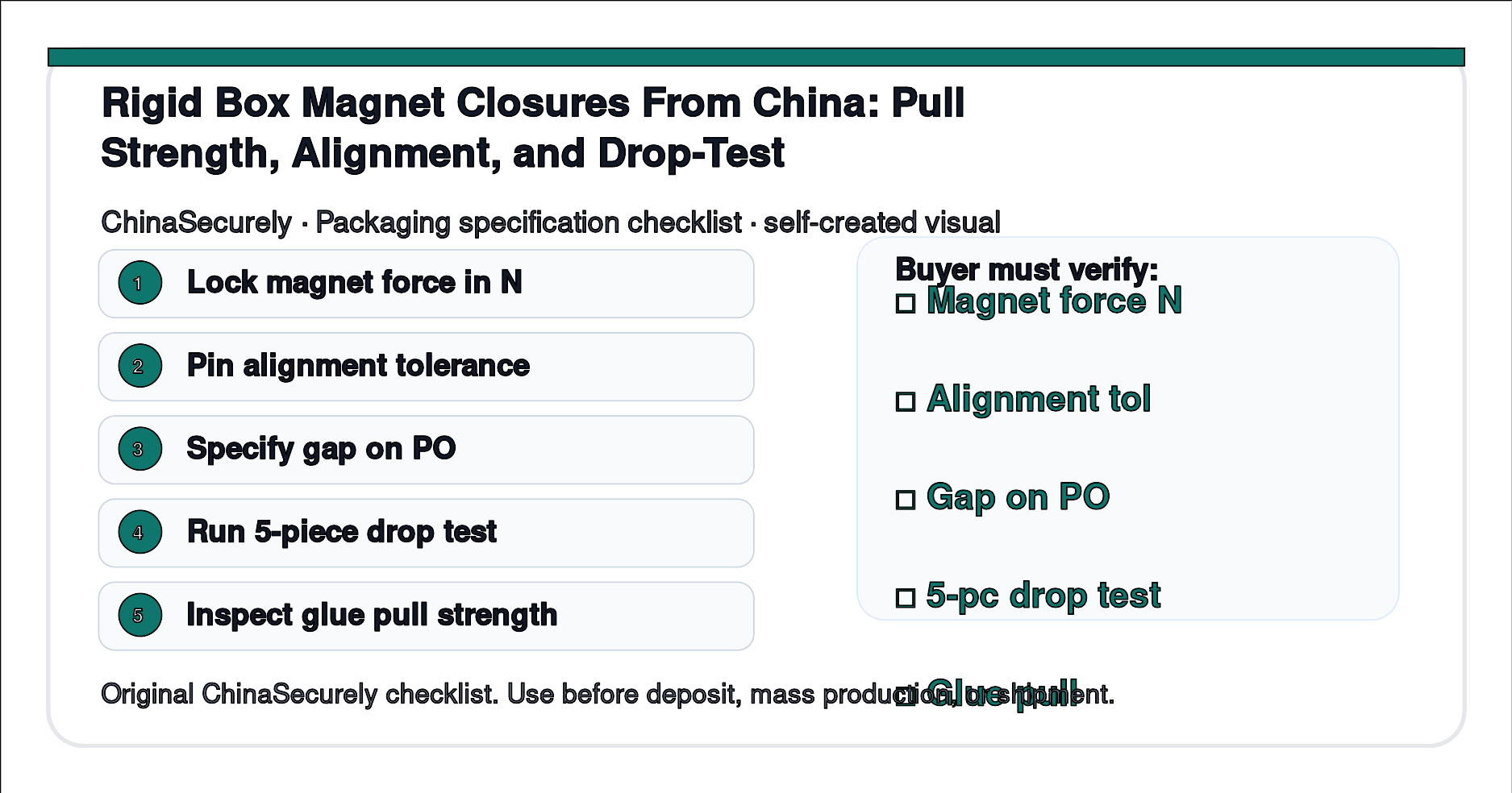
- Lock the magnet pull force on the PO: 1.0 N minimum for a rigid gift box under 500 g, 1.5 N for boxes over 500 g. Specify the magnet grade (N35, N38, N42).
- Specify the alignment tolerance: the lid magnet must sit within 1.0 mm of the base magnet centerline.
- Specify the gap tolerance between lid and base: 0.5 to 1.0 mm maximum.
- Run a 5-piece hand pull test: open each box 10 times, then check if the magnets still hold.
- Run a 5-piece drop test: drop each box from 30 cm onto a hardwood floor, then check for closure failure and magnet pocket damage.
- Inspect the glue pocket on a cut-open sample: the glue fillet must cover the full magnet circumference.
Magnetic closure verification table
| Check | What to verify | Where to look |
|---|---|---|
| Magnet pull force | 1.0 to 1.5 N minimum | PO and supplier datasheet |
| Magnet grade | N35 or higher | Supplier datasheet |
| Alignment tolerance | Within 1.0 mm | Sample inspection |
| Gap tolerance | 0.5 to 1.0 mm | Sample inspection |
| Glue pocket fillet | Full circumference | Cut-open sample |
| 5-piece drop test | No closure failure | 5-piece pilot |
What to ask the supplier
A safer way to ask the supplier:
“Please confirm the magnet grade (N35 or higher), the magnet pull force in Newtons (1.0 N minimum), the alignment tolerance between lid and base magnets (within 1.0 mm), and the glue type at the magnet pocket. Send a five-piece pilot with measured pull force values stamped on the box label.”
Buyer checklist before signing the PO
- Magnet pull force is named on the PO (1.0 to 1.5 N).
- Magnet grade is named on the PO (N35 or higher).
- Alignment tolerance is specified (within 1.0 mm).
- Gap tolerance is specified (0.5 to 1.0 mm).
- 5-piece pilot passes hand pull test.
- 5-piece pilot passes 30 cm drop test.
- Glue pocket inspection on a cut-open sample passes.
Authoritative references
- ISO 2233 – packaging – conditioning for testing
- FEFCO – European Federation of Corrugated Board Manufacturers
- TAPPI – packaging test methods
- ASTM D4169 – transport packaging simulation
- GS1 – barcode standards for retail packaging
- QIMA – pre-shipment inspection and supplier verification
Magnet pull force, alignment, and glue bond are specification decisions, not closure preferences. ISO 2233, FEFCO, TAPPI, ASTM D4169, and GS1 are the public references for this category. Run a hand pull test and a 30 cm drop test on a five-piece pilot before bulk. This article is a sourcing verification checklist, not a magnetic engineering specification.