
You ordered 5,000 kraft paper bags with handles for your boutique store. Three weeks after arrival, 8% have torn handles or split seams. The supplier says this is “normal.”
Buyer question: “We ordered 5,000 boutique kraft paper bags. Within three weeks of arrival, 8 percent had torn handles or split seams. The supplier says this is normal. What should we have specified on the PO?”
The tearing problem usually comes down to one thing: the paper grade was not specific enough in your order.
Why Kraft Paper Quality Varies
Virgin kraft vs recycled kraft: virgin has higher tear resistance. GSM: higher GSM means thicker, stronger paper. Grade classification: “Grade A” from one mill may not equal “Grade A” from another. Wet strength: standard kraft loses strength when wet; wet-strength treated kraft is needed for humid environments.
The China-Side Explanation
When a Chinese kraft bag supplier receives your order, they source paper from a mill. If you do not specify the grade and GSM, they use whatever is most economical. For Chinese retail bags, 120gsm recycled kraft with twisted paper handles is standard. For a boutique selling ceramics or heavy glassware, handles will tear.
Step-by-Step: How to Specify Kraft Bags That Will Not Tear
- State the minimum GSM explicitly — write “minimum 180gsm” not just “180gsm.”
- Specify virgin vs recycled — request “100% virgin kraft” or “minimum 80% virgin fiber content.”
- Ask about the paper mill — popular export-quality kraft comes from Nine Dragon, Shanying, or Lee & Man.
- Define handle type — “flat paper handle, reinforced top panel, minimum 8kg load capacity.”
- Request a sample with a weight test — confirm the bag can hold a specified weight without handle tear.
What to Ask the Supplier
“We need kraft bags that can hold 5kg without handle tear. Please confirm the paper grade, GSM, virgin/recycled ratio, and handle attachment method you propose.”
Trade-offs and uncertainty
Virgin vs recycled fiber: virgin kraft has roughly 30 to 50 percent higher tear resistance than 100 percent recycled. A boutique selling heavy ceramics or glassware should specify minimum 80 percent virgin. A boutique selling lightweight paper goods can use 100 percent recycled at a lower cost.
Twisted paper handle vs flat tape handle: twisted paper handles are standard on Chinese retail kraft bags but tear more easily under load. Flat tape (ribbon-style) handles handle roughly 50 percent more load. For a bag that will carry 3 kg or more, specify flat tape.
GSM vs actual thickness: GSM (grams per square meter) is the standard spec, but actual thickness and burst strength also depend on the paper mill’s process. Two 180 GSM papers from different mills can differ by 30 percent in burst strength. Ask for the mill name and an independent burst-strength test on the production-line sample.
Load capacity vs sample test: suppliers usually quote a load capacity based on the paper spec, not a real handle-pull test. A real test (hang 5 kg from one handle for 60 seconds, lift 50 times) catches the weak handle attachment that the paper spec misses.
Checklist: Before Ordering Kraft Bags from China
- □ GSM specified with “minimum” language
- □ Virgin vs recycled fiber ratio specified
- □ Paper mill named and confirmed
- □ Handle type and attachment method specified
- □ Load capacity requirement stated in writing
- □ Sample received and weight-tested before bulk
Need help specifying a kraft bag order from China? Send the product weight and supplier quote. ChinaSecurely can help you identify what is missing before you pay.
Updated source and visual note
This draft was updated with a self-created ChinaSecurely checklist image and public source notes. Buyer-forum access was degraded during the run, so any buyer scenario should be treated as a common demand pattern, not a direct quotation.
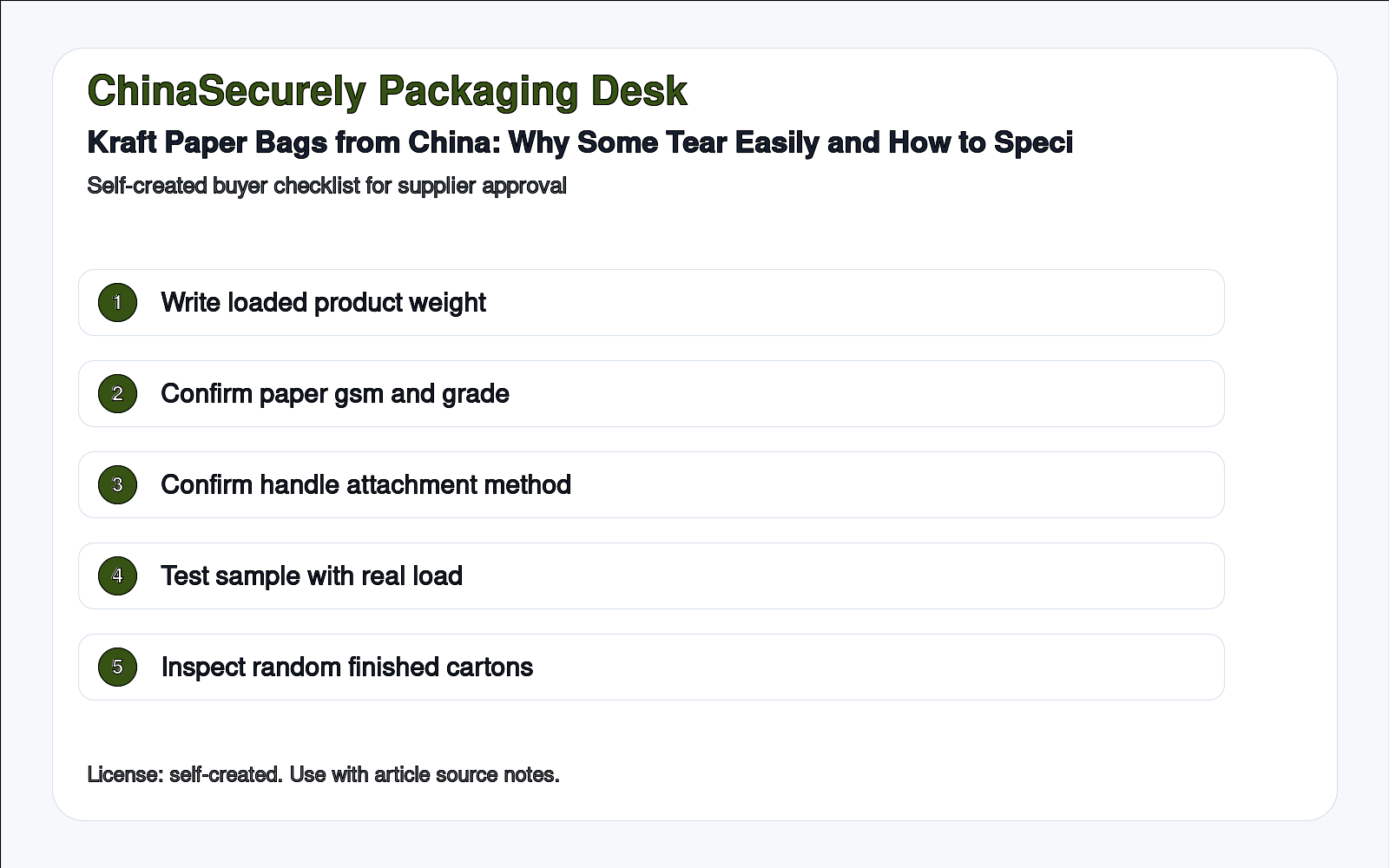
- https://www.fedex.com/en-us/shipping/packing/how-to-pack.html
- https://www.qima.com/quality-control-inspections/pre-shipment-inspection
Authoritative references (added 2026-07-22)
- TAPPI — Test methods for paper and paperboard (public overview)
- ASTM D828 — Standard test method for tensile properties of paper and paperboard
- ISO 2758 — Paper — Determination of bursting strength
- ISO 1974 — Paper — Determination of tearing resistance (Elmendorf method)
- QIMA pre-shipment inspection checklist (public overview)
Source access: TAPPI, ASTM, and ISO pages were accessed via public web on 2026-07-22. ASTM D828 and ISO 1974 full text is paid; the parameters above are taken from the public abstract and the standards’ scope statements. For boutique retail applications, ask the kraft mill for a specific datasheet with GSM, virgin fiber percentage, and tensile strength.
Source and verification notes (updated 2026-07-30)
- ASTM D1922 — Propagation tear resistance of plastic film and thin sheeting: https://www.astm.org/d1922-15.html
- ASTM D882 — Tensile properties of thin plastic sheeting: https://www.astm.org/d0882-18.html
- ISO 1924-2 — Paper and board tensile properties: https://www.iso.org/standard/68346.html
- TAPPI standards and technical information for paper testing: https://www.tappi.org/standards/
The correct paper basis weight and handle reinforcement depend on bag dimensions, product weight, humidity, and transport conditions. Supplier grade names are not proof. Approve a production-line sample and run load and handle-pull tests using the buyer’s real product before bulk production.