
Short answer: an LED bulb that looks stable to the human eye can flicker visibly under a phone camera at 240 fps. The cause is almost always a low-frequency PWM driver IC or a missing driver circuit. The factory did not lie; the bulb is technically functional. The buyer’s spec did not name the driver IC or the PWM frequency, so the factory used the cheapest driver available. Here is how to lock the spec before deposit.
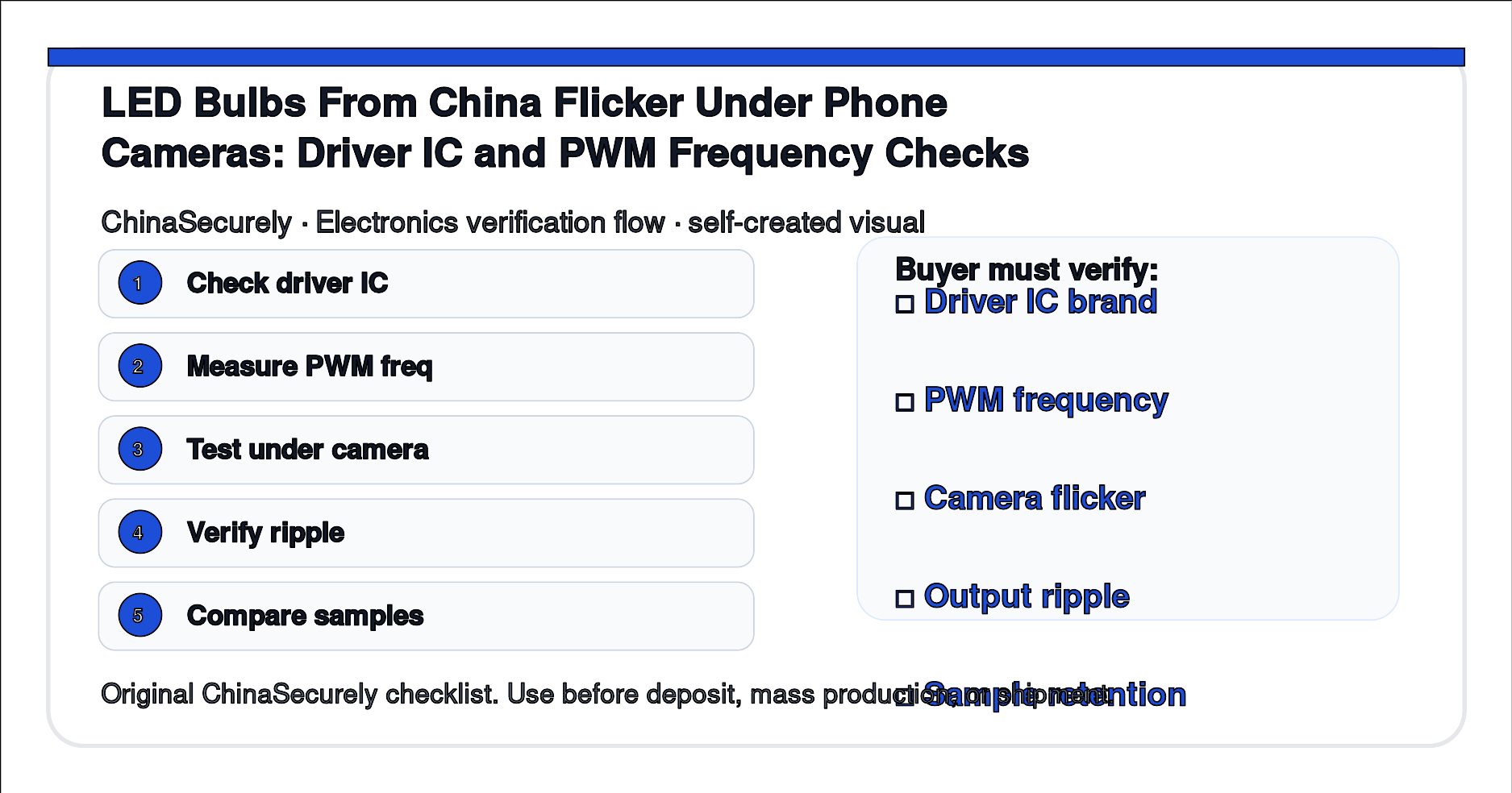
Why LED bulbs flicker under cameras
LED bulbs flicker for two reasons. The first is the driver IC design: a constant-current driver with a high-frequency PWM (over 1 kHz) produces no visible flicker; a low-frequency PWM (100 to 400 Hz) produces visible flicker on slow-motion or high-frame-rate cameras even though the human eye averages it. The second reason is ripple on the DC output: a poorly filtered driver can produce 50 to 200 Hz output ripple from the AC line frequency, which compounds the flicker. The combined effect is that the bulb looks stable in a showroom and flickers visibly on a customer’s phone camera in a kitchen or office.
The China-side explanation is straightforward. Driver IC spot pricing moves with the global semiconductor market; a factory that quotes aggressively will use a low-cost driver IC with low PWM frequency. The visual difference to the human eye is zero; the difference on a phone camera is dramatic. A small importer who orders by price-per-bulb and inspects by visual stability will accept the cheaper quote and discover the flicker when the first customer review shows up: “bulb flickers on my phone.”
What to lock on the PO
- Driver IC brand and part number: locked in writing (e.g., Power Integrations, ON Semiconductor, or equivalent).
- PWM frequency: minimum 1 kHz, ideally above 4 kHz for camera-safe operation.
- Output ripple: maximum 5 percent of the average DC output current.
- Power factor: minimum 0.9 per IEC 61000-3-2 for commercial use.
- Certification: UL 1993 or Energy Star listed, FCC Part 15B verified.
Buyer must verify before deposit
- Ask the supplier for the driver IC brand and part number.
- Ask the supplier for the PWM frequency in writing.
- Request a 5-piece pre-production sample from the real production line.
- Test the sample under a phone camera in slow-motion mode (240 fps or higher).
- Measure the output ripple with an oscilloscope at the bulb input.
- Verify the UL or Energy Star certification is current and matches the model number.
China-side explanation
LED bulb factories in Shenzhen, Zhongshan, and Foshan operate on a tight cost-down schedule. A driver IC that costs USD 0.80 versus USD 0.30 is a significant margin difference on a 10,000-bulb order. A factory that sources the cheapest driver IC for the bulk run will see the BOM cost drop by 5 to 8 percent, but the PWM frequency will fall and the flicker will rise. The visual difference to the showroom inspector is invisible; the difference on a customer’s phone camera is the first negative review. The cheapest insurance is to require the supplier to disclose the driver IC brand and part number on the PO, and to add a sample retention clause plus a PWM frequency clause so the bulk run can be checked against the original sample.
Step-by-step solution
- Send the supplier a written spec: driver IC brand and part number, PWM frequency minimum 1 kHz, output ripple max 5 percent, certification clause.
- Order a 5-piece pre-production sample from the real production line.
- Test the sample under a phone camera in slow-motion mode at 240 fps or higher.
- Measure the output ripple with an oscilloscope at the bulb input.
- Verify the UL or Energy Star certification is current and matches the model number.
- Add a sample retention clause and a driver-disclosure clause to the PO.
Quick checklist
- Driver IC locked: brand and part number in writing.
- PWM frequency locked: minimum 1 kHz, ideally above 4 kHz.
- Output ripple locked: max 5 percent of average DC output.
- Power factor locked: minimum 0.9 per IEC 61000-3-2.
- Phone-camera test passed: no visible flicker at 240 fps.
- Certification current: UL 1993 or Energy Star, FCC Part 15B.
Sources
- IEC 61547 — Equipment for general lighting purposes: EMC immunity requirements
- IEC 61000-3-2 — Limits for harmonic current emissions (equipment input current ≤ 16 A per phase)
- US DOE — Solid-state lighting technology fact sheet on flicker
- IEEE 1789-2015 — Recommended practices for modulating current in high-brightness LEDs
- UL 1993 — Standard for self-ballasted lamps and lamp adapters
- QIMA — Pre-shipment inspection for LED bulbs and lighting
This article is for sourcing verification, not for lighting engineering or certification. Confirm your final flicker performance and certification path with a qualified testing lab before listing in the US market.