
Short answer: a glass storage jar with a lid that loosens during shipping or refuses to close on the first try usually has one of three root causes: the glass thread and the metal lid thread do not match, the gasket is too soft or too hard for the closure, or the lid metal gauge is too thin to hold torque. The buyer cannot tell from the housing. The buyer has to lock the spec, test the torque by hand, and run a 24-hour leak test before bulk.
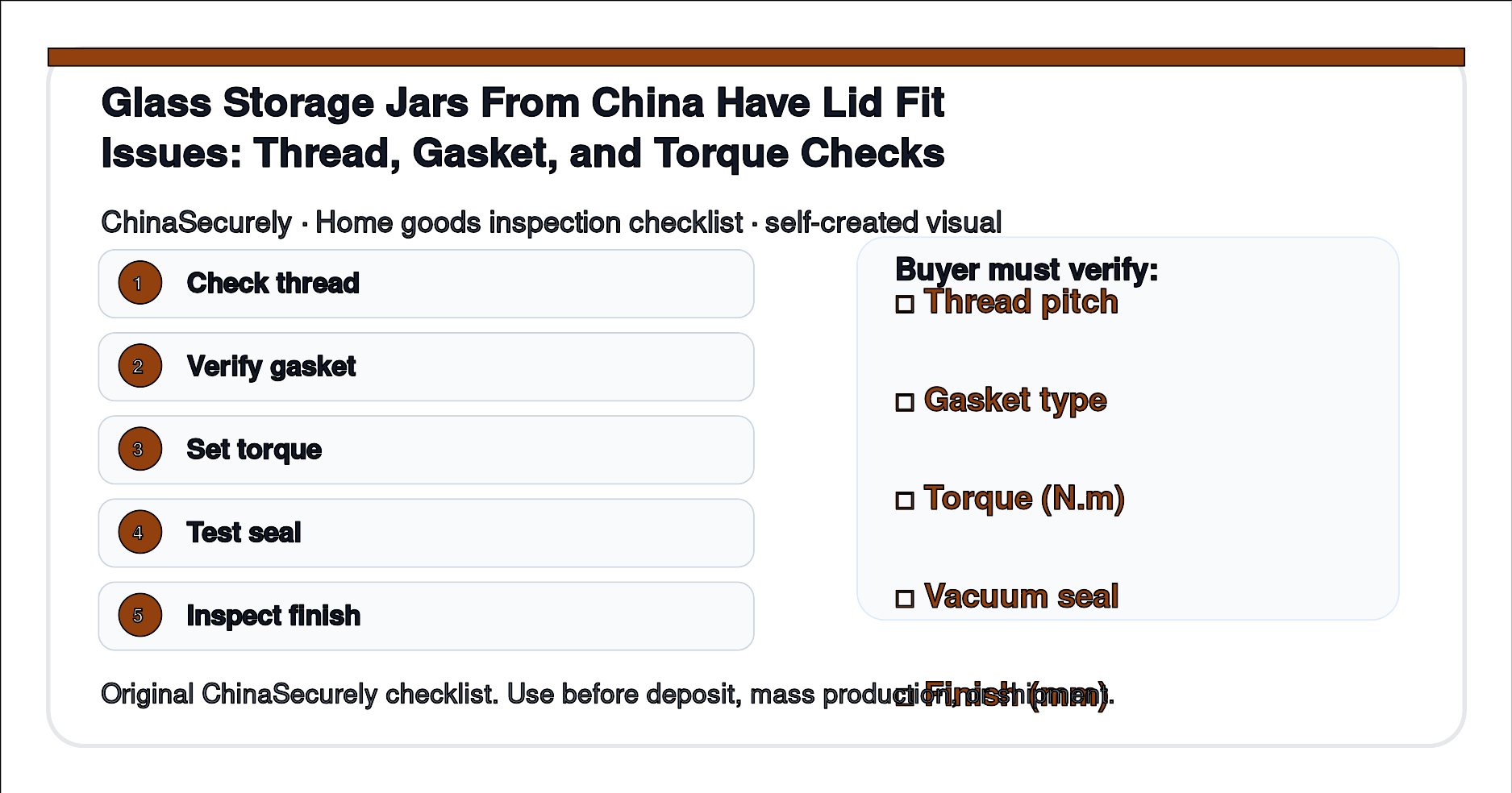
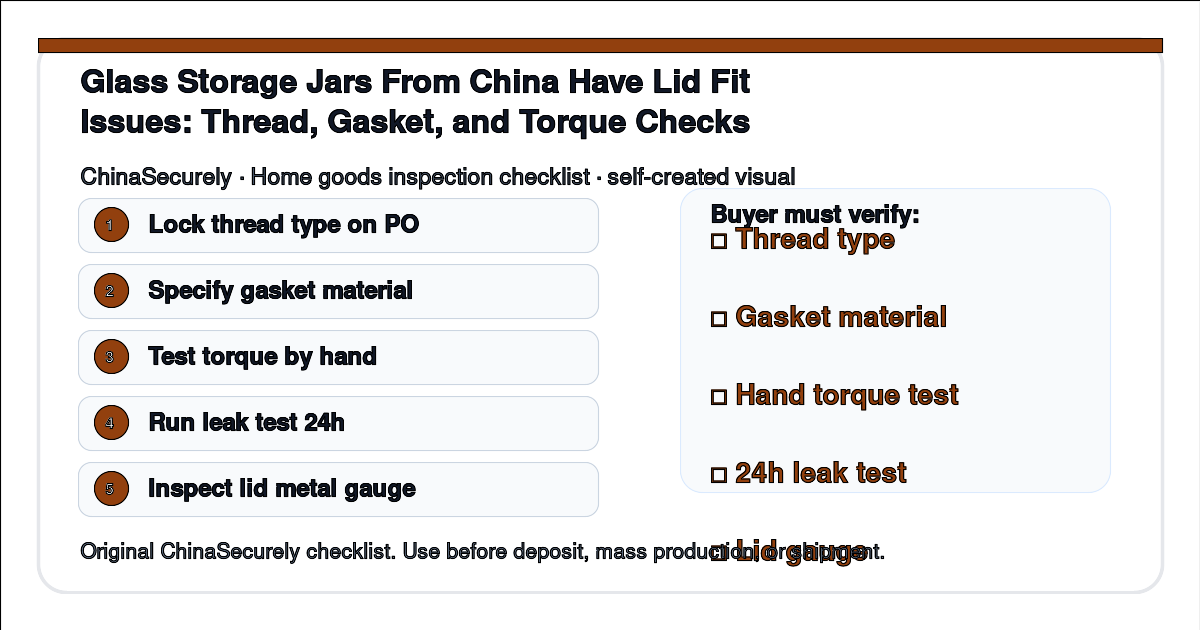
Why this problem happens
Lid fit is the single most common return reason for glass storage jars sourced from China. The hardware works on the sample line. The hardware fails in the field. Three things drive the gap:
- The glass thread and the metal lid thread are made by different suppliers. A 1 mm difference in thread pitch on the glass and 1 mm difference in thread depth on the lid creates a lid that crosses on every other jar.
- The gasket material is changed between sample and bulk. A silicone gasket on the sample and a rubber gasket on bulk will not give the same torque.
- The lid metal gauge is reduced for bulk to save cost. A 0.23 mm lid on the sample and a 0.18 mm lid on bulk will dent during shipping and lose torque.
China-side explanation
Most Chinese glass jar factories buy the metal lids from a separate lid factory. The glass factory makes the jars; the lid factory makes the lids; the assembly factory puts the gasket in the lid and packs the jar with the lid loosely screwed on. If the assembly factory changes lid suppliers between sample and bulk, the new lid will not match the glass thread even if both are labeled the same size.
The gasket is the silent variable. A silicone gasket rated for food contact (FDA 21 CFR 177.2600 in the US, EU 1935/2004 in the EU) costs more than an industrial rubber gasket. The supplier will use the silicone gasket on the sample and the rubber gasket on bulk if the buyer does not name the gasket material on the PO. Lid torque will change because rubber compresses differently than silicone.
Step-by-step solution
- Lock the thread type on the PO: GL, GPI, or continuous thread. Specify the thread diameter and pitch in mm.
- Specify the gasket material: silicone (FDA 21 CFR 177.2600 / EU 1935/2004), EPDM, or NBR. Name the food-contact compliance on the PO.
- Specify the lid metal gauge: 0.23 mm tinplate minimum for jars over 500 ml, 0.20 mm for jars under 500 ml.
- Run a 5-piece hand torque test: close each jar by hand, then try to open it. The lid should resist opening but not require pliers.
- Run a 24-hour leak test: fill the jar with water, close it, invert it on a paper towel for 24 hours. No water mark on the towel.
- Run an ASTM D4169 transport simulation on a 5-piece pilot to confirm the lid holds torque during shipping.
Lid fit verification table
| Check | What to verify | Where to look |
|---|---|---|
| Thread type | GL / GPI / continuous thread | Supplier datasheet |
| Thread diameter | Named in mm on PO | PO and lid sample |
| Gasket material | Silicone / EPDM / NBR | PO and lid sample |
| Food-contact compliance | FDA 21 CFR 177.2600 / EU 1935/2004 | Compliance cert |
| Lid metal gauge | 0.20 to 0.23 mm minimum | Calipers |
| Hand torque | Resists opening, no pliers needed | 5-piece pilot |
| 24h leak test | No water mark on towel | 5-piece pilot |
Buyer checklist before signing the PO
- Thread type and diameter are named on the PO.
- Gasket material is named with food-contact compliance.
- Lid metal gauge is named (0.20 to 0.23 mm minimum).
- 5-piece pilot passes hand torque test.
- 5-piece pilot passes 24-hour leak test.
- 5-piece pilot passes ASTM D4169 transport simulation.
Authoritative references
- ASTM C147 — alkali resistance of glass
- FDA — Food Contact Substances database
- European Commission — food contact materials
- ASTM D4169 — transport packaging simulation
- BfR — German food contact consumer information
- QIMA — pre-shipment inspection and supplier verification
Lid fit is a specification decision, not a closure preference. ASTM C147 glass, FDA Food Contact Substances, EU 1935/2004, ASTM D4169 transport simulation, and BfR food contact guidance are the public references for this category. Run a hand torque test and a 24-hour leak test on a 5-piece pilot before bulk. This article is a sourcing verification checklist, not a glass manufacturing specification.