
Short Answer
Not all lithium batteries are treated the same way, and whether you can ship them by air depends on the battery type, capacity, and how they are packed. Small lithium ion batteries (like those in power banks and most consumer electronics) can be shipped by air, but they must meet specific UN testing requirements, be properly declared, and be packed according to IATA packing instructions. Failing to declare or properly pack lithium batteries is one of the most common reasons shipments are held or rejected at Chinese export customs — and it can result in fines or worse. Here is what you actually need to do.
Why This Problem Happens
Why importers get caught
The rules for shipping lithium batteries by air are stricter than most small importers realize. The International Air Transport Association (IATA) sets the standards, and Chinese customs as well as the destination country customs all enforce them. The confusion comes from three sources: (1) lithium ion batteries (rechargeable) and lithium metal batteries (non-rechargeable) have different rules, (2) the watt-hour rating of the battery determines which rules apply, and (3) the rules distinguish between batteries shipped by themselves versus batteries installed in devices.
The UN38.3 requirement
All lithium batteries shipped by air must have passed the UN38.3 transport test series — a set of eight environmental and electrical tests that verify batteries can survive the rigors of air transport. These tests include altitude simulation, thermal test, vibration, shock, short circuit, impact, and forced discharge. A battery that has not been UN38.3 tested cannot be legally shipped by air. Suppliers sometimes claim their batteries are certified but have not actually completed the full UN38.3 test series.
Watt-hour rating is the key number
For lithium ion batteries, the watt-hour (Wh) rating determines what rules apply. The IATA dangerous goods regulations set specific thresholds:
- Under 100Wh: batteries must be for personal use or properly declared; can ship with the right documentation
- 100–160Wh: requires airline approval and special marking; limited quantity per package
- Above 160Wh: generally prohibited for passenger aircraft; cargo aircraft only with full dangerous goods documentation
Most small consumer electronics — power banks, phone batteries, small tool batteries — fall in the under-100Wh category, but you still need to declare and pack them correctly.
What It Looks Like from the China Side
How Chinese freight forwarders handle it
Good Chinese freight forwarders who specialize in electronics exports know these rules well. They will ask you for the Wh rating of your batteries before they quote shipping. If you do not know the Wh rating, they will often look it up from the battery specification sheet or refuse to quote — which is a sign they are legitimate. Forwarders who quote air shipping for lithium battery products without asking about Wh ratings are either inexperienced or willing to cut corners, and you do not want either.
What Chinese export customs checks
When your shipment leaves China, Chinese customs inspects outbound dangerous goods declarations. If your lithium batteries are not properly declared, the forwarder’s truck will be stopped at the export checkpoint. This is a common delay cause for first-time importers who did not realize their product contained lithium batteries — particularly products like power banks, portable speakers with built-in batteries, or items with backup batteries.
The test report problem
Chinese factories often do not have UN38.3 reports for the batteries they use. Battery cells are typically purchased from specialized battery manufacturers, not made in-house. The factory may not have ever requested the UN38.3 report from their battery supplier, or the report may be from an older production batch. When you ask for it, the factory may say "we have it" but then produce a report that is incomplete, from an unaccredited lab, or does not cover the specific battery cells in your order.
Step-by-Step Solution
Step 1: Identify the battery type and Wh rating in your product
Before you arrange shipping, find the battery specification sheet for your product. Look for:
- Battery chemistry: lithium ion (Li-ion, LiPo) or lithium metal
- Nominal voltage (V) and capacity (Ah) — Wh = V × Ah
- Whether the battery is installed in the device or shipped separately
If the spec sheet is in Chinese, look for "标称电压" (nominal voltage) and "容量" (capacity). The Wh rating is the key number for determining shipping rules.
Step 2: Ask your supplier for the UN38.3 test report
Request the UN38.3 test report for the specific battery cells in your product — not a generic report for a similar battery model. A real UN38.3 report includes:
- The battery manufacturer’s name and address
- The specific battery model and chemistry
- The eight test results with actual data (not just "pass")
- The testing laboratory’s accreditation number
If the supplier cannot or will not provide a UN38.3 report, treat this as a serious red flag. Without it, your shipment may be stopped at Chinese customs or rejected by the airline.
Step 3: Choose a freight forwarder who knows dangerous goods
Select a forwarder with demonstrable experience shipping electronics with lithium batteries. Ask them specifically: "Have you shipped products with [your Wh rating] batteries before? What documentation do you need from me?" A competent forwarder will have a checklist of their own.
Step 4: Prepare the proper documentation
For air shipping lithium batteries under 100Wh (the most common case for small importers), you typically need:
- Shipper’s Declaration for Dangerous Goods (if required by the airline)
- Commercial invoice with battery details and Wh rating stated
- Packing list showing quantity and battery configuration
- UN38.3 test summary (often accepted as a one-page summary rather than the full report)
For batteries over 100Wh or for large quantities, full dangerous goods documentation is mandatory.
Step 5: Pack according to IATA packing instructions
Batteries must be packed to prevent short circuits. This means:
- Each battery in its own inner packaging (plastic bag or individual box)
- terminals protected against contact with metal surfaces
- Units secured in the outer box to prevent movement
- Outer box marked with the lithium battery handling label
The IATA packing instruction for lithium batteries (PI 965 for Li-ion standalone, PI 966 for Li-ion with device) specifies the exact requirements.
Step 6: Inform your airline or express carrier in advance
If shipping by express carrier (DHL, FedEx, UPS), they will handle the dangerous goods declaration on your behalf but they still need to know what they are carrying. If using a dedicated air freight booking, confirm with the airline that they accept lithium battery shipments in your quantity and configuration.
Costs, Risks, and Tradeoffs
Cost of proper declaration and packing
The additional cost of proper lithium battery shipping documentation and packing is relatively modest — a few dollars per shipment for the declaration and labeling, plus the cost of proper inner packaging. The cost of NOT doing it properly is much higher: shipment delays at Chinese export customs, fines, airline rejection of your cargo, or worst case, a safety incident.
Risk of using a forwarder who does not handle dangerous goods
Freight forwarders who do not specialize in dangerous goods may under-declare or misclassify your shipment. If Chinese customs catches an under-declared lithium battery shipment, the forwarder faces fines and the shipment may be seized. The importer bears the cost of delays even if the forwarder is technically at fault.
Tradeoff: air freight vs. sea freight for battery products
Air freight is the practical choice for smaller orders of battery-powered electronics because the UN38.3 rules are more manageable for smaller quantities and the faster transit reduces the window for things to go wrong. Sea freight is cheaper but requires more documentation and longer transit times increase logistics complexity. For larger orders, sea freight may be the only economical choice, and the UN38.3 requirements apply there too.
Practical Checklist
Before shipping:
- ☐ Identify battery type (Li-ion vs Li-metal) and Wh rating from spec sheet
- ☐ Request UN38.3 test report for the specific battery cells — verify it covers the exact model
- ☐ Confirm Wh rating falls within airline’s acceptance limits (under 100Wh for most passenger aircraft)
- ☐ Choose a forwarder with specific dangerous goods experience — ask about their lithium battery shipment history
- ☐ Prepare commercial invoice and packing list that explicitly state Wh rating and battery chemistry
- ☐ Pack batteries with terminals protected; each battery in individual inner packaging
- ☐ Apply IATA lithium battery handling label to outer cartons
- ☐ Confirm booking with airline or express carrier — notify them of lithium battery content before drop-off
- ☐ Retain UN38.3 report and dangerous goods documentation for customs entry at destination
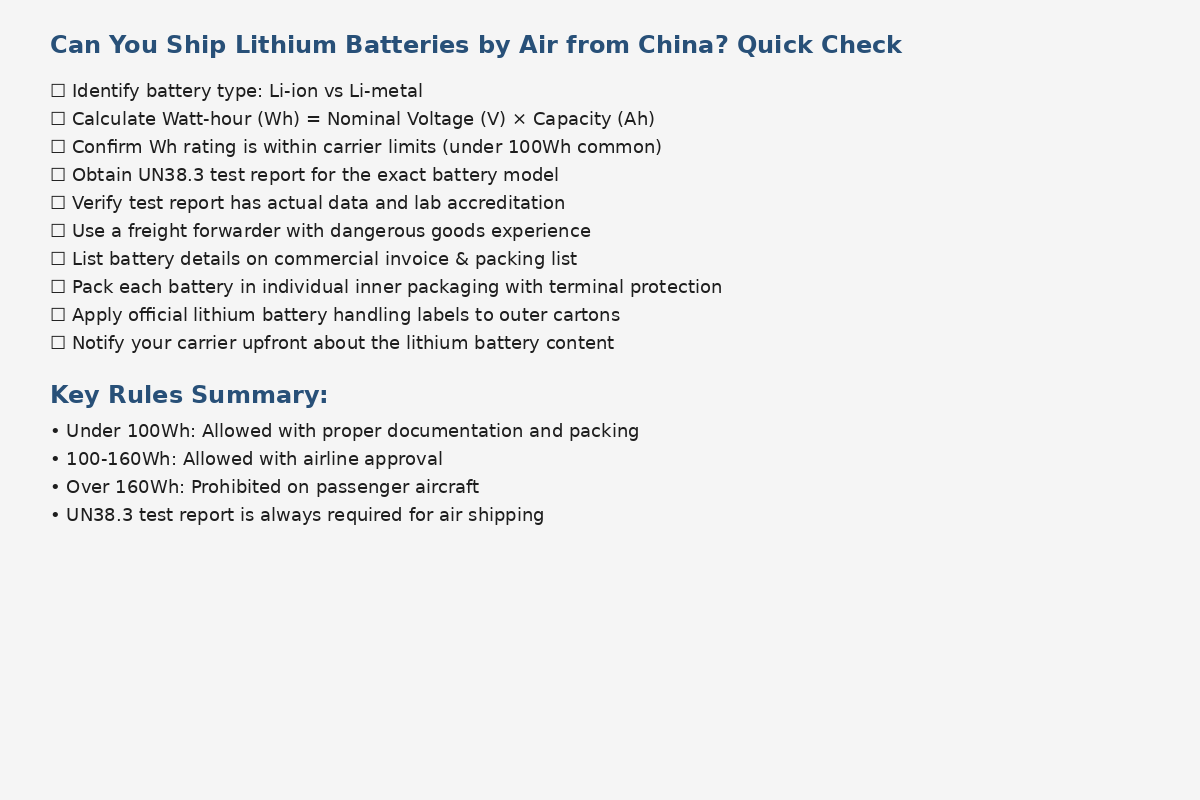
Quick Checklist for Importers
Below is a handy checklist you can follow before booking your air shipment:

(Created by ChinaSecurely based on IATA public guidelines — self-created, public domain)
Related Questions
Can I ship power banks from China by air?
Yes, power banks contain lithium ion batteries and can be shipped by air. They must be properly declared with their Wh rating, packed to prevent short circuits, and accompanied by UN38.3 test documentation. Most express carriers have standard processes for power bank shipments.
What happens if my lithium battery shipment is stopped at Chinese export customs?
Chinese customs may hold the shipment if lithium batteries are not properly declared or if the UN38.3 documentation is missing or incomplete. The forwarder typically has to resubmit documentation or provide missing test reports. This can add days to weeks to your shipping timeline.
Is sea freight a better option for large lithium battery orders?
Sea freight can handle larger quantities and higher Wh ratings than air freight, but the same UN38.3 requirements apply. The transit time is longer (3–6 weeks depending on route) and you still need complete dangerous goods documentation. Sea freight may require a freight forwarder with hazardous goods expertise.
How do I read a Chinese battery specification sheet?
Look for "标称电压" (nominal voltage) and "容量" or "额定容量" (rated capacity). The capacity is usually in ampere-hours (Ah). Multiply voltage by Ah to get Wh. For example, a 3.7V battery at 5,000mAh (0.005Ah × 3.7V = 18.5Wh).
Do all batteries in consumer electronics require UN38.3 testing?
All lithium batteries shipped by air — regardless of size — must have passed UN38.3 testing. This includes batteries installed in products, not just standalone batteries. If your product contains a lithium battery, the battery inside has to meet the standard.
Shipping lithium batteries from China involves real rules, not suggestions. Send the battery product type, Wh rating if known, and your order quantity before you book shipping. ChinaSecurely can help you understand the requirements and avoid common pitfalls.
Sources:
- IATA Dangerous Goods Regulations (publicly available summary)
- Buyer question pattern: Google Search suggestion "lithium battery shipping restrictions buyers guide"
- Note: article does not provide legal advice; importers should verify current regulations with their freight forwarder and the relevant airline/carrier