
Short answer: a cotton rug or runner from China that sheds fibers in the first month and curls at the edges within 30 days usually has one of three root causes: the backing latex was not fully dried before packing, the yarn twist is below the supplier’s sample, or the pile density dropped between sample and bulk. Cotton rugs are heavy and freight-expensive, so they are also one of the most common items to receive a quality cut when the supplier’s margin is squeezed. Here is how to lock the spec.
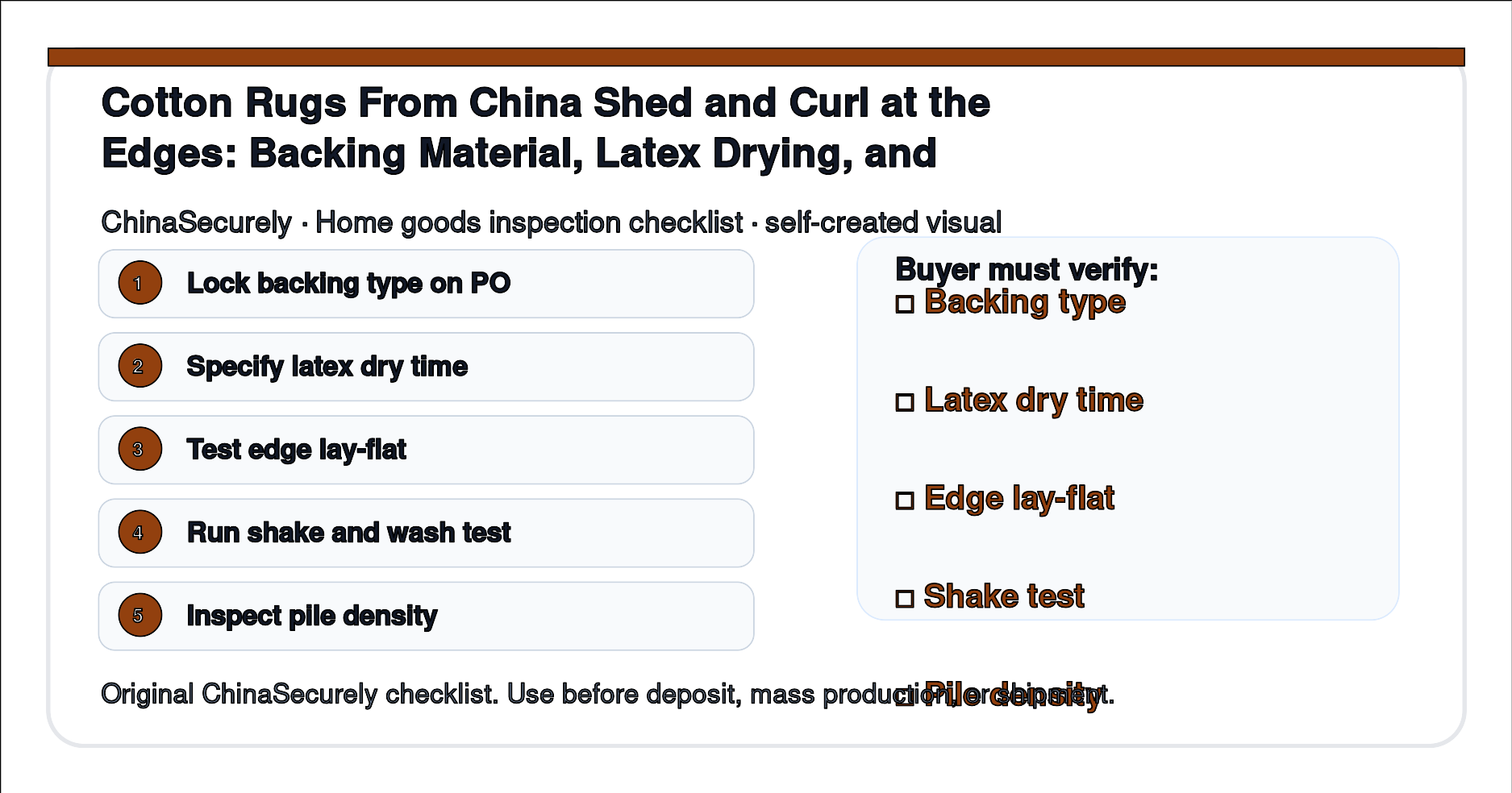
Why cotton rugs shed and curl
Cotton rugs shed for one of three reasons. The first is yarn twist: a supplier that quotes a 4-ply yarn will quietly switch to 3-ply when the order goes large, because the visual difference is hard to spot without cutting the yarn. The second is pile density: a rug quoted at 12 picks per inch may drop to 9 or 10 in the bulk run, which means loose fibers come free faster. The third is backing latex dry time: latex backing that ships before it is fully cured will off-gas in the container, curl at the edges within 30 days of unboxing, and may fail the latex delamination test.
The China-side explanation is straightforward. Latex backing needs 24 to 72 hours of drying time depending on humidity and temperature. A factory that is behind on shipping dates will pack the rug before the backing is fully cured. The rug looks flat when it leaves the factory, but the residual moisture and un-crosslinked latex will curl the edges within a month of arriving at the buyer’s warehouse.
What to lock on the PO
- Yarn ply count in writing (3-ply, 4-ply, or higher) with twist direction.
- Pile density in picks per inch, with a +/- 1 pick tolerance.
- Backing material: natural latex, synthetic latex, or cotton canvas.
- Latex dry time minimum in hours, with a packing-day clause.
- Shake and vacuum pre-pack clause to remove loose fibers.
Buyer must verify before deposit
- Request a 3-piece sample with the final yarn ply count and pile density.
- Inspect backing dry time by pressing a clean cloth against the backing for 10 seconds. No transfer is acceptable.
- Run a shake test: hold the rug by one corner and shake 10 times. Few loose fibers is acceptable; visible shedding is a red flag.
- Unroll the sample on a flat surface and wait 24 hours. Edges should lay flat within 5 mm.
- Run a wash cycle test on one sample per AATCC TM 135. Dimensional change above 5 percent is a red flag.
Source URLs
- AATCC test methods for textiles: https://members.aatcc.org
- ASTM D5848 pile yarn floor covering weight: https://www.astm.org/d5848-20.html
- ASTM D3936 backing delamination strength: https://www.astm.org/d3936-21.html
- Cotton USA sourcing reference: https://cottonusa.org/
- ASTM D4772 home laundering test: https://www.astm.org/d4772-14.html
- QIMA pre-shipment inspection reference: https://www.qima.com/quality-control-inspections/pre-shipment-inspection
This article is for sourcing verification. Confirm yarn ply count, pile density, and latex dry time with the supplier’s QC team before signing the bulk PO.