
Short answer: a stretch-wrapped pallet from China that arrives leaning, toppled, or shifted inside the ocean container usually has one of three root causes: a film gauge below the supplier’s quote, a wrap count that does not match the load, or a pallet pattern that stacks unstable. Stretch wrap is the cheapest insurance on the pallet, so it is also the first item the supplier cuts when costs go up. Here is how to lock it on the PO before you book the FCL.
Why pallets collapse in the container
Pallets loaded with cartons, bottles, or bagged goods lose containment when one of three things happens: the film stretches beyond its elastic limit, the wrap count is below the load’s geometry, or the pallet pattern stacks tall and narrow. A 20-foot container sees vertical vibration during the voyage that is much sharper than a truck or a warehouse floor. ASTM D4649 covers stretch wrap film properties; ASTM D4169 covers the transport simulation that mimics container vibration. If the film gauge drops from 23 mu to 17 mu between sample and bulk, the same wrap count holds noticeably less force on the same load.
The China-side explanation is straightforward. Stretch film is sold by weight. A factory that needs to protect a 12 percent margin will quietly drop from 23 mu to 20 mu or 17 mu, because the roll looks the same on the pallet. Pre-stretch ratio (the amount the roll is stretched before it touches the load) is set by the wrapping machine. A ratio above 250 percent reduces the holding force on the load because the film is already past its elastic limit when it touches the carton.
What to lock on the PO
- Film gauge in microns (mu), with a +/- 2 mu tolerance and a sample retention clause.
- Wrap count by pallet layer: minimum 4 wraps at the bottom, 3 in the middle, 4 at the top.
- Overlap percentage: minimum 50 percent overlap per pass.
- Pre-stretch ratio: 200 to 250 percent, locked on the wrapping machine.
- Pallet pattern: column stack for beverage and bottle loads, brick stack for cartons, interlocking for bags.
- Top stack height cap in centimeters or layers, written into the PO.
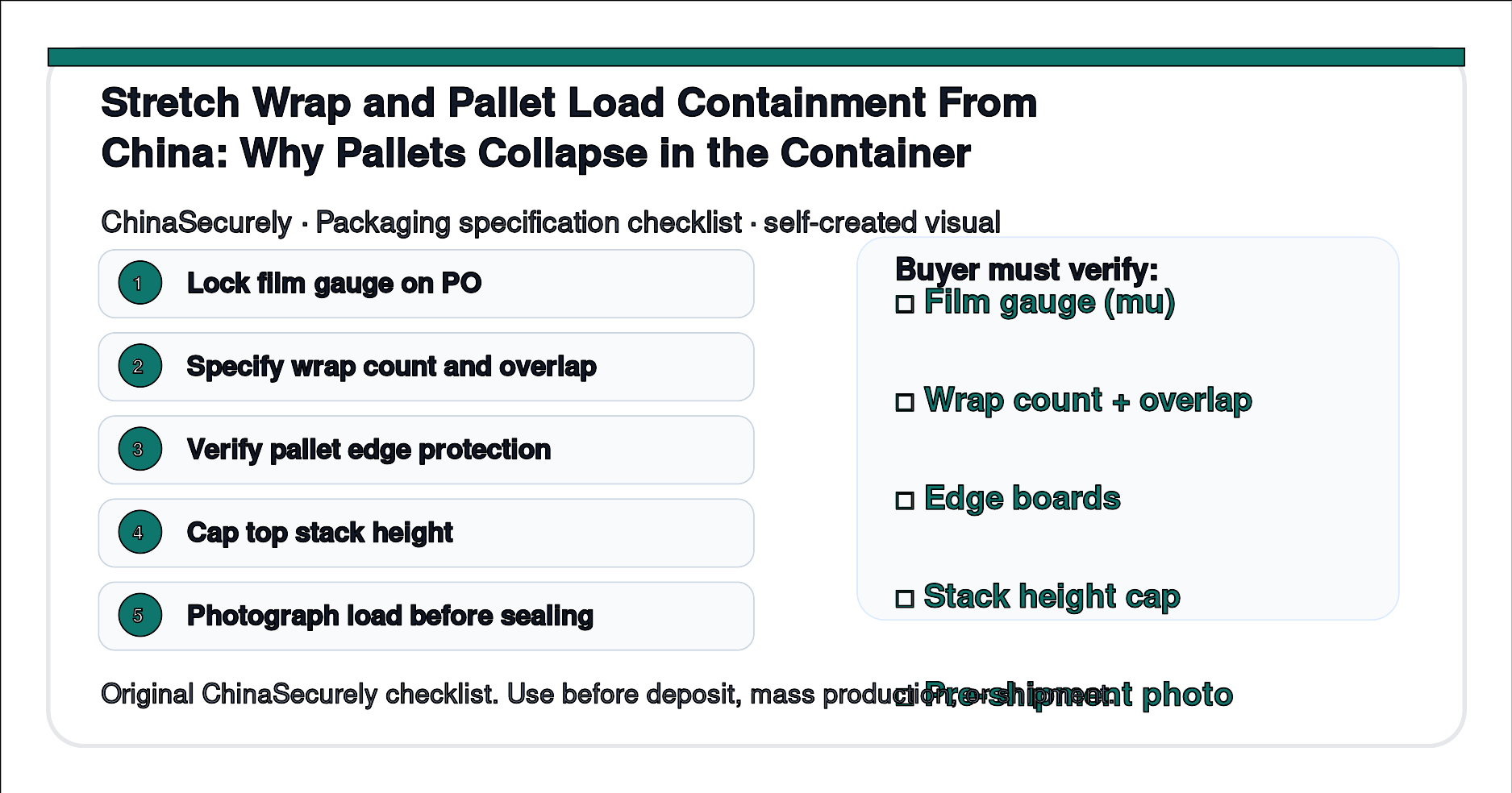
Buyer must verify before deposit
- Request the film gauge spec sheet from the supplier, with the roll batch number.
- Confirm the wrapping machine model and pre-stretch setting.
- Photograph a finished pallet with a tape measure in frame before the container is sealed.
- Cap top stack height and lock it on the PO. Do not let the factory stack to the ceiling.
- Verify pallet edge protection (edge boards or corner boards) for bagged or bottle loads.
Source URLs
- ASTM D4649 stretch wrap film selection guide: https://www.astm.org/d4649-20.html
- ASTM D4169 transport packaging performance: https://www.astm.org/d4169-22.html
- ISO stretch film standards: https://www.iso.org/standard/60541.html
- FEFCO corrugated packaging reference: https://www.fefco.org/
- TAPPI test methods for paper and packaging: https://www.tappi.org
- QIMA pre-shipment inspection reference: https://www.qima.com/quality-control-inspections/pre-shipment-inspection
This article is for sourcing verification. Confirm stretch film gauge, pre-stretch ratio, and pallet pattern with a packaging engineer before signing the bulk PO.