
Short answer
Short answer: a corrugated shipping carton sourced from China that crushes under a stacked pallet or arrives with the bottom flap blown out almost always traces back to one of three silent failures: the Bursting Strength (BCT) test result was never locked on the PO, the Edge Crush Test (ECT) rating was quoted at one value but the liner/fluting medium was substituted for a lighter one on bulk, or the stacking test never ran against a real-world 24-hour humidity curve. The buyer cannot see any of this from the outside of the carton. The buyer has to lock BCT and ECT on the PO, verify the actual paper grammage against the quote, and run a 24-hour humidity-conditioned stacking test before bulk.
Why this problem happens
Carton crush in transit is one of the top three damage reasons for small importers sourcing general goods from China. The carton looks fine at the factory floor. The carton fails in a container or in a warehouse stack. Three things drive the gap:
- The BCT rating on the supplier quote is theoretical, not measured. Many Chinese carton factories quote a BCT value computed from ECT and board thickness using the McKee formula. They do not run a bursting strength test on the finished board. The McKee formula assumes single-wall corrugated under controlled humidity; real long-haul sea freight hits 80 percent relative humidity and higher stacking loads.
- The liner or fluting medium is substituted between sample and bulk. A sample may use 150 GSM kraft liner with 120 GSM fluting medium, while bulk uses 120 GSM kraft liner with 100 GSM fluting. The carton looks identical and the ECT stamp is the same, but crush resistance drops 15 to 25 percent.
- The stacking test never runs against humidity conditioning. A dry-stack test at the factory passes at 200 kg for 24 hours. The same carton fails at 120 kg after 24 hours at 80 percent humidity. Without humidity conditioning, the buyer does not see this until the container arrives.
China-side explanation
Most Chinese corrugated carton factories source linerboard and fluting medium from a separate paper mill. The carton factory buys pre-cut sheets or reels, runs them through a corrugator (single-face, double-face, or double-wall depending on order), cuts and creases the sheets, and glues or stitches the box.
Two silent variables show up here. First, the paper mill may change the liner or fluting supplier between sample and bulk without telling the carton factory, especially when liner prices spike. Second, the carton factory’s slotter and creaser operators may cut slightly deeper creases on bulk runs to make the box easier to fold at the buyer’s packing line, which weakens the vertical edge.
Buyers who only check ECT or BCT on paper datasheets miss these two variables. The right checks are measured BCT on the finished carton, actual paper grammage verification by cut-and-weigh, and a humidity-conditioned stacking test.
Step-by-step solution
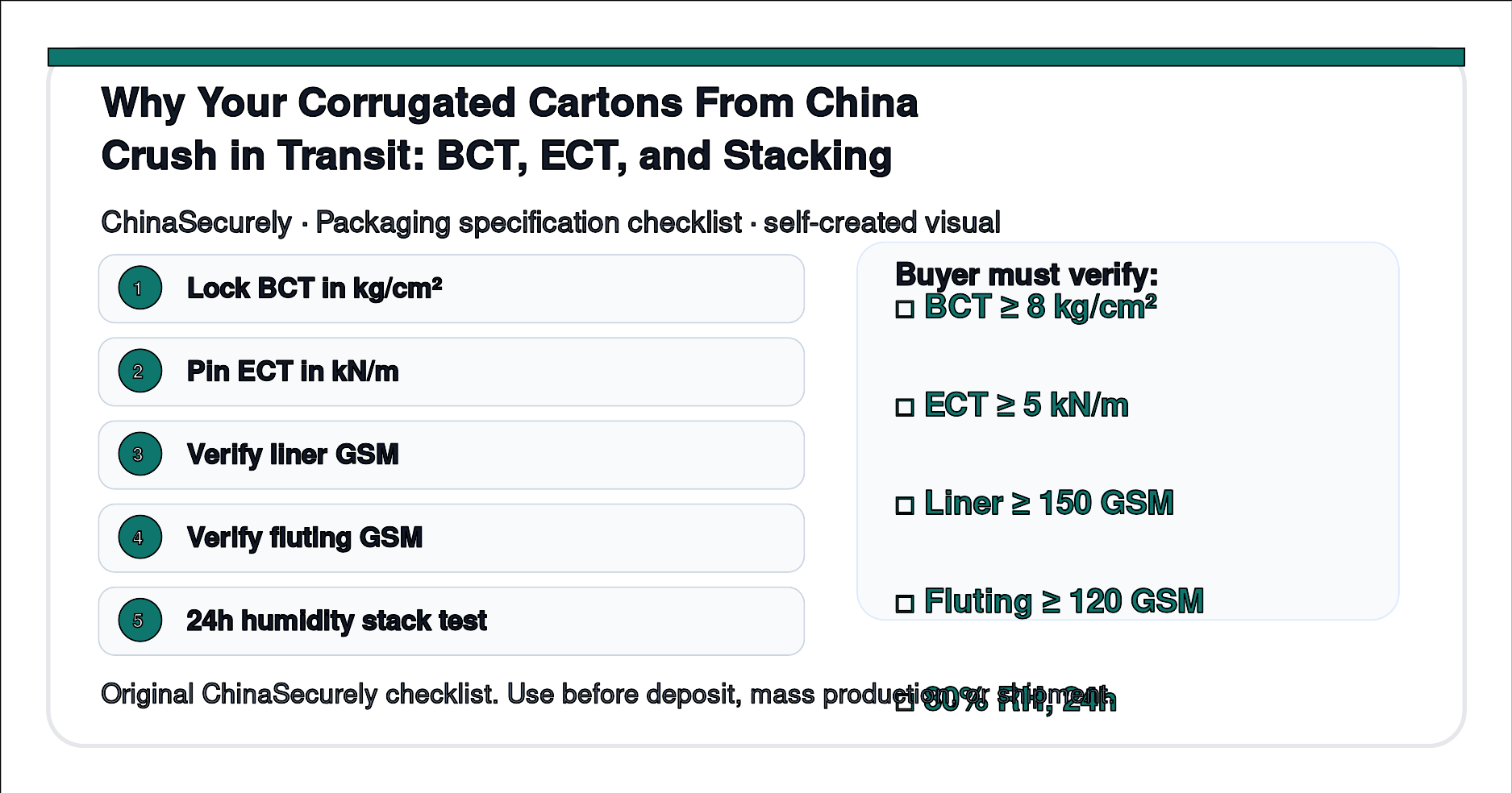
- Lock the bursting strength on the PO: 8 to 10 kg/cm² minimum for general goods cartons, 12 kg/cm² for heavier or export-grade cartons.
- Specify the Edge Crush Test (ECT) value: 5 to 7 kN/m for single-wall, 9 to 12 kN/m for double-wall.
- Specify the paper grammage: liner 150 GSM minimum, fluting 120 GSM minimum. State the values in writing on the PO, not just in the quote.
- Verify paper grammage on the bulk run: cut a 100 cm² sample, weigh it, and compare to the PO. A 10 percent drop in actual weight is a red flag.
- Run a 24-hour humidity-conditioned stacking test on five finished cartons: condition at 80 percent relative humidity for 24 hours, then stack with the rated load for 24 hours, then check for box crush or bottom flap failure.
- Run a drop test on five filled cartons: drop from 60 cm on the bottom edge, then check for flap separation or burst.
Corrugated carton verification table
| Check | What to verify | Where to look |
|---|---|---|
| BCT (bursting strength) | 8 to 12 kg/cm² minimum | PO and supplier test report |
| ECT (edge crush test) | 5 to 7 kN/m single-wall | PO and supplier test report |
| Liner grammage | 150 GSM minimum | Cut-and-weigh sample |
| Fluting grammage | 120 GSM minimum | Cut-and-weigh sample |
| Humidity-conditioned stacking test | 24h at 80% RH, rated load | 5-piece pilot |
| Drop test | No flap separation | 5-piece pilot |
What to ask the supplier
A safer way to ask the supplier:
“Please confirm the bursting strength (BCT) in kg/cm², the edge crush test (ECT) value in kN/m, the liner grammage in GSM, and the fluting grammage in GSM. Send a five-piece pilot with the actual test report stamped on each carton. The BCT and ECT values on the test report must match the PO, not the datasheet.”
Buyer checklist before signing the PO
- BCT is named on the PO (8 to 12 kg/cm²).
- ECT is named on the PO (5 to 7 kN/m single-wall).
- Liner grammage is named (150 GSM minimum).
- Fluting grammage is named (120 GSM minimum).
- 5-piece pilot passes humidity-conditioned stacking test.
- 5-piece pilot passes 60 cm drop test.
- Supplier test report stamped on carton label.
Authoritative references
- ISO 2233 – packaging – conditioning for testing
- FEFCO – European Federation of Corrugated Board Manufacturers – carton testing standards
- TAPPI T 804 – compression test for corrugated boxes
- ASTM D4169 – transport packaging simulation
- ASTM D4729 – random vibration test for shipping containers
- QIMA – pre-shipment inspection and supplier verification
BCT, ECT, and stacking performance are specification decisions, not carton preferences. ISO 2233, FEFCO, TAPPI T 804, ASTM D4169, and ASTM D4729 are the public references for this category. Run a humidity-conditioned stacking test and a 60 cm drop test on a five-piece pilot before bulk. This article is a sourcing verification checklist, not a paper engineering specification.
Authoritative references (added 2026-07-27)
- https://www.tappi.org/test-methods/t-804-compressive-strength/
- https://www.tappi.org/test-methods/t-838-edge-crush/
- https://www.fefco.org/fefco-catalog
- https://www.astm.org/d4727-21.html
Prior source set was weak on carton stacking and crush standards. Expanded with TAPPI T 804 (box compressive strength), TAPPI T 838 (ECT), FEFCO catalog, and ASTM D4727.
1 thought on “Why Your Corrugated Cartons From China Crush in Transit: BCT, ECT, and Stacking Test Reality”