
Short answer: shrink wrap and blister pack are both common for small items from China, but they are not interchangeable. Shrink wrap is faster to set up and cheaper per unit at small MOQs, but it does not protect against shelf-light damage, pilferage, or retail scan errors. Blister pack costs more in tooling but gives a retail-ready card, less pilferage, and a better first impression at the shelf.
Why this problem happens
Small importers who specify shrink wrap to keep tooling cost low often regret the choice when the goods land in retail. The product shifts inside the wrap, the barcode scans at an angle, the wrap punctures during shelf stocking, and Amazon FBA inbound rejects shrink-wrapped units without a scannable outer label. Blister pack avoids most of these problems but adds a printed card, a tooling die, and a setup fee that often doubles the per-unit packaging cost for a 1,000-piece MOQ.
- Shrink wrap tooling is essentially zero, but film gauge is the silent variable. 60 micron shrink wrap tears easily; 80 micron survives a typical warehouse.
- Blister pack tooling is a one-time die charge of USD 300 to USD 1,500 per cavity, but per-unit cost drops sharply once the die is paid off.
- Card stock weight (250 gsm vs 350 gsm) drives the visual difference but also drives freight weight.
- Both formats fail when the inner product is heavier than the card or wrap can hold. A blister card under 300 gsm will bend under a 200 g product during shelf stocking.
China-side explanation
Most Chinese packaging suppliers will quote both formats without explaining the trade-off. The supplier prefers blister pack because the die cost is paid by the buyer and the card print job keeps the printing line busy. The buyer thinks shrink wrap is the cheaper option because the unit price is lower, then ships a fragile retail product that arrives torn.
From the China side, a shrink wrap line is cheaper to run because the operator only needs a heat tunnel and a film roll. A blister pack line needs a die, a card feeder, a heat sealer, and a card printer. A small supplier with a single heat tunnel will quote shrink wrap aggressively and quote blister pack with a tooling fee to discourage the order. A larger supplier with multiple lines will quote both more evenly. Asking which line your order will actually run on tells you a lot about the quote.
Step-by-step solution
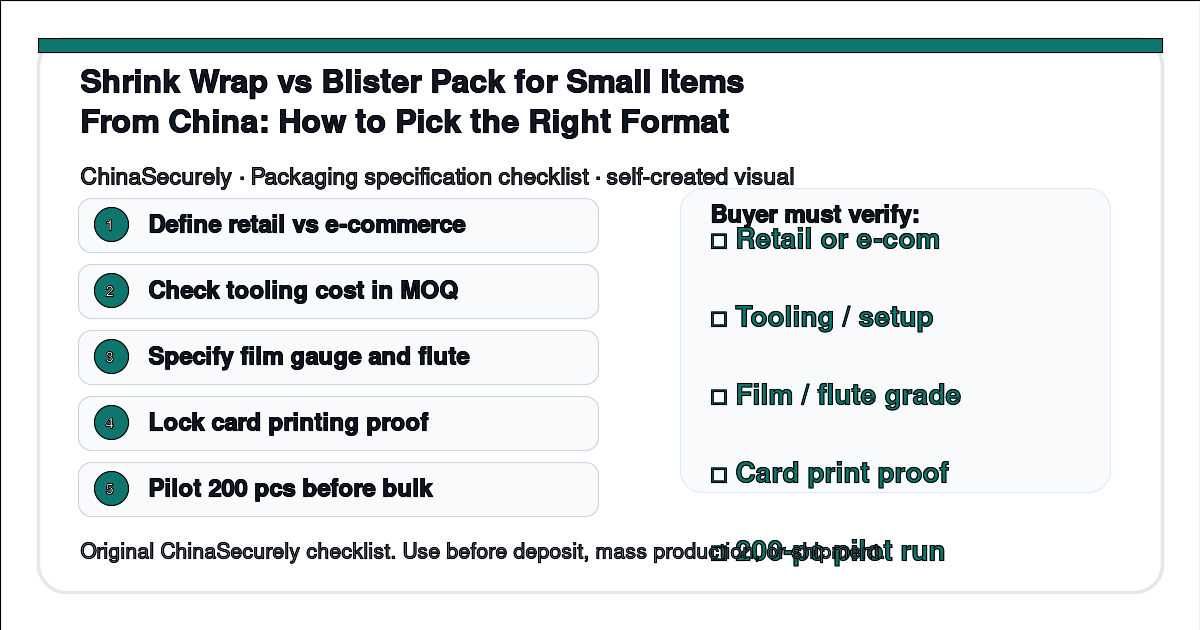
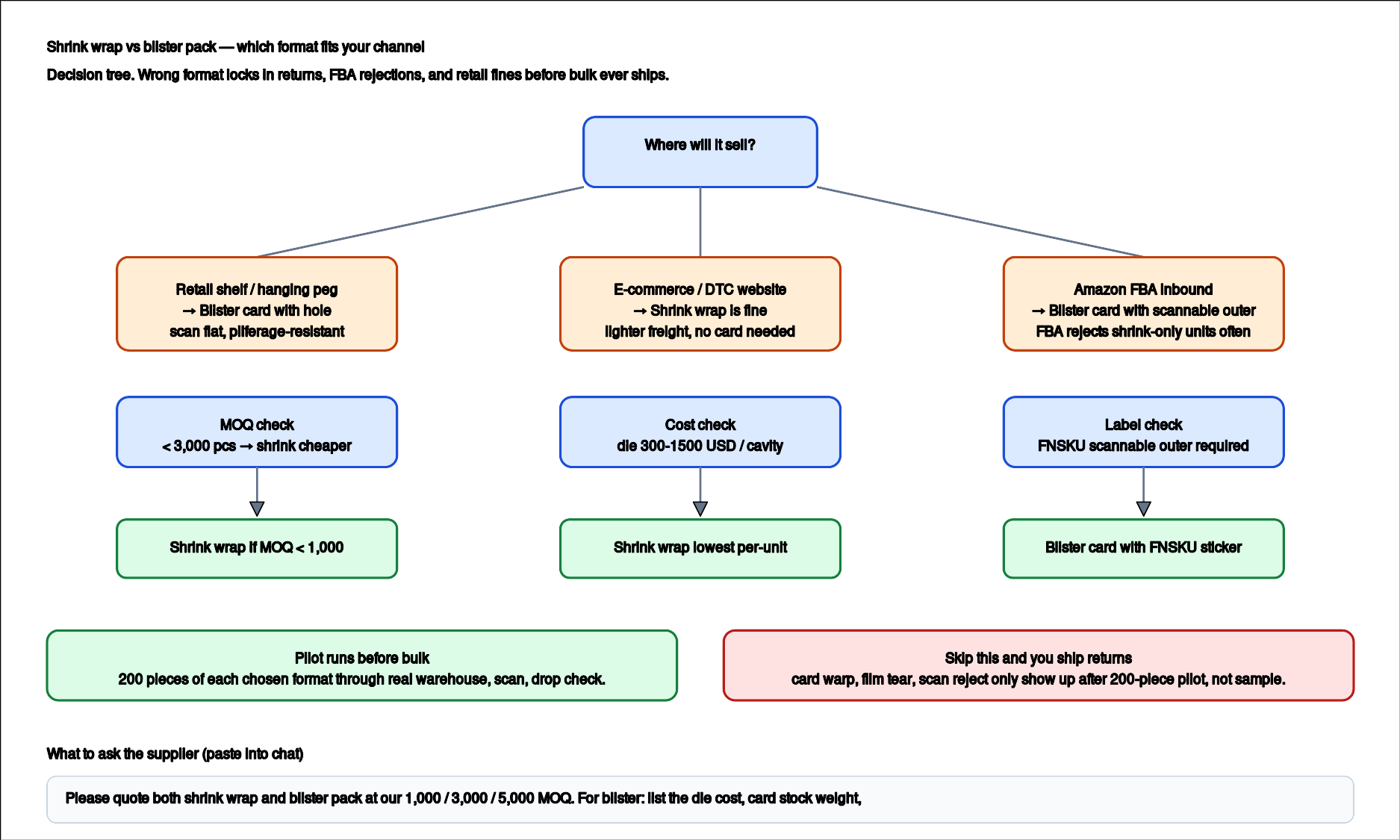
- Decide where the product will be sold: retail shelf, e-commerce, Amazon FBA, or a mix. Retail shelf usually needs a blister card with a hanging hole. E-commerce can take either, with shrink wrap usually winning on freight weight.
- Ask for a per-unit price on both formats at your target MOQ. If the supplier refuses to quote one, the format is not their strength.
- For blister pack, ask for the die cost in writing, the card stock weight in gsm, the PET or PVC thickness, and the heat seal temperature window.
- For shrink wrap, ask for the film gauge in microns, the shrink ratio, and the heat tunnel temperature.
- Run a 200-piece pilot through both formats before committing to bulk. Inspect for card warp, film tear at corners, barcode scan angle, and seal strength.
- Lock the format and the spec on the PO with a side-by-side photo and the die or film reference.
Side-by-side comparison
| Factor | Shrink wrap | Blister pack |
|---|---|---|
| Tooling cost | None | USD 300 to 1,500 per die |
| MOQ friendliness | Best under 1,000 pcs | Best over 3,000 pcs |
| Retail shelf appeal | Low | High (printed card) |
| Pilferage resistance | Low | High (sealed card) |
| Barcode scan angle | Often wrong | Always flat |
| Amazon FBA inbound | Often rejected without scannable outer | Usually accepted |
| Freight weight | Lightest | Adds 15 to 30 percent |
| Failure mode | Tear at corners, film sag | Card warp, seal pop |
Buyer checklist before signing the PO
- Format is named in writing (shrink wrap or blister pack).
- Film gauge in microns or PET/PVC thickness is on the PO.
- Card stock weight in gsm is on the PO for blister.
- Tooling cost is itemized once, not amortized into per-unit price without disclosure.
- 200-piece pilot run is completed and inspected before bulk.
- Card print proof is signed against a physical sample, not a screen PDF.
Authoritative references
- FDA — understanding packaging terminology
- ISO 15378 — primary packaging materials for medicinal products
- ASTM D3079 — standard test for permeability of flexible barrier materials
- GS1 — barcode standards for retail packaging
- FedEx — packing guidelines for retail and e-commerce
- QIMA — pre-shipment inspection and supplier verification
Format choice is a sourcing decision, not a packaging preference. ISO 15378, ASTM D3079, GS1 barcode standards, and FedEx packing guidelines are the public references for this category. Run a 200-piece pilot through the chosen format before bulk. This article is a sourcing verification checklist, not a packaging engineering specification.
Source and verification notes (added 2026-07-31)
- GS1 — barcode standards for retail packaging: https://www.gs1.org/standards/barcodes
- ISO 15378 — primary packaging materials for medicinal products: https://www.iso.org/standard/63869.html
- ASTM D3079 — standard test for permeability of flexible barrier materials: https://www.astm.org/d3079-94.html
- FedEx — packing guidelines for retail and e-commerce: https://www.fedex.com/en-us/shipping/packing.html
- FDA — understanding packaging terminology: https://www.fda.gov/medical-devices/medical-device-recalls/understanding-packaging-terminology
- QIMA — pre-shipment inspection and supplier verification: https://www.qima.com/quality-control-inspections/pre-shipment-inspection
The right packaging format depends on the sales channel, the retail-vs-e-commerce scan environment, the inner product weight, and the freight weight budget. A film gauge, a card stock weight, or a die charge is not a complete specification. Buyers should run a 200-piece pilot through the chosen format on the real sales channel before bulk production. Amazon FBA and major retailer barcode scanning rules are updated regularly.
Related reading on ChinaSecurely
- Custom mailer boxes arrive with bent corners or torn dust flaps
- Carton printing setup costs from China: what you actually pay for
- Hangtag and care label strings break in transit
Real buyer scenario
A small Amazon FBA seller ordered 1,500 cosmetic brushes with shrink wrap because the per-unit quote was lower than blister. The first inbound shipment was rejected at the warehouse because the FNSKU barcode could not be scanned through the film and the units shifted inside the wrap. The seller paid return shipping, re-purchased blister tooling (about USD 800), and lost three weeks of listing time. A 200-piece shrink-wrap pilot with an Amazon FNSKU outer scan would have shown the issue at a 1,500-piece cost, not a 3,000-piece cost.
Authoritative references (added 2026-08-03)
- ASTM D4649 — Selection and use of stretch wrap materials: https://www.astm.org/d4649-16.html
- ASTM F2338 — Standard test method for blister package integrity: https://www.astm.org/f2338-22.html
- ASTM D4169 — Standard practice for performance testing of shipping containers: https://www.astm.org/d4169-22.html
- ECMA-287 — Hardcopy printing and small form-factor scannable labels: https://www.ecma-international.org/publications/standards/Ecma-287.htm
The shrink-vs-blister decision is downstream of retailer acceptance. Always confirm the retailer's physical merchandising spec before choosing film and card format. Many retailers will not accept carded blister packs because of theft-prevention EAS tag compatibility.