
Short answer: if your custom mailer boxes arrive crushed, the problem may not be the printed mailer box itself. It is often the export carton, packing quantity, pallet or non-pallet shipping method, humidity, and how much empty space was left inside the carton.
A realistic buyer question is: “My Chinese supplier packed custom mailer boxes into big cartons, but many arrived dented. The supplier says the boxes were fine when they left the factory. What should I specify next time?”
Start by separating product packaging from shipping packaging. A beautiful retail mailer box still needs an export carton that can survive stacking, vibration, and handling.
Why this happens
Custom mailer boxes are usually made to look good for the end customer. They are not always strong enough to protect themselves when hundreds of flat or assembled boxes are packed tightly into a large export carton.
Damage often comes from compression, corner impact, moisture, loose carton fit, or overpacking. If the supplier uses a weak outer carton, the whole carton can deform and transfer pressure to the boxes inside.
Small importers may also choose cheap shipping without pallets to save money. That can be reasonable, but it means the carton specification matters more because the cartons may be handled one by one.
China-side explanation
Chinese packaging suppliers often quote the printed box first: paper grade, flute type, size, color, finish, and MOQ. Export carton strength may be treated as a routine packing detail unless the buyer asks for it.
The sales contact may say “standard export carton.” That phrase is not a real specification. Different factories use different carton grades, carton sizes, packing counts, and internal protection.
For small orders, suppliers sometimes use available cartons to avoid extra cost. The carton may be too large, too weak, or not designed for the weight and shape of your mailer boxes.
Step-by-step solution
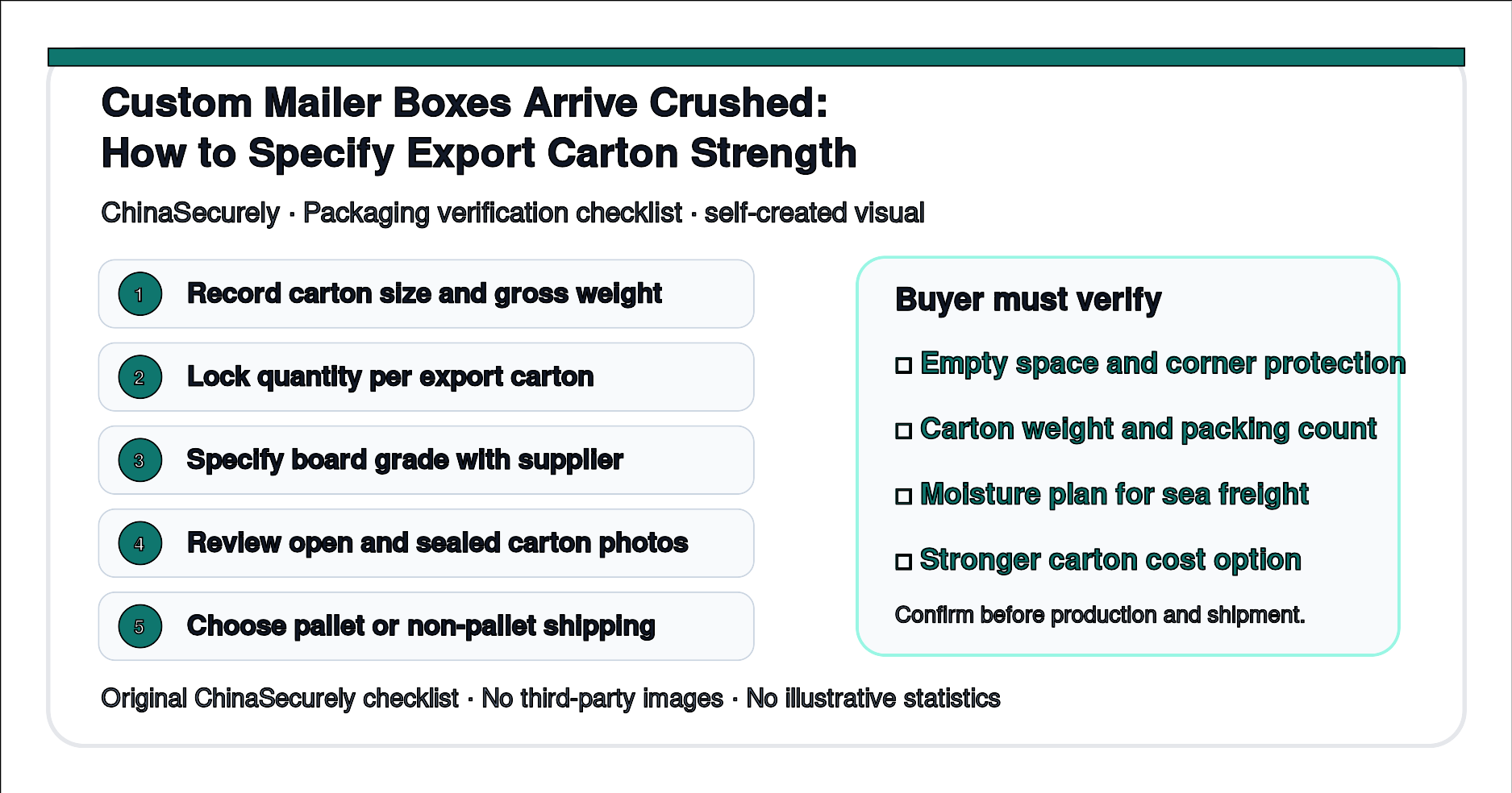
- Ask for the export carton size, board type, and estimated gross weight before production.
- Confirm how many mailer boxes go into each export carton.
- Ask whether the boxes are packed flat or assembled. Flat packing reduces volume but can still cause corner dents if strapped or compressed badly.
- Request carton photos before shipment: open carton, filled carton, sealed carton, and corner close-up.
- Ask for a simple carton drop or handling check if the order is not palletized.
- For sea freight or humid routes, ask how the supplier reduces moisture exposure.
- If the boxes are premium retail packaging, consider stronger export cartons or palletized shipping even if the freight cost is higher.
What to ask the supplier
Use this message:
“Before production, please confirm the export carton size, carton material or strength grade, gross weight per carton, quantity of mailer boxes per carton, and whether the boxes are packed flat or assembled. Before shipment, please send photos of the open carton, inner packing, sealed carton, and carton corners. If the shipment is not palletized, please recommend a stronger export carton option and quote the cost difference.”
This gives the factory a practical checklist instead of a vague complaint after damage happens.
Export carton specification table
| Item to confirm | Why it matters | Buyer decision |
|---|---|---|
| Carton size | Too much empty space causes movement | Reduce space or add filler |
| Gross weight | Heavy cartons crush lower cartons | Lower count per carton if needed |
| Board strength | Weak carton transfers dents | Upgrade outer carton for premium boxes |
| Packing method | Flat or assembled boxes fail differently | Request photos before sealing |
| Pallet use | Non-pallet handling increases impact | Decide whether freight savings are worth it |
Practical checklist before shipment
□ Export carton size and weight are confirmed.
□ Quantity per carton is written in the order.
□ Supplier sends open-carton and sealed-carton photos.
□ Empty space and corner protection are visible.
□ Carton corners are not already crushed before pickup.
□ Moisture exposure is considered for long sea freight.
□ Pallet or non-pallet shipping decision is documented.
□ A stronger carton option is quoted for premium packaging.
Cost and trade-off notes
A stronger export carton, fewer units per carton, palletization, or corner protection can increase landed cost. For low-value packaging, you may accept minor outer-carton wear.
For branded mailer boxes, subscription boxes, gift packaging, and ecommerce packaging, dents are part of the customer experience. Saving a small amount on cartons can create a much larger brand problem.
Source status
The buyer question is based on repeated packaging import complaints about cartons arriving crushed, used here as an anonymized demand signal. Public packing references from FedEx and package testing information from ISTA support the general shipping-packaging recommendations. Exact carton grade should be confirmed with the packaging supplier or inspector.
Source URLs:
- https://www.fedex.com/en-us/shipping/packing.html
- https://www.ista.org/test_procedures.php
- https://www.ista.org/
Related ChinaSecurely guides
- How to specify corrugated box hardness and edge strength
- More packaging sourcing checks for importers
Related questions
- Should custom boxes from China be shipped flat or assembled?
- What carton photos should I request before shipment?
- How do I reduce shipping damage for printed packaging?
Light CTA
If your mailer boxes arrive crushed, do not only negotiate compensation. Fix the export carton specification before the next order. Printed packaging still needs shipping packaging.