
A microfiber cleaning cloth that leaves lint on eyeglasses or a camera lens is a one-star review waiting to happen. Most lint comes not from the cloth itself feeling cheap, but from the split-fiber process being incomplete, the GSM being under-target, or the dye-bath relaxing the fiber. The fix is on the PO and a 3-wash test that takes an hour on the kitchen counter.
Short answer
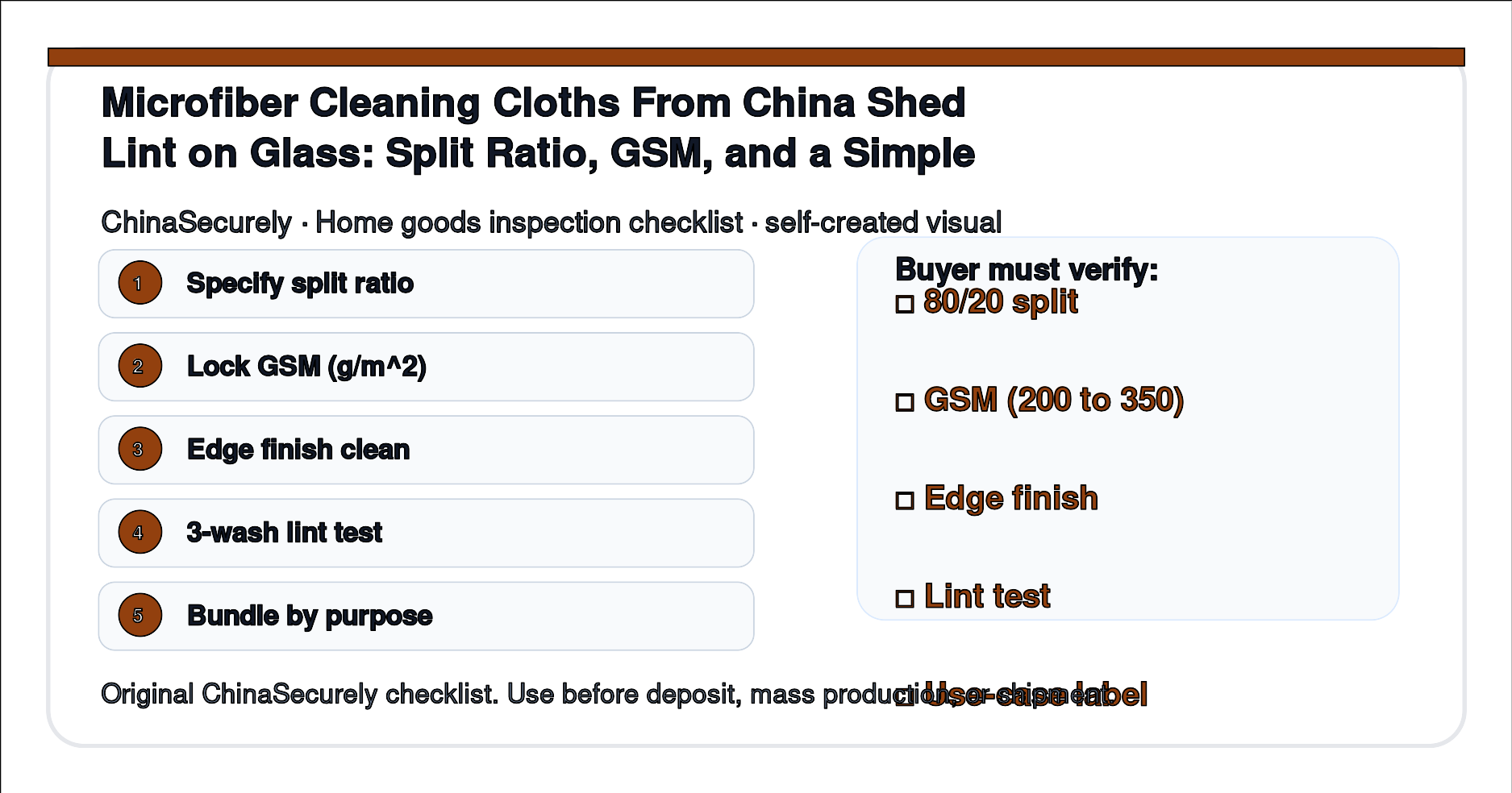
Microfiber cloths that lint almost always have one of three issues: an unfinished or skipped split-fiber process, an underweight GSM (under 200 g/m^2 is the danger zone), or a hot dye-bath that relaxed the fiber. Specify split ratio (e.g., 80/20 polyester / polyamide), GSM (250 to 350 g/m^2 for cleaning), and edge finish (laser-cut or ultrasonic). Run a 3-wash lint test on a clean glass panel before approving bulk.
Why this happens in real shipments
A small e-commerce seller in Ohio sold 12-pack microfiber cleaning kits from a Wenzhou factory for eyeglasses and camera lenses. Within weeks, returns cited “lint on lens.” Inspection of the returned cloths found an 80/20 split ratio but a finished weight under 200 g/m^2; the split process was apparently completed but the underweight GSM meant the surface pile was too short to absorb properly, and the edges were stitched not laser-cut so edge-fibers came off on the lens. Switching to 280 g/m^2 with ultrasonic edge finish brought the lint complaint rate down to under 1 percent within the next shipping cycle.
Why Chinese factories often get this wrong
Microfiber production is a two-step operation: first the yarn is woven from continuous filament polyester and polyamide, then the fiber is “split” chemically or mechanically to create the wedge-shaped micro-filaments. The chemical split uses a sodium hydroxide bath; the mechanical split uses needles. If the chemical split is incomplete (bath time too short, bath temperature too low), the cloth still feels soft but doesn’t trap grease; it also tends to lint. A factory that buys woven cloth from an upstream vendor and finishes in-house may not split at all if the upstream vendor claims it’s already split. GSM underrating is another common issue: a 200 g/m^2 cloth is sold as a “240 g/m^2” cloth to win the buyer’s spec, especially under tight deadlines.
Step-by-step: how to verify
- Specify split ratio (e.g., 80/20 polyester / polyamide for glass cleaning, 70/30 for automotive, 100/0 for harsher wiping) and lock it on the PO.
- Specify GSM as a target with tolerance (e.g., 280 g/m^2 plus or minus 5 percent). Under 200 g/m^2 is for promotional giveaway only, not for premium cleaning.
- Specify edge finish (laser-cut or ultrasonic rather than stitched) for any premium SKU that contacts glass.
- Run a 3-wash lint test on 3 sample cloths. One gentle wash, one tumble-dry low or dry-flat cool cycle, then swipe a clean glass panel under a flashlight. Lint indicates the split process.
- Verify use-case labeling. A premium SKU should be labeled “for eyeglasses and coated lenses”; a 100/0 promo SKU should not be labeled for eyeglasses.
What to ask the supplier
“For 10,000 microfiber cleaning cloths, please confirm: (a) split ratio (polyester / polyamide); (b) GSM target with tolerance; (c) edge finish (laser-cut or ultrasonic); (d) dye-bath temperature history (for relaxation risk). Send a 5-piece pre-production sample for our 3-wash lint test on glass. We accept the bulk only if the lint test produces zero visible fiber residues.”
Cost, risk, and trade-off notes
- 80/20 split cloths run 1.2 to 1.5 times the per-piece cost of 100/0 promo cloths; for premium SKUs the difference is recoverable against avoided returns.
- Cloths under 200 g/m^2 feel thin and lint easily on glass; 250 to 350 g/m^2 is the cleaning range; over 400 g/m^2 is for drying large surfaces.
- EDGE finish matters: laser-cut or ultrasonic edges don’t fray; stitched edges lint at the border.
- Eyeglass-cloth SKUs sold into the EU require REACH and dye-substance disclosures; ask the supplier for the test report.
Buyer checklist
- Split ratio captured on the PO.
- GSM target and tolerance captured on the PO.
- Edge finish captured on the PO.
- 3-wash lint test passed on a clean glass panel under flashlight.
- Use-case label content reviewed before bulk printing.
- REACH / dye-substance disclosure captured for EU shipments.
Related questions buyers ask
- Can I wash microfiber cloths with regular laundry detergent? No, fabric softener and bleach coat the fibers and destroy the cleaning effect.
- Why do my cloths feel different from sample to bulk? Most likely GSM underrating or split-process skipping between batches. Lock the spec on the PO.
- Are higher-priced cloths worth it? Usually yes for eyeglass use; less so for industrial wiping.
What to do next
If you are at sampling, send the questions above and require a 3-wash lint test report. If you are seeing lint returns in the field, request the GSM log from the factory and run your own 3-wash test on three random cloths from the suspect shipment. Compare the result to the approved sample; any GSM drop of more than 10 percent is a quiet cost-cutting change.