
Short answer
PE foam inserts from Chinese suppliers can look identical to the approved sample but compress or crack in transit when density, cell structure, thickness tolerance, and test conditions are not locked before bulk production. The box may arrive with the product loose and the foam visibly thinner. Before blaming the carrier, compare the approved sample with the production lot and check what the PI actually specified.
A realistic buyer scenario
Consider a small importer packing electronics accessories in custom mailer boxes. The approved insert is 20 mm thick and holds the product snugly, but the PO says only “PE foam insert, 20 mm.” After the goods have been stacked and shipped, some products sit loose because the bulk foam does not recover like the sample. The supplier can still say it used PE foam because density, cell structure, and a test method were never agreed. This is a representative sourcing scenario, not a quoted customer case.
Why “PE foam” on a quote is not enough
PE foam in protective packaging is a specification family, not a single product. To hold its shape under typical e-commerce shipping loads, the insert has to control:
- Density in kilograms per cubic meter. The correct range depends on the product load, geometry, and test method; lower density generally provides less support under the same conditions.
- Cell structure. Cross-linked PE foam (XLPE) recovers better than non-cross-linked (LDPE) foam but costs more. A vague PO allows the converter to use either one without documenting the change.
- Thickness tolerance. A nominal 20 mm insert can arrive materially thinner when the PO has no stated tolerance, and the buyer may not notice without caliper checks.
- Compression set. The percentage of permanent thickness loss after a defined static load. The acceptance limit must be agreed against a named test method and the packed product’s load; a lower permanent set generally means better recovery.
- Lamination or surface skin. Laminated PE foam resists abrasion but adds cost. A non-laminated foam scuffs white and looks cheap in unboxing photos.
The PI usually says “PE foam insert, 20 mm” and nothing else. It does not name density, cell type, compression set, or thickness tolerance.
China-side explanation
Converters commonly offer PE foam in broad commercial tiers. Catalog labels vary, so treat the following as a buying framework rather than a universal industry grade:
- Uncontrolled stock foam: the quote names only material and thickness, with no density or compression data.
- Specified foam: the PO names foam type, nominal density, thickness tolerance, and a supplier data sheet.
- Verified production foam: the lot is traceable and the packed product passes an agreed compression and distribution test.
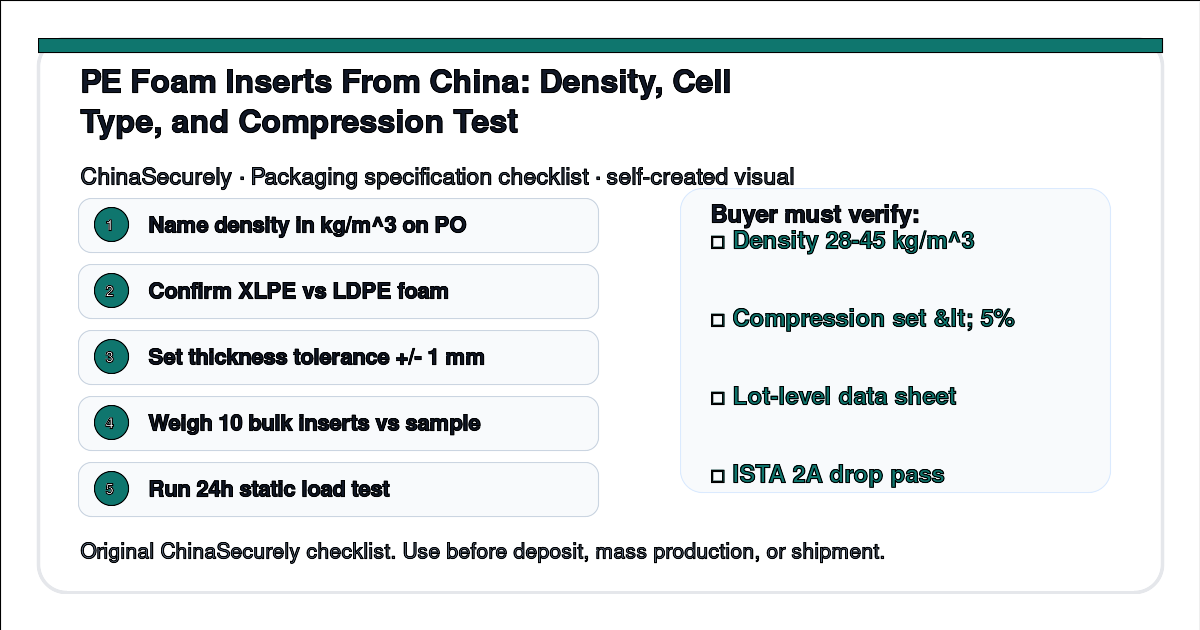
If the PO does not specify density in kg/m³, cross-linked (XLPE) vs non-cross-linked (LDPE), compression-set method, and thickness tolerance, the converter can choose a stock sheet that still satisfies the wording on the PO.
What actually verifies a protective foam insert
- Ask the supplier for the foam type (XLPE or LDPE), the density in kg/m³, the compression set percentage, and the thickness tolerance.
- Ask for a lot-level data sheet matching the density and the cell structure of the production batch.
- Weigh the sample insert and ten bulk inserts. A meaningful weight difference is a warning sign, but compare like-for-like geometry and investigate it with density and thickness measurements.
- Measure the thickness of ten bulk inserts with calipers at the center of the foam. The average should be within the tolerance written on the PO.
- Agree a static-load screening test using the actual product load, duration, and temperature, then compare sample and bulk recovery. For formal compression-set results, use the conditions in the named ASTM or ISO method.
- Run an ISTA 1A or 2A drop test on a packed retail box and inspect the foam after.
Sample-to-bulk risk matrix
| Risk | Sample impact | Bulk impact | Buyer check |
|---|---|---|---|
| Foam density reduced | Low, sample bench test fine | High, permanent compression in transit | Weigh and measure density |
| Cell structure swapped to LDPE | Low at first | High, slower recovery, lower cushioning | Ask for cell type, cut a section to inspect |
| Thickness tolerance widened | None visible | Medium, product sits loose in box | Calipers on ten bulk inserts |
| Compression set exceeds 10% | Low, short test window | High, foam crushes under stack load | 24-hour static load test |
| Lamination dropped to save cost | None visible | Medium, surface scuffs in unboxing | Inspect surface finish on bulk units |
What to ask the supplier before the deposit
“Please confirm on the PO: foam type (XLPE or LDPE), density in kg/m³, compression set percentage, thickness with an agreed tolerance, and whether the insert is laminated. Please share the lot-level data sheet covering density and cell structure for the actual production batch, and a sample of the foam at 50 mm by 50 mm for our own static load test before bulk production.”
If the sales rep answers “high density PE foam, 20 mm” without naming the cell type or the compression set value, treat the claim as unverified. That answer does not identify a measurable grade. Slow down until the supplier provides values and a test method.
Buyer checklist before releasing the balance payment
- PO specifies foam type, density in kg/m³, compression set percentage, and thickness tolerance.
- Bulk insert weight matches the approved sample within the tolerance agreed for identical geometry.
- Bulk insert thickness on ten samples falls within the PO tolerance.
- The agreed static-load screen shows comparable recovery for sample and bulk.
- ISTA 1A or 2A drop test on a packed retail box shows foam recovers and product sits tight after impact.
- Lot-level data sheet matches the bulk production batch.
Authoritative references
- ASTM D3575 — Standard Test Methods for Flexible Cellular Materials Made from Olefin Polymers
- ISO 7214 — Cellular plastics — Polyethylene — Methods of test
- ISTA — Procedure 1A, 2A, 3A for packaged-product transit testing
- FedEx — packing guidance for shipments
PE foam insert performance depends on the actual density and cell structure of the production batch, not on the marketing language in the supplier’s catalog. ASTM, ISO, and ISTA are the public technical references for this category. Confirm current packaging and prep requirements with your carrier and your marketplace before shipping.