
Short answer
A wireless charger that looks fine on the sample bench can overheat, slow-charge, or fail to charge entirely in bulk when the coil, magnet array, or temperature sensor is silently downgraded. The label still says “15W fast wireless charging”. The thermal headroom inside does not.
The buyer complaint we keep seeing
A US small importer orders 2,000 Qi-compatible wireless charging pads from a Shenzhen supplier for a desk-accessories brand. The PI says “Qi 15W, foreign object detection, USB-C input.” The sample pad charges an iPhone from 20% to 80% in roughly 50 minutes on a 30°C desk. Two lots later, Amazon reviews report the pad runs hot to the touch, the phone stops charging when warm, or the device clicks off and on through a normal charge cycle. The supplier responds “15W, supports Qi,” which is technically true on the label.
Why “15W fast wireless charging” on a label is not enough
Qi 15W is a power target, not a guarantee. To hold 15W for a full charge cycle on a typical phone, a wireless charger needs:
- A coil sized and tuned to the WPC Qi Extended Power Profile (EPP) for the target device.
- A magnet array strong enough to keep the phone aligned when the user picks it up briefly.
- A thermistor or NTC sensor placed where the coil runs hottest, tied into the charge controller to throttle power.
- A USB-C PD or QC input that actually negotiates 9V or 12V at the rated current — not 5V.
- Foreign object detection (FOD) tuned to the FOD threshold defined by the WPC Qi specification.
The label tells you the supplier claims 15W. It does not tell you whether the coil winding, ferrite shielding, or NTC placement is the same in lot 1 and lot 4.
China-side explanation
Wireless chargers in Shenzhen and Dongguan are commonly built from three to five stock PCBA tiers. Public 1688 listings usually describe them as:
- Entry tier: thin single-layer coil, no NTC, generic BPP (Baseline Power Profile) at 5W only. Sold as “Qi compatible,” “7.5W” or “10W.”
- Middle tier: larger coil, basic NTC, EPP at 9V/1.1A roughly 10W to 12W. Sold as “15W” when tested on the bench.
- High tier: stacked coil plus magnet ring, dual NTC, USB-C PD input, FOD calibrated, EPP at 9V/1.66A (15W). Sold with WPC Qi certification ID.
If the PI does not name the input voltage negotiation, the NTC, the magnet layout (for MagSafe-style alignment), and the WPC Qi registration status, the factory will usually build the middle tier and label it 15W. Sustained 15W requires the high tier.
What actually verifies a 15W Qi charger
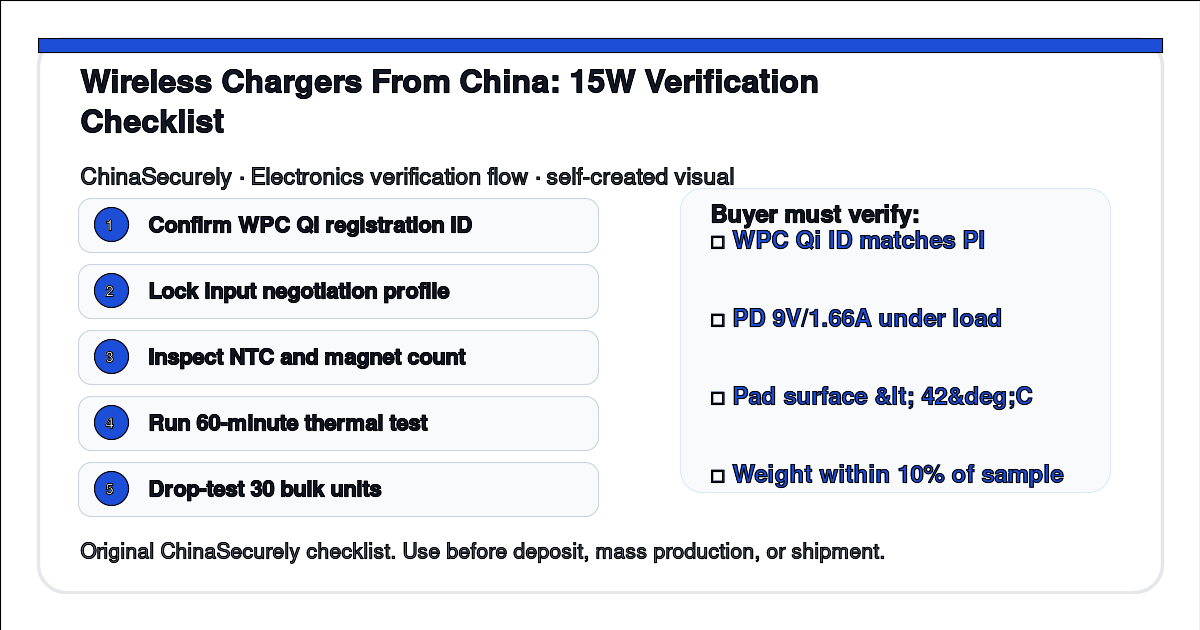
- Ask the supplier for the WPC Qi registration ID and the product entry on the Wireless Power Consortium database. Cross-check the company name and model.
- Confirm on the PI: input connector and voltage negotiation profile (USB-C PD 9V/1.66A or QC 9V/2A), coil diameter, NTC count and location, magnet ring count.
- Ask for the FOD threshold value and a sample FOD test report using a metal object between pad and phone.
- Run a 60-minute thermal test at room temperature with the phone at 50% battery. The pad surface should stay below roughly 42°C and the phone should not downshift to a lower power profile before 80% state-of-charge.
- Weigh the sample pad and ten bulk pads. A drop of more than 10% usually means less copper, fewer magnets, or a thinner ferrite.
- Compare the sample against a known-good reference pad using the same phone. Charging time from 20% to 80% should be within about 10% of the reference.
Sample-to-bulk risk matrix
| Risk | Sample impact | Bulk impact | Buyer check |
|---|---|---|---|
| Coil diameter reduced | Low, still charges | High, slower charge and hot surface | Weigh and disassemble one bulk unit |
| NTC removed or moved | Low at room temp | High, thermal throttle kicks in early | 60-minute thermal test, log temperature |
| Magnet ring dropped | Low if phone is set down carefully | High, misalignment, hot spots, FOD trips | Magnet pull test, FOD test with coin |
| USB-C PD input downgraded to 5V | Low, sample tested on QC brick | High, locks to 5W only | Inspect PD negotiation with USB tester |
| WPC Qi ID reused or fabricated | None visible | Medium, no traceable claim | Search WPC Qi database by supplier name |
What to ask the supplier before the deposit
"Please confirm on the PI: input connector (USB-C PD or QC) and the negotiated voltage and current under load, the coil diameter and layers, the NTC count and placement, the magnet ring count, and the WPC Qi registration ID for this model. Please share a third-party lab thermal report showing surface temperature and full-charge time on a phone such as an iPhone 14 or Samsung S23 at room temperature."
If the sales rep answers “yes, 15W Qi” without naming the WPC ID, the NTC, or the input negotiation profile, treat the claim as unverified. That answer usually means the middle tier under a 15W label.
Buyer checklist before releasing the balance payment
- WPC Qi database entry for this supplier and model number is real and matches the PI.
- Bulk unit passes a 60-minute thermal test below 42°C on the pad surface.
- Bulk unit charges the reference phone from 20% to 80% within roughly 10% of the sample.
- PD or QC negotiation logs confirm 9V or 12V input under load, not 5V.
- FOD test with a coin or metal ring trips the charger and stops power, per Qi spec.
- Bulk pad weight is within 10% of the sample pad weight.
Authoritative references
- Wireless Power Consortium — Qi
- Wireless Power Consortium — Qi specifications
- USB Implementers Forum — USB Power Delivery specification library
- FCC Equipment Authorization — search by FCC ID
- QIMA — pre-shipment inspection for electronics
Wireless charger performance depends on the specific PCBA, the input power adapter, and the receiving phone. The WPC Qi database and the FCC ID database are the authoritative references for certification status. Confirm current requirements with the WPC and your destination market regulator before shipping.