
A small importer approves a smooth cotton sheet sample, places a bulk order, then starts seeing customer complaints after the second wash. The problem is not solved by asking for “300 thread count” again. Yarn construction, weave, finishing, and the production lot all need to be locked and tested.
Short answer: pilling happens when loose fibers work out of the yarn and tangle on the fabric surface. A buyer cannot diagnose the cause from a sales sample alone. Use a documented pilot, a repeatable wash method, and a named pilling test before bulk approval.
Why this problem happens
Pilling is the visible result of fibers working loose under washing and abrasion. The root cause can sit in the yarn, fabric construction, finishing, or a combination of all three.
- Yarn identity is vague. “Cotton” and “thread count” do not identify the count system, fiber blend, twist, or yarn lot. A change between sample and bulk can change surface performance.
- Fabric construction changes. Percale, sateen, and twill expose fibers differently. A weave or construction substitution should not be accepted without a new wash and pilling test.
- Finishing varies between lots. Singeing, brushing, washing, and anti-pilling finishes can affect the surface. Record the process and test the finished pilot rather than relying on a verbal claim.
Thread count by itself is not proof of durability. It needs to sit beside yarn construction, finished GSM, weave, and test results.
China-side explanation
A Chinese bedding supplier may buy yarn from a spinning mill, send fabric through separate weaving and finishing lines, and then cut and sew the sheets. The company answering your email may not control every upstream variable. If the bulk fabric comes from a different mill or lot than the approved sample, the hand feel can look similar while wash performance changes.
Ask for traceability, not reassurance. A safer message is: “Please confirm the yarn count system, fiber content, weave construction, finished GSM, yarn or fabric lot reference, and finishing process used for this pilot. We need the same construction for bulk, with the wash and pilling results tied to our PO.”
If the supplier cannot connect the pilot, test report, and bulk lot, slow down before paying the balance. That gap is not proof of a defect, but it is a useful warning sign.
Step-by-step solution
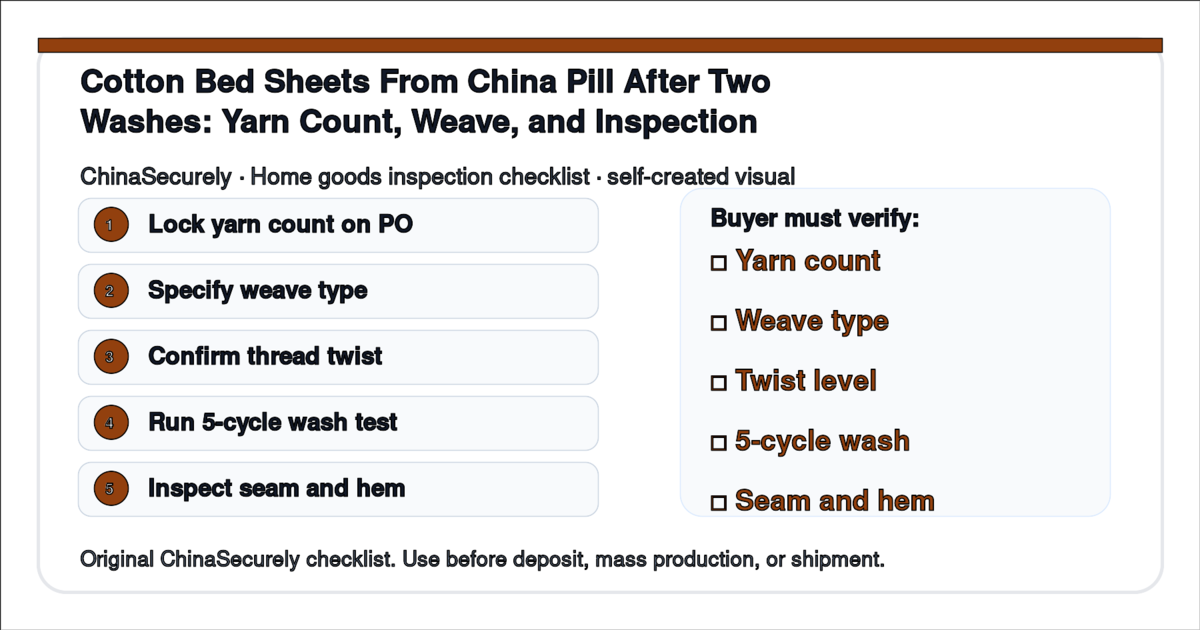
- Write the count system, fiber content, weave construction, finished GSM, dimensions, and agreed tolerances into the PO.
- Keep a signed production reference sample and record the fabric or yarn lot used for it.
- Request several pilot pieces made with production materials, not a showroom sample.
- Define the wash and dry procedure. AATCC TM 135 is one recognized home-laundering framework; confirm the current edition and settings with the test lab.
- Use a named pilling method, such as ASTM D3512, and agree the acceptance rating before testing. The standard provides a method, not a universal pass grade for every buyer.
- During pre-shipment inspection, compare bulk pieces with the approved sample and review seams, hems, labels, GSM, construction, and the test report tied to the PO.
What to lock and how to verify it
| Item | What to record | Verification |
|---|---|---|
| Yarn | Count system, fiber content, twist, lot | Mill declaration or lab check |
| Weave | Percale, sateen, twill, and construction | Approved swatch and fabric analysis |
| Fabric mass | Finished GSM and agreed tolerance | Weigh cut samples |
| Wash performance | Cycles, detergent, wash and dry settings | Documented pilot wash |
| Pilling | Named method and acceptance rating | Lab or agreed inspection test |
| Bulk identity | PO, lot reference, and production sample | Pre-shipment comparison |
Buyer checklist before signing the PO
- The yarn count system and fiber content are named, not just “300 thread count.”
- The weave construction, finished GSM, and tolerances are written into the PO.
- The production reference sample and lot information are retained.
- The wash and dry procedure is repeatable and documented.
- The pilling method and acceptance rating are agreed before bulk.
- The test report identifies the product, lot, and PO it covers.
- Seams, hems, labeling, and bulk construction are included in inspection.
Authoritative references
- AATCC TM 135 — dimensional changes after home laundering
- ASTM D3512/D3512M — random tumble pilling test
- FTC — textile and wool labeling requirements
- Cotton USA — cotton fiber and yarn reference material
- QIMA — pre-shipment inspection overview
These standards and public references support test selection and labeling checks; they do not create one universal yarn, GSM, or pilling grade for every sheet. Confirm the current standard edition, lab procedure, and acceptance level for the destination market and product. The ASTM landing page may block automated access, so its public URL is retained for manual verification.