
Why Does Packing Tape Fall Off Corrugated Boxes from China? Common Reasons and Fixes
Short Answer
Packing tape peeling off corrugated boxes is one of the most common small packaging problems Chinese suppliers get wrong. The issue almost always comes from one of three causes: the box board has too much recycled content, the tape adhesive doesn’t work in cold or humid shipping conditions, or the factory uses the cheapest tape available regardless of box type. Fixing the problem starts with specifying your requirements clearly before production.
Why This Problem Happens
High recycled content makes board dusty
Most economy corrugated boxes from China use 70-100% recycled paper. Recycled fiber is shorter than virgin fiber, and the recycling process leaves fine paper dust on the box surface. When the factory applies packing tape to dusty board, the adhesive can’t grab the fiber properly — the tape sticks to the dust instead of the box, and it peels off during shipping.
Cheap hot-melt adhesives fail in temperature extremes
Most low-cost packing tape in China uses basic hot-melt adhesive that performs poorly when temperatures go outside 15-25°C (59-77°F). If your shipment goes in a truck or container in hot summer, the adhesive gets soft and loses grip. In cold winter, the adhesive gets hard and brittle, and it won’t stick at all. Humidity also cheapens hot-melt adhesion — high moisture in the air or on the box reduces tack.
Wrong tape for box weight and size
Heavier boxes need wider tape with thicker adhesive. Suppliers will often use 48mm (2 inch) tape for a 20kg box that needs 72mm (3 inch) tape, or 1.5mil tape when 2.5mil is required. The weaker tape holds for the short trip from factory to port, but fails during ocean shipping and final delivery.
What It Looks Like from the China Side
How factories choose tape
Most Chinese packaging factories buy tape by the kilogram, not by performance specification. The purchasing department’s goal is the lowest price per kilogram, not the best holding power for your specific shipment. If you don’t specify tape requirements, they will use whatever cheap tape they have in stock that “looks good enough”.
It’s often easy to fix once you point it out
Factories know that better tape costs a little more, but they won’t upgrade unless you ask. They expect you to accept whatever they normally use unless you specify otherwise. The good news is that upgrading to the correct tape for your box and shipping route usually only adds 2-5% to your total box cost — a small amount compared to the risk of damaged goods from open boxes.
What to watch for with humid ocean shipping
Container shipping across the Pacific involves big humidity and temperature changes. Even if your order ships in a dry month, condensation inside the container can make tape peel. Suppliers who export regularly know this, but smaller factories that mainly sell domestically may not understand the problem until you explain it.
Quick Reference: Tape Specification Table
| Recycled Content by Box Weight | |
|---|---|
| Box Weight | Maximum Recycled Content |
| Standard boxes (< 15kg) | ≤ 60% |
| Heavy boxes (> 15kg) | ≤ 30% |
| Tape Adhesive by Shipping Temperature | |
|---|---|
| Temperature Range | Recommended Adhesive |
| 10-30°C (50-86°F) | Acrylic adhesive, 2.0-2.5mil thickness |
| > 30°C (hot climates) | Pressure-sensitive acrylic — avoid basic hot-melt |
| < 10°C (cold climates) | Cold-temperature rated hot-melt or acrylic |
| Tape Size by Box Weight | |
|---|---|
| Box Weight | Recommended Size |
| < 20kg | 48mm (2 inch) width, minimum 2.0mil thickness |
| > 20kg | 72mm (3 inch) width, minimum 2.5mil thickness |
| Heavy boxes / long shipping routes: Use “H” taping method (one center strip + two end cross strips) | |
Step-by-Step Solution
Step 1: Specify minimum virgin fiber content for your boxes
For outer shipping boxes that need to hold together through intercontinental transport, ask for:
- Maximum 60% recycled content for standard boxes
- Maximum 30% recycled content for heavy boxes over 15kg
- Ask for “low-dust board finishing” — factories can extra-calender the surface to reduce dust
Step 2: Specify the correct tape type for your shipping conditions
Tell your supplier exactly what tape you need:
- For normal temperatures (10-30°C): acrylic adhesive tape 48-72mm width, 2.0-2.5mil thickness
- For hot climates (>30°C regular): pressure-sensitive acrylic, not basic hot-melt
- For cold climates (<10°C regular): cold-temperature rated hot-melt or acrylic
- For boxes over 20kg: 72mm (3 inch) width, minimum 2.5mil thickness
Step 3: Do a simple adhesion test before production
Ask the factory to pack a sample box with the actual tape they will use for your order. Leave it for 24 hours, then try to pull the tape off. If the tape peels off easily and leaves no paper fiber on the adhesive, the job is not acceptable. Ask them to change tape and test again.
Step 4: Add packaging inspection to your pre-shipment check
When you or your inspector checks the order, include a simple tape check: randomly select 3-5 packed boxes and try to pull the tape corners. If more than one fails, require the factory to re-tape all boxes with the correct tape before shipment.
Step 5: If you still have problems, allow extra tape layers
For heavy boxes or long shipping routes, ask for the “H” taping method — one strip down the center seam, one strip across the ends — instead of just a single center strip. This adds very little cost but significantly improves holding power.
Costs, Risks, and Tradeoffs
Cost of upgrading tape
Better acrylic tape costs about 10-20% more per roll than basic hot-melt. Because tape is such a small part of your total product and packaging cost, this usually translates to less than 3% additional cost per finished box. The cost of not fixing the problem is much higher — open boxes in transit lead to lost or damaged units, and you have to absorb the cost.
Risk of recycled fiber
Higher recycled content is cheaper and better for the environment, but it increases the risk of tape adhesion problems. If your product is lightweight and ships domestically after import, the standard recycled board is fine. If it ships intercontinentally, pay a little more for lower recycled content.
Tradeoff: local vs factory tape application
Some importers choose to have the supplier ship un-taped boxes and apply the packing tape themselves after receiving the goods in their warehouse. This gives full control over tape quality, but adds labor cost and requires extra warehouse space. It’s a good option if you consistently have tape problems and can’t get the factory to fix it.
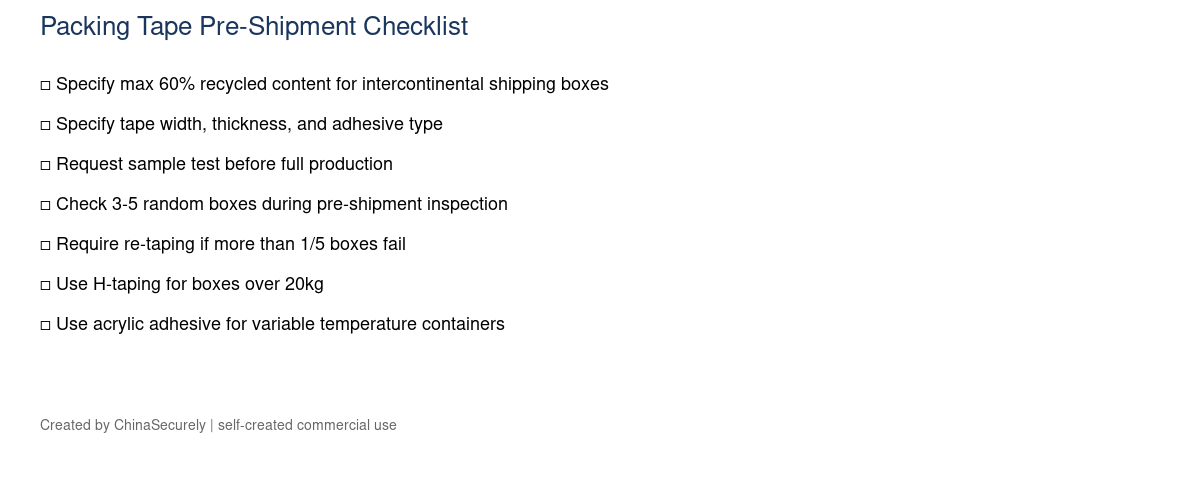
Practical Pre-Shipment Tape Checklist
☐ Specify maximum recycled content for your box board (≤60% for intercontinental shipping)
☐ Specify tape type, width, thickness, and adhesive type (acrylic vs hot-melt) based on shipping temperature
☐ Ask the supplier to pack 3-5 sample boxes and test tape adhesion before full production
☐ Confirm the factory uses the specified tape, not whatever they have in stock
☐ Randomly test tape on 3-5 packed boxes during pre-shipment inspection
☐ For heavy boxes (>20kg), confirm 72mm width and H-taping method
☐ Require re-taping before shipment if more than 1 in 5 tested boxes fail the peel test
Related Questions
Does the moisture content of the box affect tape adhesion?
Yes — if the box is stored outside or in a very humid warehouse before taping, the board absorbs moisture and adhesive can’t stick properly. Good factories store boxes indoors in a dry area before packing. Ask your supplier to confirm they store corrugated material in dry conditions.
Is acrylic tape always better than hot-melt for international shipping?
Acrylic generally performs better across a wider range of temperatures and humidity than basic hot-melt, so it’s the safer choice for intercontinental container shipping. Good-quality hot-melt rated for cold/hot temperatures works fine too, as long as it’s specified correctly.
Will better tape completely eliminate peeling?
No tape is 100% guaranteed — occasionally one box in a thousand will still have a problem even with good materials and correct application. The goal is to reduce the failure rate from 10-20% down to under 1%, which is acceptable for most small importers.
Need help specifying corrugated box or packing tape requirements for your order from China? Send the box size, box weight, and your shipping route. ChinaSecurely can help you write the technical specs your factory needs to get it right the first time.
Suggested internal links:
- /corrugated-boxes-china-soft-edges-hardness-spec/
- /why-corrugated-boxes-from-china-arrive-crushed-how-to-specify-the-right-compression-strength/
- /packaging/paper-tube-packaging-dents-prevention/
Sources:
- Corrugated packaging industry public guidelines
- Buyer question pattern: Google “packing tape won’t stick to boxes from China”
- China packaging factory practical experience shared by exporters
- Note: general guidance; specific requirements vary by box size and shipping route