
Short answer
If folding cartons from China crack along the crease, do not treat it as only a printing defect. The buyer should check paperboard grade, grain direction, ink coverage, lamination, scoring pressure, folding test results, and export packing before approving mass production.
Buyer question: “Our cosmetic folding cartons looked fine flat, but the printed boxes cracked along the crease when assembled. What should I ask the Chinese packaging supplier before the next run?”
A carton can look acceptable in a flat proof but fail when the fold line is bent repeatedly. For a small importer, the practical goal is to approve the carton as a finished box, not just as a printed sheet.
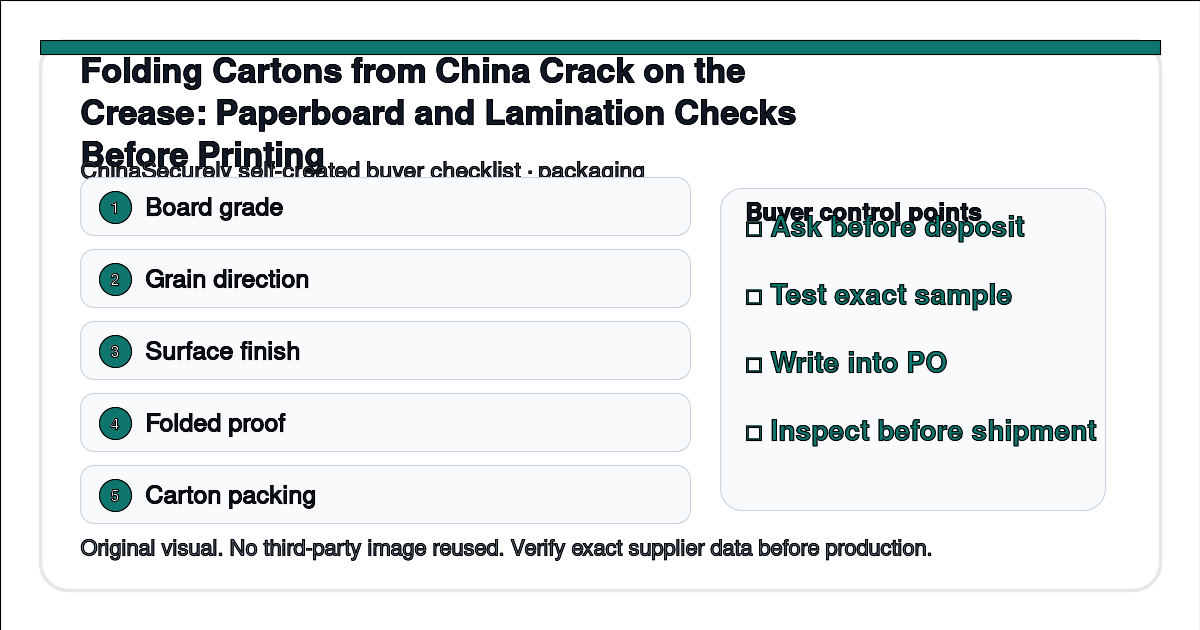
Why this problem happens
Folding carton cracking usually happens when the printed surface cannot stretch cleanly at the score line. Heavy ink coverage, matte lamination, varnish, dry paperboard, wrong grain direction, or a score that is too sharp can make the crease brittle. If the carton is folded by hand during packing, small stress marks may become visible on dark colors.
The problem is easier to miss when the buyer only approves a PDF or a flat printed sheet. A digital proof can show color and layout, but it cannot prove how the paperboard behaves when folded, packed, squeezed, and opened by a customer.
Transit packing also matters. Carrier packing guidance focuses on protecting goods from normal handling, compression, and movement. Custom cartons are not the final shipping box, but the same logic applies: if finished cartons are packed too tightly, bent, or stored in poor humidity, crease damage can appear before the product reaches you.
China-side explanation
Chinese packaging suppliers often quote folding cartons from several paperboard and finishing options. The salesperson may focus on size, print color, and unit price, while the factory’s prepress and die-cutting team must decide score depth, die line, board direction, and finishing sequence.
For a small run, the supplier may not automatically make an assembled proof unless the buyer requests it. If the purchase order only says “350gsm paper card, matte lamination,” the supplier may not treat crease durability as a separate acceptance item.
Step-by-step solution
- Ask for the exact paperboard grade, thickness, and whether the board direction is suitable for the fold.
- Request an assembled sample, not only a flat printed proof.
- Fold and unfold the sample several times under normal use conditions.
- Check the darkest printed panels and laminated areas first; cracks show there more easily.
- Ask whether the score line can be adjusted before mass production.
- Confirm whether the final cartons will be shipped flat or pre-assembled.
- Add crease cracking to the pre-shipment inspection checklist.
- Ask for photos of finished cartons packed in export cartons, not just clean studio photos.
- If the brand color is dark or the surface is laminated, approve a physical proof before full printing.
What to ask the supplier
Copy and adapt this message:
Please confirm the paperboard grade, thickness, grain direction, lamination or varnish, score line method, and whether the carton has been folded and assembled for testing. Before mass production, please send an assembled sample or proof photo showing the crease area after folding. For inspection, please check whether the printed surface cracks, turns white, or peels at the main fold lines.
If the supplier replies only “no problem,” ask for a folded proof. This is one of those issues that needs a physical check.
Crease approval checklist
| Check point | Buyer action | Supplier evidence |
|---|---|---|
| Paperboard | Confirm grade and thickness | Quotation and production spec |
| Grain and score | Ask if fold direction is suitable | Prepress or die-line confirmation |
| Surface finish | Check dark ink and lamination | Folded proof photos |
| Assembly test | Fold several sample cartons | Assembled sample or short video |
| Packing | Avoid crushing or bending | Export carton photos |
Cost and trade-off notes
A stronger board or adjusted finish can raise cost. So can a physical proof. But the cost of cracked retail cartons is often higher because the problem is visible to every customer.
For a low-value insert box, small cosmetic whitening may be acceptable. For cosmetics, candles, supplements, or gift packaging, the carton surface is part of the product experience. Make that clear in the approval notes.
Sources and source status
- FedEx packing guidance for transit protection concepts: https://www.fedex.com/en-us/shipping/packing.html
- UPS packaging support page was checked as a general packing reference but may be intermittently blocked from this server; use as secondary source until manually reviewed: https://www.ups.com/us/en/support/shipping-support/packaging-tips.page
Related questions
Can a supplier fix cracking after printing?
Sometimes only partly. Adjusting folding method may help, but paperboard, lamination, and scoring choices are usually locked once printing and finishing are done.
Is thicker paperboard always better?
No. A thicker board can still crack if scoring and grain direction are wrong.
Should I approve by photo?
Photos help, but a folded physical proof is safer for dark colors, coated boards, and retail packaging.
Light CTA
Before you approve custom cartons, fold the proof like a customer would. A flat sheet is not the same as a finished package.