
Buyer question: “My earbud sample from a Chinese supplier sounded fine, but the bulk order had charging problems and pairing complaints. How can I catch this earlier?”
Short answer: A good sample is only the start. Earbuds combine batteries, charging contacts, PCB assembly, firmware, speakers, microphones, and packaging. If the buyer approves sound quality but never freezes the sample version or writes a bulk test plan, visually identical units can behave differently.
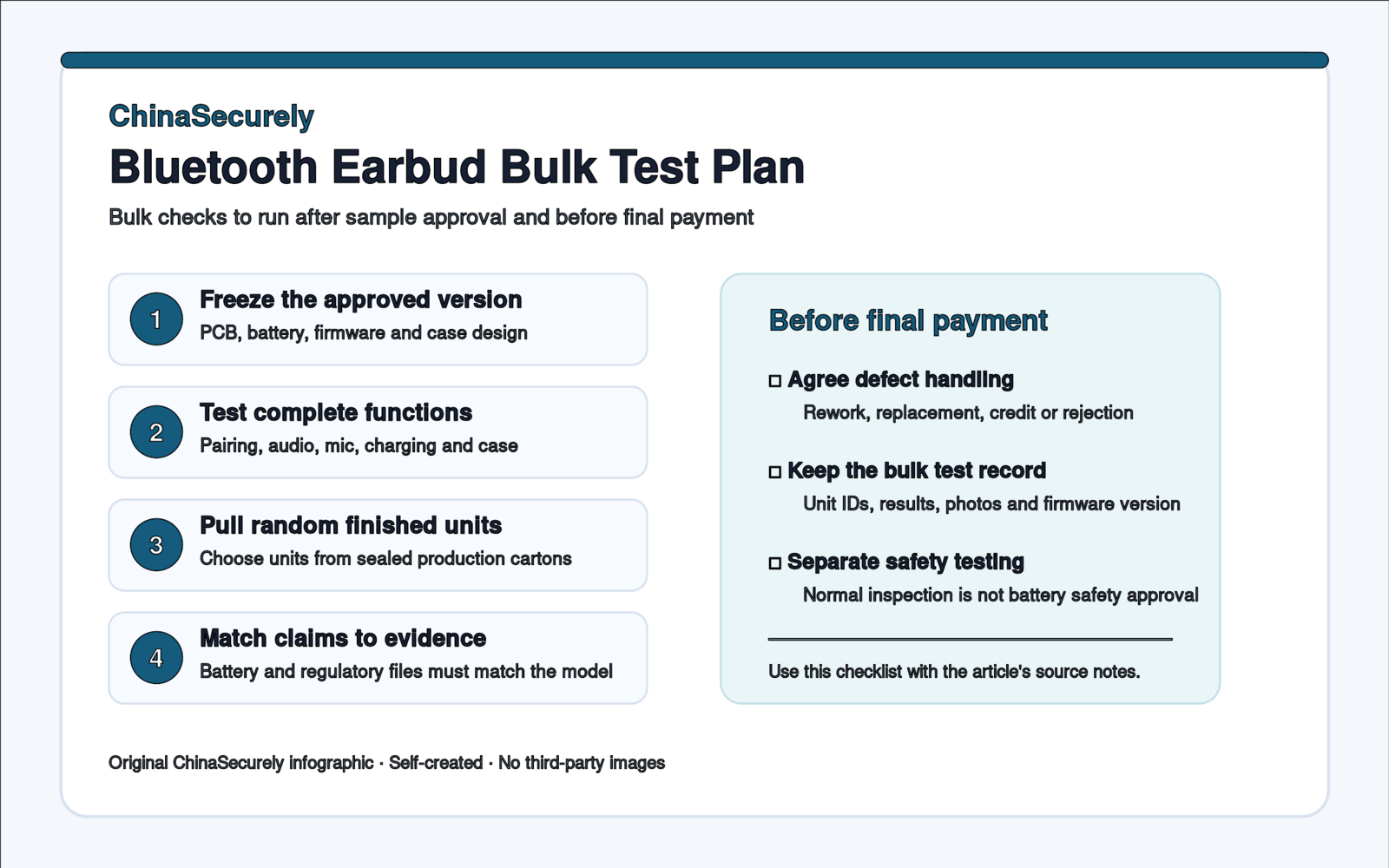
Why a good sample can turn into a bad bulk order
The approved sample may have been assembled from a small, carefully checked batch. Mass production adds new variables: different battery lots, charging-contact alignment, firmware versions, soldering quality, speaker matching, and packing-line handling. None of these differences is obvious from a product photo.
Another common gap is the inspection brief. If it says only “check appearance and quantity,” an inspector can pass units without testing pairing, microphones, case charging, or left/right consistency. The factory may have done its own checks, but the buyer has not defined what evidence is needed before final payment.
The China-side production picture
Many electronics suppliers in the Shenzhen and Dongguan supply chain assemble earbuds from modules sourced from several vendors. The shell, battery, PCBA, speakers, microphones, and charging contacts may not come from one factory. A supplier can keep the same exterior while changing one internal part because of price, availability, or lead time.
This does not prove that a supplier substituted parts. It does mean the buyer should tie the approved sample to a written version record. Record the sample label, PCB or chipset claim, battery specification, firmware version, charging-case configuration, accessories, and packaging. If the supplier cannot confirm these points clearly, slow down before paying the balance.
Build the test plan before production
- Freeze the approved version. Record the sample ID, firmware, battery and PCBA claims, case design, accessories, and packaging configuration. Put “no change without written approval” in the purchase order.
- Define complete functions. Include power-on, pairing, reconnect, left/right audio, microphone, controls, earbud charging, case recharge, indicators, and the pairing name shown on the phone.
- Choose devices and conditions. Name the phone models or operating systems, chargers, cables, audio source, distance, and test duration. A vague instruction such as “Bluetooth works” is not reproducible.
- Pull random finished units. Select units from sealed production cartons rather than accepting samples handed over separately by the salesperson or production line.
- Record results by unit. Keep carton number, unit ID, firmware version, pass/fail result, photos, and short video evidence for failures. A summary without traceable units is weaker evidence.
- Agree defect handling before final payment. State whether failed units will be reworked, replaced, credited, or rejected and whether the corrected lot will be retested.
A practical functional test table
| Check | How to run it | Evidence to keep |
|---|---|---|
| Pairing and reconnect | Pair, disconnect, restart, and reconnect on the named test device | Unit ID and pass/fail record |
| Left/right audio | Play a channel test and listen for dropouts, imbalance, or distortion | Result by unit; video for failures |
| Microphone | Make a short call or recording in the same test environment | Audio sample for failed units |
| Earbud and case charging | Seat both earbuds, confirm indicators, recharge the case, and repeat | Photos and charging result |
| Controls and pairing name | Check buttons or touch controls and confirm the displayed device name | Checklist result and screen photo |
| Version match | Compare labels, firmware, accessories, and packaging with the approved record | Version sheet signed by supplier |
What to ask the supplier
Please confirm that mass production will use the same approved PCB or chipset version, battery specification, charging-case design, firmware version, accessories, and packaging. No component or firmware change is allowed without written approval. For pre-shipment inspection, please allow random testing from sealed finished cartons for pairing, reconnect, left/right audio, microphone, controls, earbud charging, and case recharge.
A safer second question is: “If any unit fails, what is the rework and retest process before we release the balance payment?” That answer is more useful than a general promise that quality will be “100% good.”
What a normal inspection does not prove
A pre-shipment inspection can verify the agreed functions on a sample of finished units. It does not prove long-term battery life, electrical safety, transport compliance, or every regulatory claim. Those items may require document review and qualified laboratory testing for the exact model and destination market.
Bluetooth qualification is also separate from a factory functional check. The Bluetooth SIG qualification process and Core Specification are useful references for understanding product claims, but they do not replace testing the units you are buying.
Release-payment checklist
- □ Approved sample version and bulk version match
- □ Test devices, functions, conditions, and acceptance criteria are written
- □ Units are pulled randomly from sealed finished cartons
- □ Results are traceable to carton and unit IDs
- □ Failed units have an agreed rework and retest path
- □ Battery, transport, and regulatory claims are reviewed separately where required
Sources and limits
Direct public Reddit access was blocked during the original research run, so the opening question is presented as a common buyer scenario, not as a quotation from a named buyer. The practical inspection workflow is supported by public QIMA inspection guidance. Bluetooth SIG sources provide general specification and qualification context. Exact sampling levels, battery tests, certification, and destination-market requirements should be set by a qualified inspection company, laboratory, forwarder, or compliance adviser for the specific product.
- QIMA: Product Inspections
- QIMA: Pre-Shipment Inspection
- Bluetooth SIG: Qualify Your Product
- Bluetooth SIG: Core Specification
The useful decision is simple: do not ask whether the sample is good. Ask whether the finished bulk units still match that sample, whether the agreed functions were tested, and whether failed units can be traced and corrected before payment.