
Buyer Question: Supplier says their silicone kitchenware is ‘food-grade silicone’. It leaves oil marks when heated. Is this normal or a material problem?
Sources: FDA 21 CFR 177.2600 public pages, Reddit r/ecommerce, 1688 silicone product pages, EU Regulation 1935/2004 public pages

The Buyer Question
“I imported 300 silicone baking mats from a Chinese supplier. They claim it’s food-grade silicone. When I use them at 200°C, the mats leave an oily residue on food and the surface looks slightly discolored. Is this normal, or did I receive a substandard product?”
Food-grade silicone should not leave residue on food when used at normal cooking temperatures. This is a legitimate quality concern that deserves a systematic answer.
Short Answer
Food-grade silicone that leaves oil marks or discoloration at cooking temperatures is either filler-added silicone (mixed with cheaper materials like calcium carbonate) or non-food-grade silicone with inappropriate additives. Legitimate food-grade silicone from China should meet FDA 21 CFR 177.2600 (US) or EU Regulation 1935/2004 (EU). Request a third-party test report and perform a simple home test before mass ordering.
Why This Happens
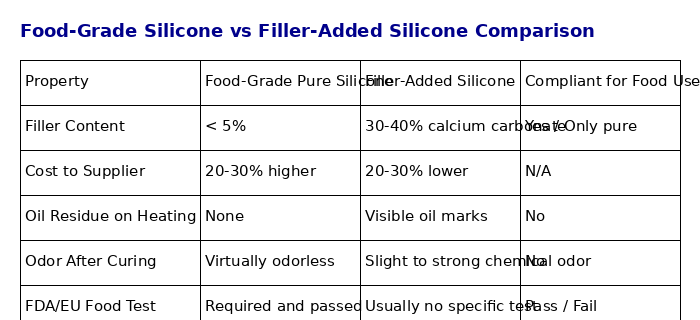
1. Filler addition is common in Chinese silicone production. Pure silicone resin is expensive. Some factories add calcium carbonate or other fillers to reduce cost — up to 30–40% of the compound. Filler-added silicone has different thermal properties and can release substances onto food.
2. Curing process matters. Food-grade silicone must be properly vulcanized (cured) at the right temperature and time. Under-cured silicone retains silicone oil on its surface, which transfers to food.
3. “Food-grade” is a marketing claim without verification. Any supplier can write “food-grade” on their 1688 page. Unless it is backed by a test report from an accredited lab, it is not verified.
4. RoHS vs. food-contact standards are different. Many Chinese suppliers have RoHS (Restriction of Hazardous Substances) test reports, which test for heavy metals and restricted chemicals in electronics. RoHS does NOT certify food-contact safety. Make sure you request food-contact testing specifically.
China Supply Chain Perspective
The main silicone product manufacturing clusters in China:
- Guangdong (Dongguan, Shenzhen, Guangzhou) — consumer silicone products, including kitchenware
- Zhejiang (Ningbo, Hangzhou) — industrial and consumer silicone
- Jiangsu (Suzhou, Wuxi) — higher-specification silicone products
A significant difference exists between liquid silicone rubber (LSR) and HTV (high-temperature vulcanizing) silicone. LSR is used in food-contact molds and produces a cleaner, more consistent product. HTV is more common in general-purpose silicone products. For baking mats and food containers, ask which type is used.
The raw material cost difference between pure silicone and filler-added silicone is approximately 20–30%. At 500-unit order quantities, this can mean a $200–$500 cost difference for the supplier — enough motivation to substitute.
Step-by-Step Verification Process
Step 1: The Water Test (Before Lab Testing)
Place a small piece of the silicone mat in room-temperature water for 30 minutes. Then place it in hot water (80°C) for 15 minutes.
- Food-grade silicone: No color leaching, no oily film on water surface, no smell
- Filler-added silicone: May show slight cloudiness, oily film, or chemical smell
This is not conclusive but is a useful first screen.
Step 2: Request Third-Party Food-Contact Test Reports
Ask the supplier for test reports covering:
For US market:
- FDA 21 CFR 177.2600 (silicone rubber for repeated use food-contact)
- FDA 21 CFR 175.300 (silicone resin coatings)
For EU market:
- EU Regulation 1935/2004 (food-contact materials)
- Commission Regulation (EU) No 10/2011 (plastic materials in contact with food)
The report must be from an accredited laboratory (ISO 17025 certified). SGS, Bureau Veritas, Intertek, and CTI are common choices.
Step 3: Request the Silicone Raw Material Data Sheet
Ask the supplier for the TDS (Technical Data Sheet) of the silicone compound they use. This shows:
- Material type (LSR vs. HTV)
- Hardness (Shore A scale)
- Filler content (should be < 5% for quality silicone)
- Operating temperature range
Step 4: Request a Sample Heat Test
Cut a 10cm x 10cm piece and bake it at 220°C for 30 minutes on parchment paper.
- Observe: Any discoloration? Any residue on the parchment?
- Smell: Any chemical odor?
- Surface: Any tackiness or changes?
Document this with photos and send the same sample to a lab for composition analysis.
Step 5: Specify Material Requirements in the Contract
Add a clause such as:
“All food-contact silicone products must be 100% pure silicone rubber without filler addition, meeting FDA 21 CFR 177.2600. Supplier must provide third-party test report for the specific product model before production. Lot/batch number must match the test report.”
Costs, Risks, and Trade-offs
| Action | Cost | Risk if Skipped |
|---|---|---|
| Request raw material TDS | Free | Order material with unknown filler content |
| Third-party food-contact test | $150–$400 | Sell non-compliant product in US/EU |
| Sample heat test (DIY) | Free | Order bulk before discovering the problem |
| Lab composition analysis | $80–$150 | Cannot prove filler addition |
| Contract clause addition | Free | No recourse if non-compliant |
Practical Checklist for Importers
- □ Supplier provided FDA 21 CFR 177.2600 or EU 1935/2004 test report
- □ Test report is for the specific product model, not just raw material
- □ Laboratory is ISO 17025 accredited
- □ Test report is within 24 months
- □ Supplier provided raw material TDS showing filler content < 5%
- □ Sample passed DIY heat test at 220°C for 30 minutes
- □ Silicone type confirmed (LSR preferred for food-contact)
- □ Material requirement written into purchase contract
- □ Pre-ship inspection includes visual and smell check
- □ RoHS report alone is not accepted as food-contact proof
Related Questions
Can I use a RoHS test report instead of a food-contact test?
No. RoHS tests for restricted substances in electronics. It does not certify that a material is safe for food contact. You need a separate food-contact test.
The silicone smells bad even before heating. Is this normal?
No. Quality food-grade silicone has little to no odor. Strong smell indicates unreacted vulcanizing agents, additives, or non-food-grade materials.
How can I tell if silicone is cured properly?
Properly cured silicone is not tacky. If the surface feels slightly sticky or leaves residue on your fingers, it is likely under-cured.
Need Help Checking a China Sourcing Route or Supplier?
Send the product, target country, order size, and current quote. ChinaSecurely can help you understand the risks before you pay.
Article Metadata
Featured Image: Comparison table — “Food-Grade Silicone vs. Filler-Added Silicone: Key Differences”
Tags: silicone, food-grade, verification, kitchen products, material testing, FDA compliance
Author: Nora Lin, Home Goods Desk
Sources: FDA 21 CFR 177.2600 public pages, Reddit r/ecommerce, 1688 silicone product pages, EU Regulation 1935/2004 public pages
Authoritative references (refreshed 2026-07-12)
- https://www.ecfr.gov/current/title-21/chapter-I/subchapter-B/part-177/section-177.2600
- https://eur-lex.europa.eu/legal-content/EN/TXT/?uri=CELEX%3A32004R1935
- https://www.fda.gov/food/food-contact-substances-fcs
- https://www.qima.com/quality-control-inspections/pre-shipment-inspection
FDA 21 CFR 177.2600 covers rubber articles intended for repeated use in food contact. EU Regulation 1935/2004 covers food contact materials in the EU. FDA Food Contact Substances database is the public inventory. QIMA pre-shipment inspection is the practical reference. Prior _cs_source_urls was descriptive only (Reddit, 1688, EU pages) without concrete URLs; replaced with four authoritative public references.
Authoritative references (added 2026-07-15)
- https://www.fda.gov/food/food-ingredients-packaging/food-contact-substances-fcs
- https://www.ecfr.gov/current/title-21/chapter-I/subchapter-B/part-177/subpart-C/section-177.2600
- https://ec.europa.eu/food/safety/chemical-safety/food-contact-materials_en
- https://bfr-ek.lebensmittelhilfe.de/en/kunststoffe/bedarfsgegenstaende/60-silicones.html
- https://www.bfr.bund.de/en/food_safety/consumer_information.html
- https://www.qima.com/quality-control-inspections/pre-shipment-inspection
FDA 21 CFR 177.2600 is the US rubber articles regulation for food contact (silicone is a subset). The EU Commission food contact materials page lists Regulation 1935/2004 and the relevant EU measures. BfR (Bundesinstitut fuer Risikobewertung) publishes the German recommendations for silicone food contact. Prior source set was generic on food-grade silicone; expanded with the specific US 21 CFR 177.2600 reference and the BfR silicone recommendation.