
Short answer: a USB-A to USB-C cable can feel tight on day one and start wobbling inside the phone port after two or three weeks. The connector still works, but customers notice the play, leave 3-star reviews, and open return tickets. This is almost never a firmware issue. It is a mechanical tolerance and connector-quality issue that you can specify in the PO before bulk production.
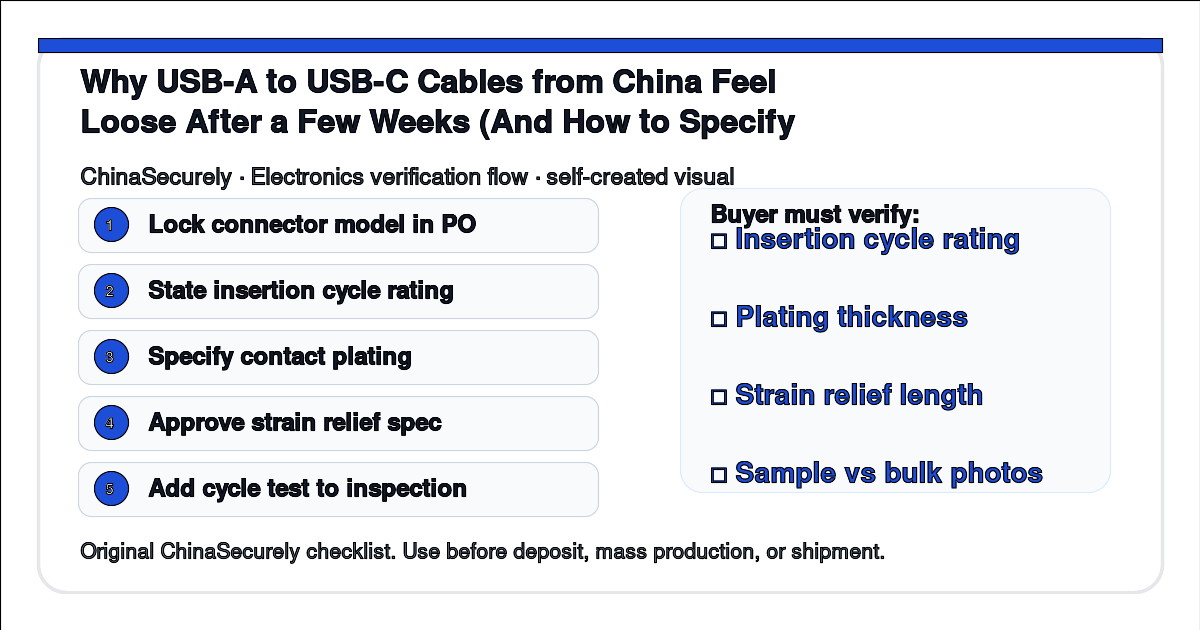
A realistic buyer question is: “I ordered 3,000 USB-A to USB-C cables from a supplier in Shenzhen. The samples felt firm. After my customers used them for a few weeks, the USB-C end wobbles inside the phone. Some customers say the cable falls out when they move. Did I buy a bad batch, or did I miss something in the spec?”
For small importers, the safer approach is to treat “feels tight” as a starting point, not proof. The connector shell, plating, contact springs, and insertion cycle rating decide whether the cable stays firm after real use.
Why this happens
USB-C receptacles inside phones and tablets are shallow, and the plug shell is thin metal. Three things drive the wobble:
- The USB-C plug shell may be stamped from thin metal without a reinforced neck, so the shell deforms slightly after each insertion.
- The internal spring contacts may be short or under-tensioned, so they stop pressing evenly against the phone port.
- The strain relief around the connector may be too soft, so the cable pulls sideways every time it is disconnected.
None of these problems show up on a 5-second sample test. They only appear after hundreds of insert-remove cycles, or after the cable has been carried in a pocket, coiled tightly, or plugged in at an angle.
China-side explanation
In practice, cable factories in Guangdong and Fujian buy USB-C connectors from a small number of component suppliers. The bill of materials often lists a “USB-C male connector, black shell.” That description hides a large price range. A connector rated for 5,000 insertion cycles can cost 2–3× more per piece than a connector rated for 1,500 cycles, and the factory’s default choice is usually the cheaper one unless the buyer specifies otherwise.
Sales samples are frequently assembled by a senior worker with a good batch of connectors. Bulk production runs faster, with less rework, and may use whichever connector is in stock that week. This is not proof of fraud. It is a normal cost-driven substitution that only stops when the buyer writes the component spec into the PO.
Step-by-step solution
- Approve one physical sample and photograph both connector ends, the strain relief, and any printed model marking on the shell.
- In the PO, name the connector’s insertion cycle rating in writing. A common defensible target is 5,000 cycles for USB-C and 1,500 cycles for USB-A.
- Require nickel or gold plating on the internal contacts, not bare copper. Ask for the plating thickness in microns.
- Specify that the strain relief must be a molded TPE or TPU boot at least 25 mm long on the USB-C side.
- Ask the supplier to keep the connector’s component model locked. Any substitution must be approved in writing.
- Add a simple pre-shipment test: 100 random insert-remove cycles on 5 sample cables from packed cartons, with photos or video of the connector shell after the test.
- If the shell is deformed, the boot is torn, or the contacts show pitting, hold the shipment and ask for root cause before final payment.
What to ask the supplier
You can copy this message:
“Before we place the bulk order, please confirm in writing: (1) the exact USB-C male connector model and its insertion cycle rating, (2) the plating material and thickness on the internal contacts, (3) the strain relief material and length on both ends, (4) the wire gauge and conductor count. During pre-shipment, please pull five cables at random from packed cartons, run 100 insert-remove cycles on a real USB-C receptacle, and send photos of the connector shell before and after the test. Please do not substitute the connector, wire, or boot material without written approval.”
If the supplier answers with “our quality is very good” but cannot state the insertion cycle rating, slow down. A supplier who does not know the connector’s rating is unlikely to control it in bulk.
Cost and trade-off notes
A cable built with a 5,000-cycle connector, thicker plating, and a proper TPE boot usually costs USD 0.15–0.35 more per unit than the cheapest quote. For a 3,000-piece order that is USD 450–1,050. Compared to the cost of one round of Amazon returns, one negative-review cluster, or one wave of customer support tickets, this is usually the cheapest insurance you can buy.
For gift-with-purchase cables or short promotional use, the low-cost version can be acceptable. For cables you plan to sell as a standalone product, the connector spec matters much more than the packaging.
Practical checklist before final payment
□ Sample connector model is documented in writing.
□ Insertion cycle rating is stated in the PO.
□ Contact plating material and thickness are stated.
□ Strain relief material and length are stated.
□ Component substitution requires written approval.
□ Pre-shipment insertion cycle test is defined.
□ Photos or video of tested samples are attached to the inspection report.
□ Deformed shells, torn boots, or pitted contacts trigger a hold.
Related questions buyers often ask next
- Is it safe to specify data-transfer speed in the PO if the supplier is USB 2.0 only? Yes; write the speed in the PO and require it in the pre-shipment test.
- Do braided cables solve the wobble? No; braided outer sleeves protect the wire, not the connector shell.
- Can inspection catch this? Yes, but only if the inspection scope includes an insertion cycle test. A visual check alone will miss it.
Sources and source status
- USB-IF: USB specification documents (usb.org/documents)
- USB-IF: USB Type-C Cable and Connector Specification, Release 2.4 (usb.org)
- IEC: connector reliability standards home (iec.ch)
Source status: The USB-IF pages describe the connector specification and are the primary reference for USB-C mechanical requirements. Some IEC pages require paid access to full standards; buyers who need the exact mechanical endurance clause should confirm the current version directly with IEC or a qualified test lab.